
Army Vietnam War Downers Grove, IL Flight date: 07/23/25
By Mark Splitstone, Honor Flight Chicago Veteran Interview Volunteer
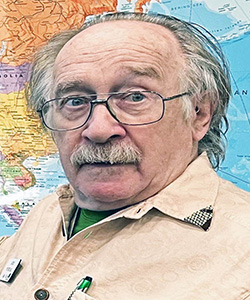
Joe Furgal was born in 1940 and grew up on the near west side of Chicago. He was the second of six siblings who were raised by his parents in a two-bedroom Polish-Catholic household. His father was a precinct captain for the Chicago Democratic party and often switched jobs, usually with the help of his contacts in the party. Growing up, Joe was an avid reader and recalls sometimes getting a book from the elementary school library at morning recess, reading it during class and at lunch, and then returning it in the afternoon. He graduated from Holy Trinity High School in 1958 and then enrolled at Wilbur Wright Junior College. His parents hadn’t gone to college, so this was a milestone for him and his family. While at Wright he became involved in the Newman Club Movement and through that the Catholic Worker Movement, an anti-war organization that campaigned for nonviolence.
After Wright College, he enrolled at Western Illinois University, and was elected Newman state chairman and onto the national executive committee. His overinvolvement with Newman club caused him to drop out after a year and returned to Chicago. He got a job at the Chicago Public Library, courtesy of his father’s connections. Driven in part by the Catholic Worker teachings, he tried to register with the draft board as a conscientious objector.
Joe’s thinking changed on November 22, 1963, when JFK was assassinated. After that, he decided that while he still believed killing was a sin, he was willing to volunteer to serve in the military if that would put him in a defensive position to potentially protect a good man like Kennedy. After speaking with several branches of the military, he learned about the Army Security Agency (ASA). The ASA was the army’s signals intelligence branch, a group that performed a wide range of eavesdropping and spying, using electronic means. Although the ASA was relatively small, it’s resources could monitor people all over the world. The COMSEC (Communications Security) section of the ASA monitored American communications. This wouldn’t require Joe to be in contact with enemy forces, so he decided to join the Army.
Joe enlisted in February 1964 and was sent to basic training at Fort Leonard Wood in Missouri. After receiving his Top Secret Crypto clearance, Joe began his ASA training at Fort Devens in Massachusetts. He learned about encryption, Morse code, and the use of technology and equipment such as switchboards, conventional telephones, radio telephone, teletypewriters, and direction finding. Joe’s specific department within the ASA was Communications Security (COMSEC). Rather than monitoring enemy communications, this group monitored the communications of Americans to ensure there was no leaking of sensitive information.
After completing his ASA training, Joe was assigned to the 318th ASA battalion, at a detachment in Würzburg, Germany to monitor the Third Infantry Division. In his role as a monitor, he spent his days listening in on communications between different American units and providing a verbatim transcript of what he heard. To do this, he wore split headphones, with one ear listening to one network and the other listening to a different one. He typed up everything he heard. If there was activity on both networks at the same time, he’d record one of them and transcribe it later. The goal was to listen for any information that would enable the enemy to know what we were doing, which was particularly important when the division was out in the field doing maneuvers. The assumption was always that whatever Joe and his team could hear, the East Germans, Russians, Poles and Czechs could hear too. Joe says that the work was monotonous, especially because he and the other monitors weren’t expected to think about what they were doing, they were just transcribing it. To try to make things more interesting and get more responsibility, Joe cross-trained to be an analyst, whose role was to take the information transcribed by multiple different monitors and then piece it together to look for potential issues.
After two years in West Germany, in 1967 Joe volunteered to go to Vietnam. While he knew the war was heating up, he thought there would be more to do in Vietnam. Because the ASA’s work in Vietnam was highly classified, the ASA units there were given the cover designation Radio Research Unit (RRU). For the year that he spent in Vietnam, Joe was assigned to Hq and Hq Co, 313th Radio Research Battalion in Nha Trang, thirty miles north of Cam Ranh Bay. Teams of COMSEC monitors deployed upcountry with the 1st Cav Div., 4th Inf. Div., 101st Abn. Div., and units of IFFV, would gather information every day, and then Joe, as an analyst, would compile it and prepare a report that would be sent to the S-2 at the appropriate unit. Joe would get up at 3:00 every morning to compile the reports and then give them to officers during an 8:00 AM briefing. Commanders hated to see their units mentioned in these reports, not just because of the risk to their units, but also because the violations would go into their files and make them look bad. Just like in Germany, the assumption was always that the enemy could hear everything that Joe’s team did, but in Vietnam the stakes were much higher. If it was determined that the leaked information could be of use to the enemy and therefore plans were changed, then Joe feels that what he did helped save American lives, which was his goal when he joined the Army.
Although Joe did not participate in the Airborne Radio Direction Finding program carried out by the Radio Research Units in Vietnam, he explained how they operated. If a ground based monitor heard a morse code transmission with a call sign from a known NVA unit. He would have a colleague use a secure radio to notify one of the RRU’s airborne monitors working in a small propeller driven plane of the frequency. The technician would tune in to the signal and the pilot would fly around to catch the signal from three or more different directions to triangulate the location of the NVA radio. Once the NVA location was identified the coordinates would be transmitted back to the RRU ground unit who then forwarded it to the American units operating in the area.
When the Tet Offensive occurred, Nha Trang was hit with some rocket and mortar fire, but beyond that, Joe says that he saw more fighting in German bars than he did in Vietnam.
When Joe completed his enlistment in April 1968, he was encouraged to re-enlist and was even unofficially recruited to enlist in the Air Force. He, though, was ready to come home. Also, he needed to figure out his relationship with a young German woman to whom he had gotten engaged before leaving Germany for Vietnam. After spending a short time with family in Chicago, he flew to Germany, to be with his fiancée for several months. They realized the relationship wasn’t going to work out, so he once again returned to Chicago and then re-enrolled at Western Illinois University. He stayed there for a couple of semesters but then came back to Chicago, changed his major and enrolled at the University of Illinois at Chicago. While studying and working at the library there, he met a young woman, Mary Jo, who would become his wife.
By this point in their lives, Joe and Mary Jo had both lived in Europe and Asia, and these experiences were their first common bond. They both also valued education, with Joe finishing his bachelor’s degree and received his MSW degree in community development and planning at the Jane Addams School of Social Work, and Mary Jo receiving her second master’s degree, in library science. They were married in 1971, the beginning of an adventure that would take them all over the world. Until 1974 a woman could not be a Foreign Service Officer and married. When the rules were changed, they both joined the State Department, and while their roles were different, the State Department was able to make it work so that they were stationed together for nearly their entire careers. In total, they would spend seventeen years overseas, which when added to Joe’s three years in the Army meant that he spent twenty years working for the U.S. government outside of the United States. Joe proudly displays a rack that shows the flags of the countries that one or the other of them lived, studied or worked in, including Austria, Bangladesh, India, Japan, the Maldives, Malawi, Nepal, Romania, South Vietnam, Sri Lanka, West Germany, Zimbabwe and, of course, Chicago and United States. Despite all the time Joe spent overseas, because they worked mainly in former British colonies, he says that the only two languages he ever became proficient in were slang and profanity. In 2000, they returned to the United States and lived in Arlington, Virginia, where Joe was assigned to head the section teaching Human Resources at the Foreign Service Institute. The Foreign Service Institute is located in Arlington Hall, which was the headquarters of ASA during the Vietnam years. He and Mary Jo both retired in the early 2000s.
After retirement, Joe and Mary Jo continued to live in Arlington, but about ten years ago, Mary Jo began having memory issues, and as she continued to deteriorate, she eventually needed to be cared for in a memory care unit. Three years ago they moved to Downers Grove, Illinois, and live in a retirement community where Joe can stay in independent living while Mary Jo receives the care she needs in the memory care and skilled nursing setting. facility. Mary Jo is no longer able to walk or talk, but Joe sees her every day, takes her to concerts within the facility, and helps her eat, often bringing some of their favorite foods from when they lived in Africa and Asia. The way Joe looks at it, they had fifty great years together, so he can handle a few lesser years.
In 1977 the ASA was merged with the Army’s Military Intelligence component to create the United States Army Intelligence and Security Command (INSCOM). Since members of the ASA signed non-disclosure agreements, much of the information about what the relatively short-lived organization accomplished has just been coming to light in the past few decades after much of the information was declassified in the 1990’s and multiple books have recently been published about the organization. Joe’s license plate is “ASA 55”, with the “55 short for “O55,” the Army’s code for Communications Security Specialist MOS. Six months ago a man in a parking lot saw Joe’s license plate and asked if he was in the ASA. It turned out that the man had the same job as Joe and had lived in the same building on the same base in Würzburg Germany a few months before him. He and Joe have been communicating ever since, and Joe also recently attended an ASA Old Spooks and Spies reunion in Chattanooga. The ASA may have been a relatively small organization, but its impact wasn’t, and the bonds run strong even to this day.