
Army Vietnam War Whiting, IN Flight date: 07/23/25
By Al Konieczka, Honor Flight Chicago Veteran Interview Volunteer
Robert grew up in Chicago’s far South Side area commonly known as South Deering. He attended St. Francis de Sales High School but dropped out in 1968 to work and help support the family. One positive thing that came from high school was that he met his sweetheart Joan at the age of just 15. Robert went to work at the Superior Match Company in Chicago where his father worked. Robert married Joan on February 22, 1969 and was drafted into the Army just a week later on March 5, 1969.
Robert, who goes by the nickname “Klod” was sent to Fort Polk, Louisiana, for 8 weeks of basic training. After completing basic training he spent another 8 weeks in Advanced Infantry Training (AIT) at Fort Knox, Kentucky and then Non Commissioned Officers (NCO) Academy where he made the rank of E5 as a Buck Sergeant. He was assigned as a Tank Commander under F Troop, 17th Cavalry American Division and eyes of the 196th Brigade.
Robert would take his first ever plane ride out of O’Hare Airport a month before his 21st birthday as he headed for Vietnam. He arrived in country on February 7, 1970, and proceeded to his base camp called Hawk Hill. Firebase Hawk Hill (also known as Blackhawk Hill, Hill 29, Landing Zone Golden Rose and Landing Zone Porazzo) was a U.S. Army firebase northwest of Tam Kỳ in Quang Nam Province in central Vietnam.
Robert recalled, “They dropped me off on Highway 1 which is the only highway in Vietnam. I had no rifle or anything I just had my clothes. And they told me, Sarg, walk down to the end of this and make a left turn and you’ll be where you need to be.”
Within his first week in Vietnam, Robert was assigned to guard the helicopter landing zone for the base. They set up a perimeter with 30 tanks, including Robert’s crew, around the helicopter landing zone. During the night, enemy soldiers came in and Robert was quickly involved in his first battle and even killed several enemy soldiers. In fact, during his time in country, Robert received 3 bronze stars for meritorious achievement in ground operations against hostile forces.
Robert told me he would attend frequent meetings with all the tank commanders where his superiors would hand out mission assignments and assign crew members to each tank. “On our missions, we usually went out in groups consisting of multiple tanks. The M551 Sheridan tank had only three people, a driver, a gunner and the tank commander. The driver was the only person inside the tank, everyone else rode on top.”
The M551 “Sheridan” AR/AAV (Armored Reconnaissance/Airborne Assault Vehicle) was a light tank developed by the United States and named after General Philip Sheridan, of American Civil War fame. It was designed to be landed by parachute and to swim across rivers. It was armed with the technically advanced but troublesome M81/M81 Modified/M81E1 152 mm gun/launcher, which fired both conventional ammunition and the MGM-51 Shillelagh guided anti-tank missile.
Robert chuckled as he told me, “That gun was very loud. We actually sat on top of the gun. The Combat Vehicle Crewman (CVC) Helmet we wore was designed for personnel operating and manning military armored and other tactical vehicles and had ear protection built into it.”
Robert told me that his crew would be out in the bush and away from base camp at times for up to 90 days. Some supplies were strapped on top and some stored inside. The crew slept outside the tank each night since room inside the tank was very limited and the walls were made of aluminum and not safe. On some missions his tank went out into the bush along with a company of infantry soldiers and sometimes without. Robert always had a soft spot for the infantry soldiers. “If we came across foot soldiers, I would have them hop onto the tank and I would give them a ride to their assigned location.”
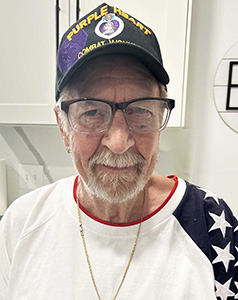
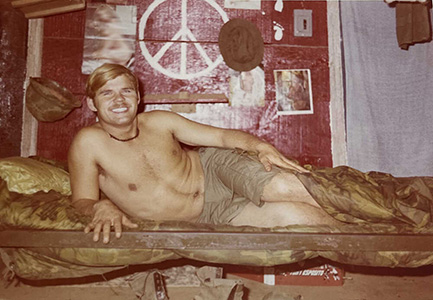
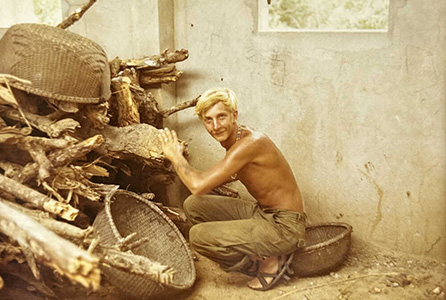
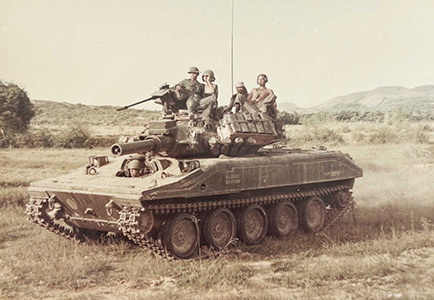
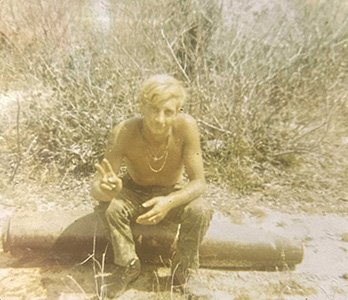
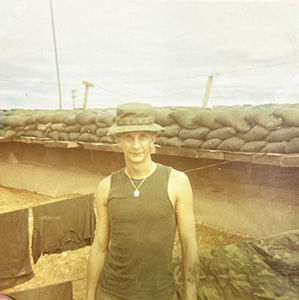
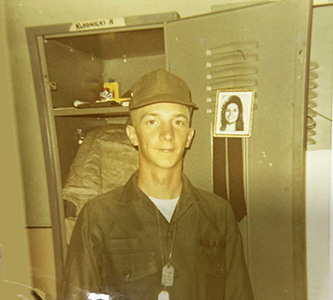
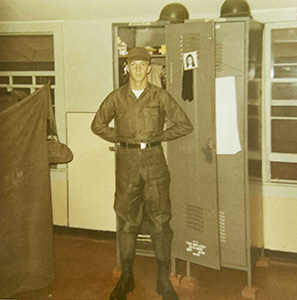
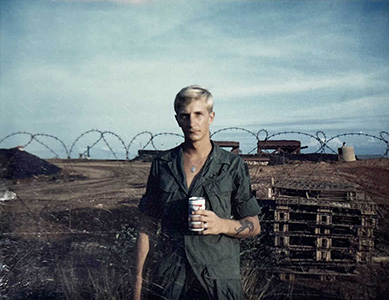
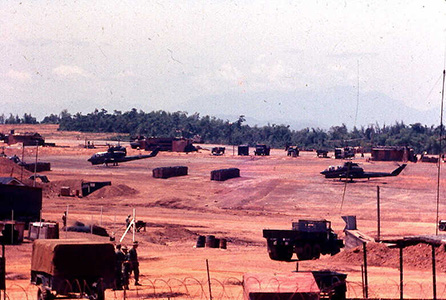
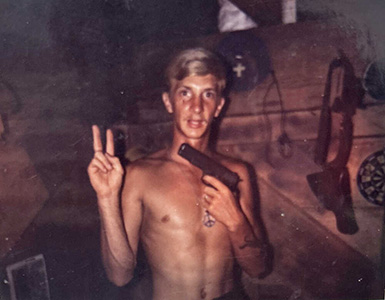
On one of his missions, Robert and his crew were seriously injured and he would later receive a Purple Heart from that encounter. “On September 17, 1970, my entire crew was injured when our tank drove over a landmine. I received shrapnel injuries to my legs and buttocks and both of my eardrums were busted. The explosion blew off the first three sets of wheels on our tank. The landmine we hit was actually a 250 pound bomb. All I remember was hearing a very loud boom. The next thing I knew I was on a chopper being medevacked out to the hospital.”
During the explosion, Robert was thrown 30 feet away but was fortunate to land in a rice paddy which softened his fall. Robert still has hearing loss today as a result of that explosion. He spent five days in the hospital before being sent back to base camp and put on light duty.
Shortly after returning to base camp, Robert received his furlough and flew to Hawaii to spend time with his young wife Joan. During my interview with Robert, Joan also sat with us at the table and shared an amusing story. “When the guys came off the plane, they all had the exact same clothes on. They had stopped at the commissary to shop for something to wear besides their uniform and that’s all the commissary had for sale so every one of them was dressed exactly the same.”
A commissary is a place that provides goods or services, often to a specific group like on a military base selling groceries and household items at discounted prices.
Robert spent seven wonderful days in Hawaii with Joan and he admitted it was very hard to leave his wife and return to Vietnam. In fact, many of the other women were hanging onto their men and crying and yelling don’t go back. When he finally returned to Vietnam, he was pulled from the field and re-assigned to the Technical Operations Center as a radio telephone operator. His new role was to decipher the crypto codes coming in from the field and to take re-supply orders from troops out in the bush.
Robert finished out the remainder of his tour in Vietnam working at base camp. “I had friends that were helicopter pilots and when I was re-assigned to the rear area, I hung out with those guys a lot.” During his time at base camp he received care packages from family containing cigarettes, candy, cookies and also many letters from his wife Joan. Robert told me about one job you never wanted at base camp. “The duty you never wanted was to burn the fecal waste at base camp in these steel barrels. I didn’t have to do that being an E-5, but the lower ranked guys, the grunts, they had to do it and it was an awful job!”
When I asked Robert about the food during his time in country he told me, “Out in the field we ate c-rations. We only had one hot meal a day out in the field. Once we got back to base camp, our commanding officer (CO) really took good care of us when it came to eating well.”
Robert remains in touch with a few of the men he served with, mostly Greg Morowski (nicknamed Baby Bear) who was a gunner on a different tank. The two men talk on the phone from time to time and still exchange Christmas cards. Robert completed his tour at base camp and was discharged from the Army in January 1971.
Upon returning to Chicago, Robert attempted to get his old job back at Superior Match Company but they refused to re-hire him. With some help from the Veterans Department, he did get his old job back and eventually moved on to work in the construction industry and then on to the railroad. He worked for Amtrak for several years as a conductor and then went to Con Rail for 17 years. He ended his railroad career with a job at the Norfolk and Southern Railroad before finally retiring in March of 2009.
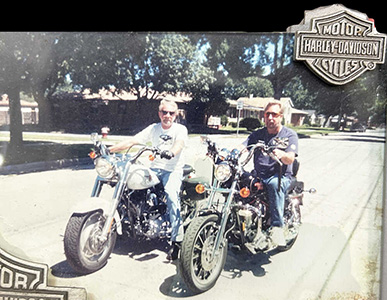
Even before Vietnam, Robert was a big motorcycle enthusiast and built and customized several bikes for friends and family. Robert also owned a stained glass business in Burnham, IL, for a short period of time and loved making stained glass items for friends and family. Robert and Joan have one son and three grandchildren and have been married for 56 years.
Robert’s son Jason will accompany Robert on his Honor Flight trip to Washington. In addition, Robert is getting a ride to Midway Airport for his Honor Flight from his good friend Ed Marco who was a previous Honor Flight honoree. Robert currently suffers from slight dementia and Parkinson’s disease.
Robert, thank you very much for your dedicated service in the Army. Enjoy your well-deserved trip to Washington D.C.!