
Navy/Marines Vietnam War Elgin, IL Flight date: 08/20/25
By Mark Splitstone, Honor Flight Chicago Veteran Interview Volunteer
The phrase “The Walking Dead” has been used in everything from books to TV shows to movies. However, when used in the context of the Vietnam War, it means only one thing: The First Battalion Ninth Marines. In 1966, North Vietnamese General Giap promised President Ho Chi Minh that he’d wipe out the battalion as a present for his birthday, and allegedly used the Vietnamese phrase for Walking Dead to describe what he believed would be their fate. Sadly, his prediction nearly came true, as the battalion ended up having the highest casualty rate of any Marine unit in the war (over a quarter of the men who served in the 1/9 from 1965-1969 were killed). Jack Imburgia saw a lot of bloodshed while in the battalion, but he wasn’t able to fully understand the magnitude of the carnage until nearly two decades later, when he finally started to come to grips with what he had endured there.
John “Jack” Imburgia was born in Chicago in 1947. His father died when Jack was only five years old, and even though his mother remarried and her new husband adopted Jack, his youth was spent in and out of trouble. His family moved around quite a bit, and his mother had a difficult time controlling him. He joined gangs, was kicked out of a number of schools, and ended up attending twelve different schools in twelve years. By 1964, when he was seventeen, he realized he was on a very bad path and that if he didn’t change the direction of his life, there was a good chance he’d end up in jail.
The change he decided to make was to join the military. In January 1965, he enlisted in the Navy, and after completing boot camp, he trained to be a gunner on a patrol plane at Naval Air Station Glenview. After a year and a half in the Navy, his enlistment period was nearly complete, but he decided that he wanted to provide additional service to his country. The Vietnam War was heating up, and he wanted to go there. He considered himself to be a tough guy who wanted action and was looking for trouble, and even though most people thought he was crazy, in May 1966 he made the fateful decision to switch from the Navy to the Marines.
Joining the Marines meant starting over, and while Jack thought Navy boot camp was easy, this was not the case with Marine boot camp. The idea was to tear recruits down so they could be rebuilt into Marines, men who would consider themselves to be the toughest fighting machines in the world. Jack completed boot camp in San Diego and then went to Camp Pendleton for infantry training, followed by jungle training in the Philippines. While all of this training was difficult, Jack considers it to be very helpful and believes it was vital in helping him survive what he was about to get into.
In December 1966, Jack was sent to Vietnam and became a member of the 1/9. While he was initially based in Da Nang, his unit never stayed in one place for very long. He spent nearly all of his time in Vietnam in what was known as Leatherneck Square, an area just south of the DMZ that saw some of the heaviest fighting of the war. He participated in fourteen combat operations, each of which lasted between two and six weeks. These operations were sometimes search and destroy missions, and other times were a part of a larger battle. Often, reconnaissance would spot the enemy, and the Marines would be sent in, by truck or helicopter, to engage them. The size of the unit could vary, sometimes just a company, and other times the entire battalion.
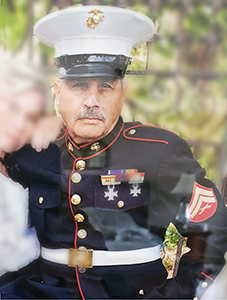
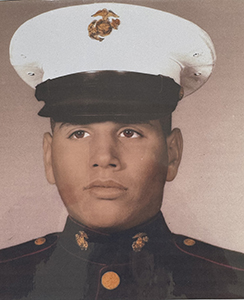
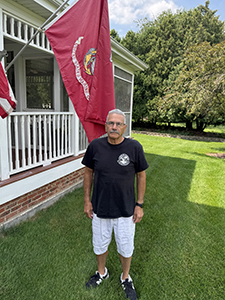
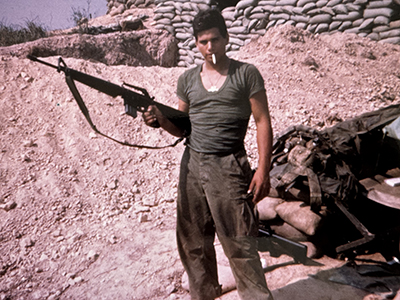
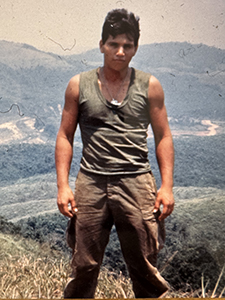
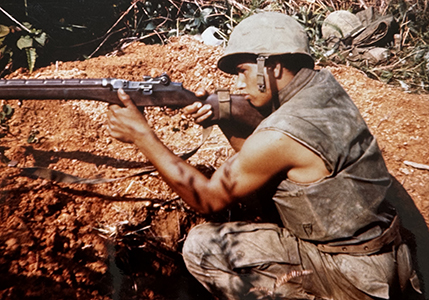
Jack was often assigned to walk point for his unit. Since this was the most dangerous role in a patrol, green soldiers were usually assigned to do it. Jack was green the first time he did it, but since he survived, he was assigned to do it again. Since he kept surviving, they kept giving him the assignment. While jungle warfare terrified him, he wasn’t afraid of walking point. He was very careful, had good eyesight, and had a knack for spotting booby traps and mines. He was considered to be an excellent point man by his fellow Marines, but wasn’t perfect. He recalls one time when a sergeant called out his name just before he was about to trip a line, thereby saving his life. Along with most of the rest of the 1/9, he eventually was awarded a Purple Heart. In March 1967, a mortar round exploded near him, resulting in shrapnel hitting his right arm and leg. He was fortunate that his wounds weren’t serious enough for him to require evacuation, so he stayed in the field and continued to fight.
Not everyone was so lucky. Jack’s best friend in the Marines was a man named Tom Mastroianni. On the first day of Operation Prairie III, on March 19, 1967, their unit was ambushed, and Tom was hit in the leg by shrapnel from a mortar. The wound was bleeding badly, but would’ve been survivable with prompt medical attention. A medevac was called for, but the night was rainy and foggy, and the first helicopter that came was shot down. No more helicopters were sent until the morning, and by then, it was too late for Tom. Jack says there’s nothing worse than hearing the moans and screams of your friends all night, knowing there’s nothing you can do to help them. Tom was only twenty years old and had a wife and young son, also named Tom, whom he would never meet. Jack considers that to be his most difficult night of the war.
Their unit was ambushed frequently. If the ambush was just harassment, point men were often the Marines who were targeted. However, in a full-scale ambush, the main target was often the radioman. The enemy knew that one of the Marines’ advantages was their ability to call in support from artillery or the air, so killing the radioman was a way to improve their odds. One of Jack’s good friends was a radioman who was killed in this manner. As Jack’s time in Vietnam dragged on, the casualties mounted and his friends continued to die. More and more fresh Marines joined the 1/9, but Jack realized he was losing interest in befriending them, since the rate of attrition was so high that he didn’t want to become friends with someone who might be dead tomorrow.
While Jack was in Vietnam, his stepfather was dying of cancer back in Chicago. Jack’s family was able to petition to get him sent home early, and in September 1967, he returned home in time to see his stepfather before he died. Afterward, his request to be stationed near his mother was granted, and Jack spent the rest of his enlistment at the Great Lakes training center. His roles there included working at the prison the Marines were responsible for guarding, as well as working in the hospital on base, trying to help wounded veterans become reacclimated after they returned to the United States. In March 1969, after four years, one month, and nine days (but who’s counting, says Jack), he left the military and returned to civilian life.
Throughout his years in the service, Jack stayed in touch with his high school sweetheart, Caren. When he first returned home, they went through a rough stretch, in part because Jack was having a difficult time adjusting to his post-Vietnam life. Eventually, though, they reunited, wed in November 1968, and have now been married for 57 years. They have four children and twelve grandchildren. After leaving the service, John went into the concrete trade and then became a foreman before eventually starting his own business. He retired in 2011 and now enjoys playing golf, fishing, gardening, and spending time with his grandchildren.
For the first 20 years after his return, Jack kept his memories buried and chose not to think about his wartime experiences. In the 1980s, though, Chicago held a “Welcome Home” parade for Vietnam vets. Jack’s wife pushed him to go, and it was only then that he learned of the legendary status of his battalion. This led to years of research into the 1/9, as well as an increasing sense of pride in what they had been through and accomplished. Even after this breakthrough, though, he still didn’t think he needed help, and it wasn’t until the early 2000s that he was diagnosed with and began treatment for PTSD. He’s found that speaking with other veterans, especially those with whom he served in the 1/9, is very helpful for him, and this is one of the reasons that he’s looking forward to his Honor Flight. While he still sometimes struggles, he’s now comfortable enough talking about his experiences that he regularly gives speeches to schools, the VFW, and other organizations.
Jack began attending 1/9 reunions in 1996, and before one of them, he reached out to the son of Tom Mastroianni to see if he’d like to come. At this point, young Tom, who was very curious about his father, was only a bit older than his dad was when he died. For everyone involved, it was emotional but gratifying, as Jack and the other veterans shared stories about Tom’s father and what a great man he was. For Jack, this was further evidence of the importance of not keeping things buried, but instead talking about them. He also realized that this applies to both the veterans as well as those they left behind.