
Air Force Vietnam War Lake in the Hills, IL Flight date: 08/20/25
By Wendy L. Ellis, Honor Flight Chicago Veteran Interview Volunteer
Nineteen-year-olds are invincible. Give them a gun, send them out into the dark of night in a foreign country with only a dog as companion, tell them to look for the enemy, and they’ll do it. No questions asked. Nineteen-years-old. The age when having a bounty on your head, and the head of your dog, was “cool”. So says Air Force dog handler Carl Adams about his years in Vietnam, 1967 to ’68.
A year out of high school in Detroit, Michigan, with no real plans for the future, Adams says he joined the Air Force on a dare from his then girlfriend. His dreams of Air Force Intelligence or Air Traffic Control were dashed when “the biggest Master Sergeant in the world” told him, and his fellow recruits, that they were all cops. His first year was spent at Turner Air Force base in Georgia, amidst B52s and Air tankers, that serviced Vietnam. When the bombers went to Guam and the tankers went to Okinawa, he went along with the latter to guard the ships in Japan. Six months later, the ships were being sent to Vietnam, or Thailand.
Adams and two friends, who’d been together since the beginning, all wanted to go to Vietnam, but they didn’t want to be split up. There were four jobs you could apply for that would almost certainly get you to Vietnam – Fireman, working with nuclear weapons, bomb disposal, and Canine. Canines won. Eight weeks of training stateside and off they went.
“Our dogs had been on patrol for a year and their handlers had gone home, so we went through two weeks of training with our new dogs,” says Adams, whose partner was a German shepherd named Andy. “These Sentry dogs weren’t Rin-Tin-Tin,” says Adams. “They were bad dogs, but they were great. They would never lie to you. They didn’t know how to tell a joke. If they smelled somebody, they smelled somebody, or heard somebody, or saw somebody.”
Adams and Andy were part of the 65 dog handlers who patrolled the 20 mile perimeter of Phan Rang Air Base every night. There were three shifts a night, but they overlapped, so in the darkest of night, all 65 handlers and their dogs were out there at the same time, but never together. Each team had a section of barbed wire fence to patrol. “After you’d known your dog for awhile, you could tell whether he was alerting on a Vietnamese or an American. Different diet, different smell, different hygiene. If it was an American, he would just pull and want to go on. If it was a Vietnamese, you’d feel a low growl. It wasn’t very loud, but you’d feel it come right up the leash.”
What handlers didn’t want was backup. “In the first minutes of contact with the enemy, you don’t want anyone behind you,” says Adams. “If they come out shooting you’d get blown away too. What we did was call in a time check on the radio, and that was code for ‘my dog’s on alert.’ Then the guys on your right or left would start moving towards you, and if you came under fire, they’d lay down crossfire.”
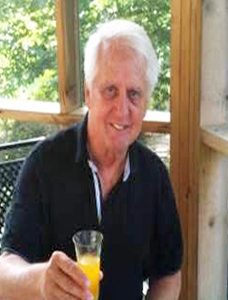

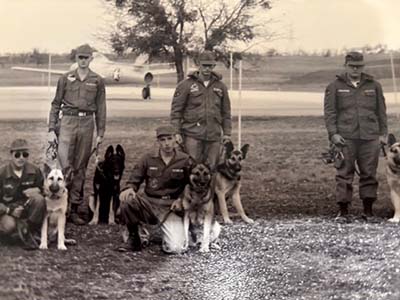
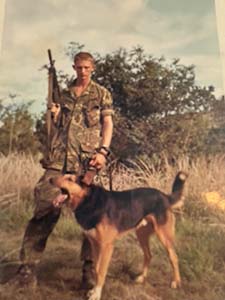
Phan Rang Air Base was home to both the US and South Vietnamese Air Force as well as the White Horse Korean Marines. The 101st Airborne were located on the south and west area of the base, and there was one small section where there was no barbed wire fencing. One of the oddest experiences for Adams took place one night as he and Andy approached an area of chest high jungle grasses. “My dog went on alert with what I could tell was a GI by the way he was acting,” says Adams. ““I hear ‘Who’s there?’ And I say ‘canine.’ I go over and sit down and I can only see his outline in the dark.”
So they talked. The first question GIs would ask each other when meeting in Vietnam was how long they had left. “Everyone knew to the day how much time they had left,” says Adams. “The second question is ‘where you from?’ He says, ‘Detroit!’ I say, ‘Me, too, what part?’ He says ‘West side.’ ‘Me, too!’ ‘Where’d you go to High School?’ ‘Redford Union.’ ‘When did you graduate?’ He says 65. I’m with my dog, in the middle of the night in Vietnam, takes me right to a guy I went to high school with! Graduated a year a part.”
Adams did two nine-month tours of duty in Vietnam before coming home for good. Andy moved on to another handler after he left. Oddly, Adams’ first job back in the states was at the police dog training facility in Plymouth, Michigan. But it was a totally different kind of training.
“With a sentry dog, once you turn a sentry dog loose on somebody it’s the same as shooting someone. You really didn’t want to do that. Many times that’s a one-way trip for the dog,” says Adams. “We were training patrol dogs, drug sniffing dogs, and at the time we were finding marijuana because we didn’t know how to train them for anything else that wouldn’t addict the dog. Also bomb detector dogs. First thing we did was walk right up to them and if they growled they were out. 99% of the time you were tracking a lost kid, and what you don’t want is for some kid that’s been lost for two days to be greeted by a big German shepherd growling at them.”
Eventually he realized he needed to make more money, so Adams went back to college, and then spent many years hopping from city to city as part of the Kerr Steamship company. He and his wife Linda started their own logistics company about 20 years ago and retired just before COVID shut the world down. He and Linda and their dog Boston now live in Lake in the Hills.
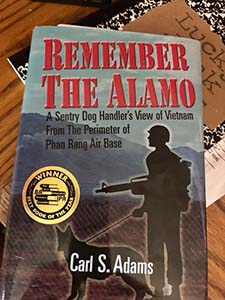
Needless to say there is so much more to Carl Adams’ story, and it can be found in his book
Remember the Alamo, A Sentry Dog Handler’s View of Vietnam From the Perimeter of Phan Rang Air Base. The day before he left Vietnam, he went out to the kennels to see Andy one last time. He took him to the training area and let him run loose and do whatever he wanted. They spent the afternoon together, just playing. “You can take your time when you’re doing something easy. It’s best to do the things that are hard as quickly as possible. What do you say when goodbye is forever? I gave Andy a hug and walked out of the kennels without looking back.”
Thank you for your service, Carl Adams, and Andy, too.