
Marines Vietnam War Hinsdale, IL Flight date: 09/17/25
By David Adams, Honor Flight Chicago Veteran Interview Volunteer
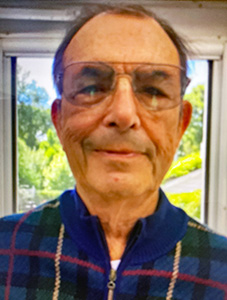
William A. Trader (“Bill”) was born on July 17, 1943, in Louisville, KY. He grew up in Philadelphia, attended and graduated from Philadelphia’s Central High School in 1961. Bill was a three-sport athlete competing in football, basketball, and baseball.
To attend college, he secured a Naval Reserve Officers Training Corps (NROTC) Scholarship and enrolled in the University of Pennsylvania. He was privileged to command the unit’s drill team during his junior and senior years. Given the option, he would elect a commission in the Marines. His NROTC military training included three summers at various facilities. After his freshman year he was posted to Guantanamo Bay Naval Base to experience life on a destroyer. He says this exposure persuaded him that he was meant for “higher altitudes”. The second summer found him at Naval Air Station (NAS) Corpus Christi for three weeks of aviation orientation followed by three weeks at NAS Willow Grove for amphibious orientation. After his junior year he reported to Marine Corps Base Quantico for the counterpart of OCS training. Bill remembers it was physically demanding but the drill instructors eased up on the mental challenges that usually confronted Marine recruits. After all these cadets would soon be officers.
He graduated from the University of Pennsylvania with a degree in economics in May 1965 and a commission as a second lieutenant in the Marine Corps.
Marine Basic School and Naval flight training.
After graduation he attended Basic School at Quantico, VA as required of all new Marine officers. Bill recalls distinctly completing Basic on November 24, 1965, the day before Thanksgiving and then marrying Marie. Their honeymoon was the drive to Pensacola, FL for flight school.
Pre-flight beginning in December took about 4 weeks. Primary followed at Naval Auxiliary Air Station (NAAS) Saufley Field. There he mastered the Beechcraft T-34 Mentor. He did solo in a Piper Cherokee, however. After completing primary flight training his Marine Corps student pilot class split into “choppers and jets” for advanced training. Bill ranked high enough in his class to move on to jets at NAAS Meridian, MS. From March to September 1966, he flew out of McCain Field named for the storied McCain family of Naval officers. Coincidentally, John McCain was IP in the other student squadron. Bill became proficient in air-to-air gunnery and qualified in carrier landings. The trainer was the North American T-2 Buckeye. Next to NAAS Kingsville, TX to fly the Grumman F-9 Cougar and TF-9. Four more carrier landings. Bill got his wings in April 1967.
Cherry Point NAS A-6 training
Selected for the A-6 Intruder he reported to Cherry Point NAS, North Carolina. Intensive flight training began in May 1967. Flight simulator sessions occurred at NAS Oceana, Virginia Beach, VA. Bill joined the 224th training squadron one of two at Cherry Point. The fighter community is famous for nicknames. The A-6 was dubbed the “Flying Drumstick”. Its thick nose held then-new ground-mapping and targeting radars necessary to bomb accurately in the dark and under adverse conditions. The cockpit layout seated the pilot and bombardier-navigator (B/N) next to each other allowing them to work together more effectively. Bill recalls that the weapons system was a complicated one that gave occasional trouble but remained a leap ahead in flying technology. However, he says that “it was a maintenance nightmare.”
Bill remembers that the A-6 could carry up to 18,000 pounds of ordnance on five external hardpoints. The Intruder was not a fast airplane, with a maximum subsonic speed of slightly less than 600 knots. Its job was to put bombs on target. Bill learned to do this efficiently and effectively in many challenging target environments.
He was on the squadron’s basketball team having had high school experience. The 225th won the Cherry Point basketball tournament thus advancing to a tournament at Camp Lejeune. It won again and advanced to the Atlantic Fleet tournament. The players had completed their A-6 training by then and begged off, wanting to join the fleet as A-6 aviators. The squadron commander remarked that he was not authorized to grant their request. Rather the Commanding General of Cherry Point, Marion Carl (a WW2 Navy ace) would decide. His order: “you must go!” The team took second.
Finally, after sixteen months at Cherry Point he deployed to Viet Nam.
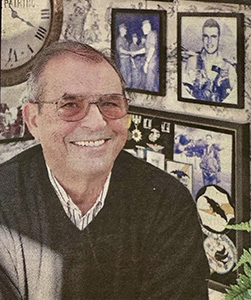
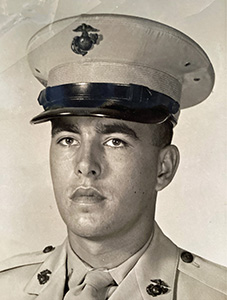
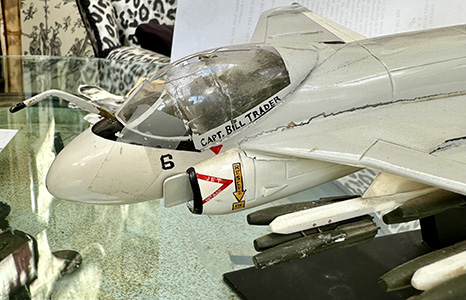
Da Nang AB, First Marine Aircraft Group Eleven
On September 11, 1968, Bill departed the States on a military charter flight from Travis AFB, CA with intermediate stops in Hawaii, Guam and Okinawa. A final hop took him to Da Nang Air Base. He joined VMA(AW) 242, soon to have a sister A-6 squadron, the 235th. Of the air base itself he recalls that “it was hot as the dickens – and humid.”
His squadron nicknamed the “Batmen” had twelve fighters. He recalls that at any one time, four were fully capable and mission ready. Four were what he calls “iron bombers”, delivering ordinance without the complete aid of the Intruder weapons systems. Finally, a couple were “hangar queens” used for parts.
The 1st Marine Air Wing occupied one side of the airfield’s runway and Air Force units the other. Bill remembers some differences in their respective facilities. For example, the Marine Corps Officers Club was manned by male stewards while the Air Force club patrons were served by a compliment of civilians including young ladies. Oh well!
His first combat flights involved a familiarization with I Corps, the northern most military operations area in South Viet Nam. He calls them “soft missions” if there ever were any! The customary bomb load for his Intruder was 28 500-pound bombs. From time-to-time cluster bombs (CBUs) were carried as well depending on mission requirements. He also dropped magnet-fused bombs into river fords along the Ho Chi Minh Trail (The Trail) which were used by PAVN (North Vietnamese) trucks and troops.
Checked out he flew with a combat-experienced B/N before being crewed with a newer one. His next month or so of missions were into North Vietnam seeking targets within 200 miles north of the DMZ. These sorties were in support of Operation Rolling Thunder which would end on November 1, 1968, per order of President Johnson. No more strike sorties in North Viet Nam (at least not for many years afterwards.) The bulk of his remaining combat missions, he remembers, were essentially “chasing trucks on the Ho Chi Minh trail in Laos”.
On one of his first what he calls “rookie missions” he was jolted by bright tracers of AAA (anti-aircraft artillery) fire in the sky ahead. Brushing off the tracers, his combat-experienced B/N said, “Oh, that’s far away, don’t worry about it.” Bill recalls “because it’s at night, you see the tracers streaming and it’s like, Ooh!”
Eighty percent of his 242 combat missions were flown at night between 8 p.m. to 4 a.m. Most were single ship. Some night missions were flown looking for road traffic on The Trail with two F-4 Phantoms as strike aircraft. He used the A-6 weapons systems, including its Moving Target Indicator (MTI), to identify trucks and mark them for attack by the F-4s.
About the turn of the year Bill served as a briefer at the Group level and was attached to the Headquarters and Maintenance Squadron. Accordingly, he flew missions with his own squadron and the 225th which arrived in February 1969. Not all combat missions ended uneventfully. Bill describes that during the monsoon season the runway was “like a skating rink”. To ensure a safe recovery a mid-field barrier, like the arresting gear on carriers, assisted the fighters in stopping without incident. On one mission he was unable to release his entire bomb load due to a systems malfunction. Landing on Da Nang’s “skating rink” required lowering the Intruder’s tailhook and engaging the barrier thus bringing the heavy-weight fighter to a smooth halt. “Not this time,” he says. Although the hook deployed properly, it skipped over the barrier. Bill was left with only brakes. With blown tires his Intruder turned sideways and skidded into the runway’s overrun. You could say “no harm, no foul”. Bill said, “it was a little hairy”. He does remember the terrain past the runway’s end was mined!
One of his most significant combat sorties earned him the Air Medal. On the night of January 25, 1969, he launched in his Intruder on an extremely hazardous mission. The official citation accompanying the award states in pertinent part as follows:
“Captain Trader launched as Aircraft Commander aboard an A-6 Intruder assigned to interdict a column of enemy soldiers moving into a village and into an adjacent tree line in Quang Nam Province. Despite the malfunction of his search radar and weapons systems ballistics computer and poor air-to-ground communications which gave him only intermittent radio contact, he skillfully utilized his available instruments and systems to maneuver to the designated area. Undaunted by the darkness and the threat of intense hostile fire which previous flights had encountered, Captain Trader extinguished his aircraft lights and skillfully maneuvered his Intruder on repeated bombing runs against the enemy positions and delivered all his ordinance with pinpoint accuracy upon the target. As a result of his devastating air strikes, two structures and 500 meters of positions in the tree line were destroyed and twenty hostile soldiers were killed. . . .”
In the spring Bill enjoyed a five-day R&R in Hawaii with Marie. Then back to work and many more months in combat until he left Da Nang for home on August 4, 1969.
Replacement Air Group (RAG), Cherry Point
His next orders were to the RAG (replacement air group) back at Cherry Point where it all had begun two years earlier in May 1967. Now he would instruct and share his combat experience with incoming Marine Corps A-6 pilots destined in some cases for combat duties in Viet Nam. Bill says his most famous student was Charles Bolden (Naval Academy 1968), A-6 pilot, astronaut who flew on four Space Shuttle missions, and an Administrator of NASA.
Bill also checked out in the TC-4 “Acadame”, the military version of the Grumman Gulfstream G-1. The G-1 had been modified to be a flying classroom for the radar and navigation systems of the A-6 to train B/N and pilots. Bill’s flying the TC-4 informed his decision not to pursue an airline pilot career.
He received an honorable discharge as a Captain on May 31, 1972, completing seven years of Marine Corps service. Bill holds the following awards and decorations: Air Medal (16 Awards), National Defense Service Medal, Vietnam Campaign Medal, Vietnam Service Medal w/4 stars, Vietnam Gallantry Cross, Meritorious Unit Citation w/Palm and frame.
A civilian again
Bill sought a job consistent with his economics education at Penn. He joined the Continental Bank in Chicago as a bond trader rising to the head of trading and underwriting. After 1984 he continued in bond futures and trading until his retirement. He and wife Marie have a daughter and two grandsons. Marie and he, married in November 1965, will soon celebrate 60 years of marriage. Bill has been and continues to be an avid golfer as well as employing his Green Thumb in their garden.
Reflections on his service
Bill is introspective of his Marine Corps service. His bottom-line assessment: “I am proud of it!”
Reflecting further on his combat experience, he credits his predecessors with “doing the risky groundwork of softening the adversary’s defenses. They were losing crews like one every 40 missions.” As his tour matured, he admits growing disillusioned with his superiors’ decision-making, “which seemed to yield scant results.” He says that “probably after three months, I felt I’d met the challenge. Then it became a matter of survival. We lost a lot of lives for nothing.” For him and many other Viet Nam War vets, Veterans Day is a bittersweet occasion. “It’s remembering a lot of good friends, alive and dead.”
Bill, enjoy your well-earned Honor Flight to Washington, D.C. with other veterans who have shared similar experiences!