

Navy Vietnam War Munster, IN Flight date: 09/17/25
By Al Konieczka, Honor Flight Chicago Veteran Interview Volunteer
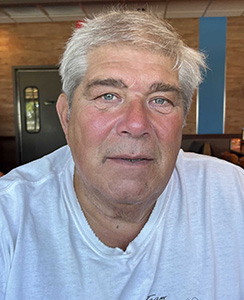
Dennis, or Denny as he prefers to be called, grew up in Hammond, IN. He signed up for the Navy 2-3 days after he turned 18. His older brother, who had been in the Army, tried to talk him out of it, but he signed up anyway. “I went up to Chicago where I had to take a test. You had to score a certain amount of points to either get into the Navy or into the Air Force. So I took the test and I passed and that’s how I ended up in the Navy.”
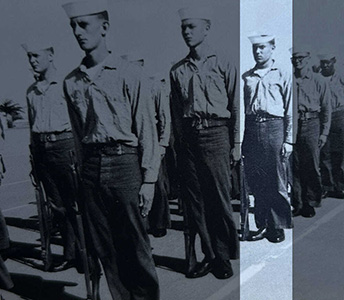
After his test he was called in for an interview and was asked what field he wanted to go into and Denny chose data processing because he already had data processor experience. But in the back of his mind he wondered what exactly that would entail. The U.S. Navy Data Processing Technician (DP) was an enlisted rating for sailors who operated, maintained, and performed administrative tasks for data processing equipment and was later merged with the Radioman. “I’m thinking, OK, I’m going to the Navy. Well, going to data processing school, that was a joke. Because once I signed my name on that line, I’m government property. I’m not protected by mom and dad no more. So for boot camp they did ask me, where do you want to go to – Great Lakes or San Diego? I looked at them and I said, well I’ll go to San Diego since my cousins all went there.”
After basic training, Denny headed home for two weeks of leave before heading back to California. He took the test and qualified for Radioman A school which he remembered all too well. “At that time, Radioman A school was kind of hard to get into. I went to afternoon sessions. So when I first started my schooling I had to go to typing school first. Then after typing school, I went to Radioman A school.”
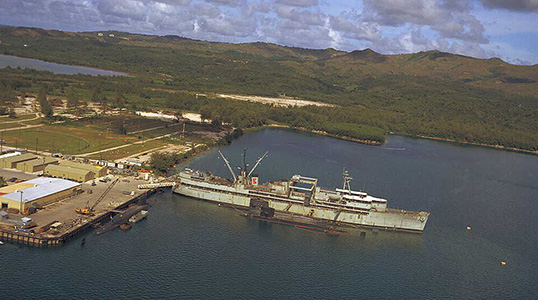
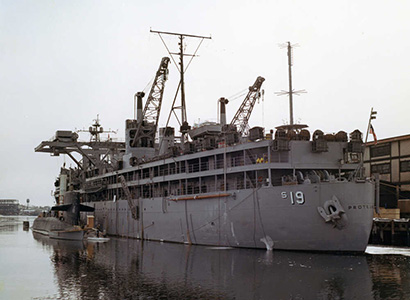
Denny wasn’t too fond of his time in San Diego. “Then I finally made it out of that place. When I got out, I’m thinking, God, I don’t have to come back here ever again.” When Denny put in his orders, he requested to be stationed at any of several locations in California other than San Diego. When his orders came in a few days later, he found out he was going to serve on the USS Proteus, AS -19, which was a nuclear submarine tender – a type of depot ship that supplies and supports submarines. He would soon be headed to Guam and thought it was going to be paradise.
Denny flew to Guam and reported for duty on the Proteus. “They had nuclear submarines tied up to the ship, which they did maintenance on all the time. We took the crew members onto our ship. They ate and slept with us and everything else. I was stationed there for maybe five months. I thought it would be paradise but in reality it was the most boring place. There was nothing going on for a radio operator. And the island was only 26 by 7 miles.”
The ship remained docked in the harbor all the time, except when a typhoon came rolling in or when the captain designated what he called ‘sea days.’ “Being on that ship was like being in the old TV Show McHale’s Navy. It was bring your friends, your girlfriends, your wife or whoever, up to four or five people. Bring them on the ship and they go out to sea with us. We had sea days like one or two days out of each month.”
In addition, Guam would experience a typhoon every week or once every three weeks. Whenever a typhoon came in, the crew was alerted ahead of time. When a typhoon arrived, the ship went out to sea for a few days until the storm passed and then they would return to the safety of the harbor and tie back up again. As Denny recalled, it was a very boring assignment. “So when we went out to sea, then I went to the radar department. But we would only go out to sea for like 1 or 2 days and then come back. So I’m thinking, this is the most boring place that there is for me. I gotta find a way to get out of here.”
Denny saw other sailors getting re-assigned to other locations so he came up with his own plan get off of Guam. “I had a real bad injury on my left hand before I ever went into the service. In fact, I almost lost my left hand. So I went and I got orders to go back to the States. You go to the closest naval hospital that there is to your house, which for me would be Great Lakes. However, that hospital was filled up, so they sent me to a Pennsylvania hospital for an evaluation of my hand. They wanted to get me completely out of the service, but I didn’t want to leave the service. I still wanted to put in my four years. I just wanted to get out of Guam.”
So Denny spoke with the captain and asked if he could go anywhere except for Guam. The captain told Denny to write down a list of where he would like to go. Once again Denny put down multiple bases in California, aside from San Diego. When his orders came in, he found out he was scheduled for two years duty aboard the USS Proteus AS-19. His plan to leave Guam had backfired and he found himself right back on the same ship he had just tried to get away from.
Denny decided to try and make the best of the next few years in Guam. “So I ended up going back, and I’m thinking, there’s got to be a better way to live than living on that ship. If I can get off that ship and find an apartment somewhere, that’d be great.” Denny ended up getting a one room apartment with a reservist who was also stationed in Guam. They bought themselves some old motorcycles and used them to get around the island. As Christmas approached, his roommate left to go home for a month.
Denny would soon learn that perhaps living on the ship wasn’t such a bad idea after all. “One night I went to bed and in the middle of the night, I tossed and turned a little bit and I turned over and I heard a splash. We lived right across the street from the ocean. My hands were full of water. I was so tired, a typhoon came in, came across the street, into our apartment, and we were flooded out. We lost everything. The only thing I had left was the pair of blue and white swimming trunks I was wearing in bed. I went aboard the ship in my swimming trunks. All my fellow sailors looked at me like, what the heck are you doing? But the Navy did furnish me with new clothing and I moved back into the apartment for another year.”
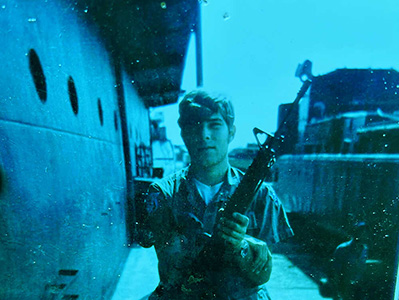
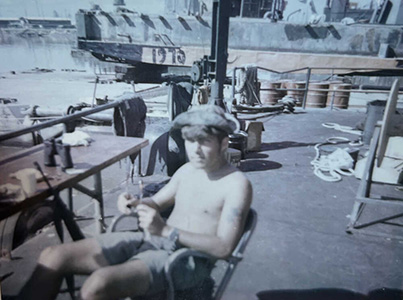
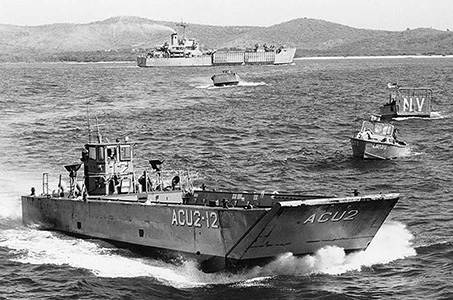
After his tour in Guam finally ended, Denny headed back to San Diego, this time to Coronado. Denny had a little more than a year left before being discharged from the Navy. “I got stationed at the Naval Amphibious Base for riverboat training. We did maneuvers with the Marine Corps, and with the Navy Seals. So we motored through the Bay Area, picking them up. They have these ties and they grab onto the tie and they grab onto the boat and then jump in the boat. And then they tell me, we’re going to send you on the Mike boat.” The LCM-8 (“Mike Boat”) is a river boat and mechanized landing craft used by the United States Navy and Army during the Vietnam War and subsequent operations. The acronym stands for “Landing Craft Mechanized, Mark 8”. (The “Mike Boat” term refers to the military phonetic alphabet, LCM being “Lima Charlie Mike”.)
The Mike Boats were typically operated by three individuals. There was a coxswain, the guy who drove the boat, along with an engineer and a radio man. Denny and his crew would travel to different ships in the bay area for training. “We would pull into the back of the ship, and we’d take the guys from the Marine Corps. They would jump inside the boat, and we’d take them to shore. Then we’d take them back, you know, just doing training exercises prior to heading off for Vietnam.”
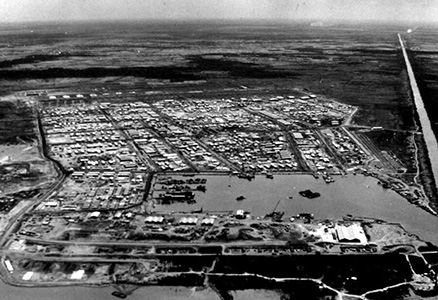
Once his boat training was over, Denny headed off to Vietnam. He flew to Saigon and landed at the Tan Son Nhut Air Base. He hopped a truck and headed to a temporary berthing place while he waited for his orders. When his orders arrived, he was headed off to Đồng Tâm Base Camp west of Mỹ Tho in the Mekong Delta, in southern Vietnam. “So Đồng Tâm was about 80 miles out of Saigon. And when we get to our base I’m looking around, and there’s nothing there. It was just a big camouflaged berthing boat sitting in brush, and some river boats. There was a small hall that they built themselves. I reported for duty on the boat, and I’m thinking, what am I going to be doing here? Well, the first couple of times I was there, I was chipping paint off that boat, repainting and whatever. And they had warned us in Saigon that this place was called Mortar City.”
Denny would find out quickly why it was called Mortar City because nearly every single night they would get hit with mortars. “I mean, you could be sleeping and boom, boom. So I started standing watch. At first, I was getting broken in. Then I was given a case of concussion grenades, and they said every 10 to 15 minutes pull the pin and throw it over the side of the ship. That’s how I lost my hearing, I think, doing that for like nine months.”
During the daylight hours Denny would ride up and down the river and was either assigned to one of the guns or acted as a radio man. “We went out, almost on a daily basis, in our Mike Boat. We would go down the river and end up at the sea. They called us the Brown Water Navy because of the muddy rivers and deltas we maneuvered through every day. We would bring cargo back, food, whatever, to feed and supply the people on our base. I’ll never forget, the planes flying over us dropping this powdery stuff. That lasted for about eight months. At the time I didn’t think anything about it. Well, that’s apparently how I got Agent Orange. When we finally left that camp, the Navy just gave our river boats, gave our Mike boats, they gave them all to the South Vietnamese.”
For his final three months in Vietnam Denny was moved to a berthing ship at Nhà Bè Base, about seven miles out of Saigon. It was a significant logistical hub for U.S. Navy operations, including a base for Patrol Boat, River (PBR) units and SEAL Team platoons. The base also hosted the largest fuel storage facility in South Vietnam, with approximately 80% of the nation’s fuel storage capacity.
There were openings in the personnel department and Denny got a job as the personnel director. He was put in charge of distributing Liberty Cards. Liberty cards were used to identify sailors and allow them to leave the ship and pass through the security gates. After 12 months his tour in Vietnam came to an end, and Denny flew from Saigon to Long Beach, CA where he was discharged from the service.
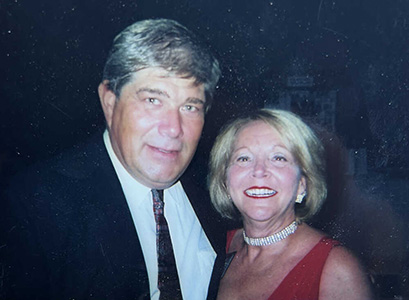
Denny had a job lined up before he left for the Navy. So 2-3 weeks after returning home he went to work for the Indiana Harbor Belt Railroad. A year later he took the entrance exam and joined the Hammond Police Department where he worked for 26 years. After leaving the Hammond PD, he joined the US Marshall Service where he worked for another 18 years before finally retiring in 2018. Denny met his wife Lucy, who was becoming a nurse, at the hospital while visiting his grandmother. As they talked, they realized they had attended high school together. They have been married for 52 years and have three children and five grandchildren. They enjoy travelling to Tempe, Arizona a few times each year to visit with their daughter.
Denny, thank you very much for your dedicated service in the Navy and as a first responder and please enjoy your well-deserved trip to Washington D.C.!