
Navy Korean War Shorewood, IL Flight date: 09/17/25
By Charlie Souhrada, Honor Flight Chicago Veteran Interview Volunteer
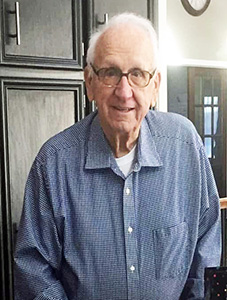
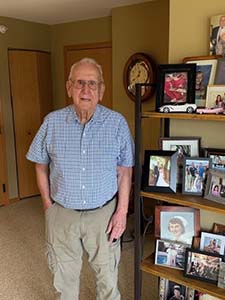
U.S. military history is rich with unsung heroes – individuals whose behind-the-scenes contributions have quietly shaped the course of events. Take Bill Haines, for example, a Korean War veteran, who will be honored for his service this month.
Born on January 16, 1931, in Joliet, Bill was the only son of Louis Earl and Iona Haines. His father worked in a wallpaper manufacturing plant, while his mother cared for Bill and his younger sister, and kept the house.
Growing up, Bill managed three newspaper routes – the Chicago Tribune in the morning, the Joliet Herald in the evening, and the weekly Joliet Spectator. “I worked those routes all through junior high school, then went to work in a laundromat during high school,” he says. There, he maintained supplies and used his electrical and mechanical skills to keep the machines running.
After graduating from Joliet Township High School in 1949, Bill got a job as a meter reader with Public Service Company and became a certified lineman after one year. During this time, to avoid the threat of being drafted into the Army, he signed up for the Navy Reserve and attended weekly meetings in nearby Rockdale.
In late 1951, a bout with pneumonia forced Bill to miss two reserve meetings in a row. As a result, he was inducted and ordered to report to Great Lakes Naval Base for basic training in January 1952. “I wasn’t too enthused about going,” he says. “But I learned quickly that if you don’t adapt, you’re in trouble!”
After successfully completing basic, Bill was sent to Naval Base San Diego, where he received specialty training as a radioman. “They gave me a choice,” he says. “I was pretty good with electrical things and even made extra money wiring houses, so it seemed like a natural fit.”
As a radioman, he learned how to operate, maintain and repair radio equipment. He also learned how to use Morse code to transmit messages through a complicated sequence of dots and dashes. “Morse code requires you to focus and concentrate,” he says. “I still remember a lot of it after all these years!”
Near the end of radio school, Bill learned submariners earned $50 more each month for hazardous duty. “They asked if anybody wanted to serve aboard a submarine and the extra money sounded pretty good to me, so I volunteered and got accepted!”
Bill’s next stop was Naval Submarine Base New London in Groton, Connecticut, for specialized training. “Between boot camp, radio school, and New London, I spent almost a year in training,” he says. “At the end of sub school, the Navy gave me a specific date to report to Naval Submarine Base Key West, Florida, but it was up to me to get there!” After a brief visit back home to Joliet, Bill took a series of un-airconditioned buses down to Florida to report for duty.
In Key West, Bill was assigned to serve on the USS Manta (SS/ESS/AGSS-299), a World War II-era, Balao-class submarine that had been converted to auxiliary service, hence the designation “AGSS-299.” At the time, the Manta was paired with the USS Sarsfield (DD-837), a Gearing-class destroyer, to conduct a series of anti-submarine warfare testing and training missions.
He explains the crew of the Manta received orders to steer a specific course, while the crew of the Sarsfield used the Manta as an open water target. “The diving officer would give us an order, ‘I want a 3-degree down bubble,’ and we had to maintain that downward angle by using the stern and bow planes, which work like the wing flaps on an airplane.” The Sarsfield then fired exercise torpedoes, with the warheads removed, at the Manta to test systems and train crew members.
“We were a target,” he says. “Our sub wasn’t the best for speed or maneuverability, and we could hear the torpedoes coming at us. Sometimes they’d hit us; sometimes they’d go right on by.” After each training mission, the crew would attempt to recover the exercise torpedoes for future use. He recalls one instance when a torpedo struck the Manta’s propeller shaft, bending it slightly but not disabling the sub. “The ship vibrated quite a bit after that,” he says. “We had to visit the Navy base in Guantanamo Bay to get it fixed!”
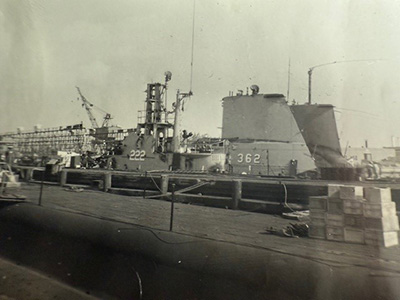
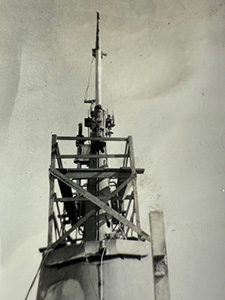
During his time on the Manta, Bill earned the Submarine Warfare Insignia, or his “dolphins,” by demonstrating mastery of all submarine systems. He explains that the Manta had nine compartments, and he had to show he knew how each one functioned and how to operate them expertly. “Earning your ‘dolphins’ is just like a pilot earning his wings,” he says. It’s a big deal!”
When he wasn’t on duty, he remembers skin diving to pass the time. “We’d dive for langoustines, which are small lobsters without claws,” he says. “We’d make a dive, collect several, then have our cook prepare them with lots of butter and lemons in return for a share of the catch. They were delicious! You really can’t beat lobster right out of the ocean.”
In November 1953, Bill received his discharge papers at the Charleston Naval Shipyard, South Carolina. He vividly remembers the journey from Key West to Charleston because the Manta rode on the edge of a hurricane. “The waves were in excess of 35 feet high,” he says. “We’d come up at the crest of a wave and our screws would come out of the water, the entire ship, which was longer than a football field, would vibrate, then we’d head back down into the trough. That was an incredible experience!”
Bill returned to Joliet, moved in with his parents and rejoined Public Service Company in December 1953. His life soon took a major turn for the good when he met his future wife, Mary Frances, on a blind date in February 1954. Just several months later, the couple married on September 4 that same year. As Bill fondly recalls, ‘I offered her a house or a ring—and she said, ‘I’ll take the house!’”
In 1990, after 40 years of service, Bill retired from Commonwealth Edison—which had absorbed Public Service Utilities in the 1970s—and settled into retirement with Mary Frances, first in Joliet, then in Florida, before returning to Joliet in 2017.
Sadly, Mary Frances passed away seven years ago after 65 years of marriage. The couple’s legacy lasts however with five children, 13 grandchildren, and 22 great grandchildren. Nowadays, Bill spends his time driving to family celebrations in Indiana and Michigan, reading technical books, and maintaining his extensive computer skills.
In anticipation of his upcoming Honor Flight Chicago trip to Washington, D.C., Bill looks back on his military service with pride. “It changed my attitude about life,” he says. “I learned that if there’s something to be done, you can’t come in empty, you’ve got to look into it. I’ve been a very lucky guy!”
Thank you, Bill! We’re the lucky ones to have you aboard Honor Flight 125!