
Army Vietnam War Chebanse, IL Flight date: 06/18/25
By Kenna Rathai Honor Flight Chicago Veteran Interview Volunteer
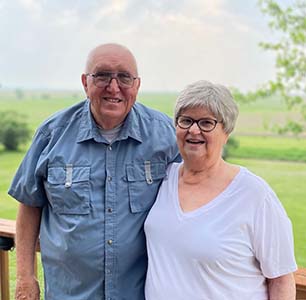
“I don’t consider I did anything spectacular,” Alfred Weedon insists. But after talking with him, it’s clear that his definition of “just doing what was told of me” involved extraordinary courage and resilience during the Vietnam War.
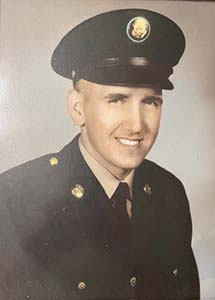
Weedon grew up on a farm near Chebanse, Illinois. At 19, in the fall of 1969, he was drafted into the Army. His military journey would take him from Fort Jackson for basic training to Fort Knox for advanced instruction in armored reconnaissance.
Initially trained as a scout, he was soon reassigned. “They said, ‘We’re switching your MOS. You’re now a tanker.’” He climbed into the loaded, 60-ton M60 battle tank, a behemoth of iron and firepower. He spent time in Germany on border duty, staring across from Russian outposts and witnessing escapes from East Germany. But in 1970, the Army needed manpower in Vietnam. After a brief leave to marry his now-wife at home, Weedon received his orders.
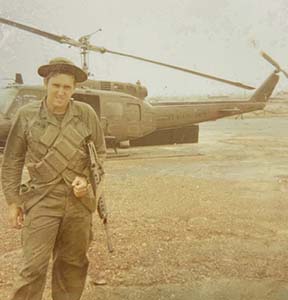
Following staging at Fort Lewis, Washington, he shipped out to Cam Ranh Bay, Vietnam. From there, he moved north to Camp Eagle near Phu Bai. Assigned to the 2nd Squadron, 17th Cavalry, he quickly learned that his unit was unique: “We were the only ground unit that didn’t have helicopters. We were the ones who went out on foot, doing reconnaissance and ambushes.”
His baptism into combat came fast. On his very first mission, his small troop learned a full regiment of North Vietnamese Army (NVA) soldiers was pursuing them. “We weren’t going to fight them,” he recalls. “We were just too small.” They narrowly escaped, thanks to supporting fire from Cobra gunships. The lesson was clear—survival depended on wits, teamwork and luck.
Missions often meant setting ambushes, sweeping landing zones (LZs), or trekking through rivers and bamboo thickets. Weedon vividly remembers a mined LZ, where the enemy buried mortar rounds with trip mechanisms that could detonate under the weight of a helicopter. His unit secured the site while explosive ordnance teams cleared the danger. Booby traps were constant threats: punji pits lined with bamboo spikes smeared in feces to guarantee infection, or 50-caliber rounds rigged with nails to explode underfoot.
One of his toughest memories was retrieving bodies from a downed helicopter during monsoon season. “You’ve never smelled a burnt body,” he says quietly. The wreckage was so horrific that gloves used in the recovery were discarded immediately. Other times, Weedon and his men stumbled upon NVA tunnel networks, hearing enemy soldiers talking just beneath their feet. The razor-edge tension of knowing death could come from above, below, or behind never left him.
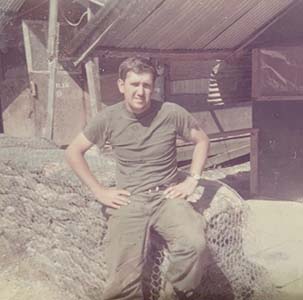
Weedon’s service was marked by countless brushes with death. He recalls one sapper attack on Camp Khe Sanh, where enemy soldiers infiltrated razor wire to hit an ammo dump. A fellow soldier smothered a satchel charge with his flak jacket and body, survived, and earned the Congressional Medal of Honor. Weedon also survived a grenade landing just feet away, saved only by the luck of a fallen tree absorbing the blast. On another occasion, a bullet sheared off his comrade’s elbow even as Weedon, inches away, walked away without a scratch. “God was hovering over him,” his wife often says.
Perhaps the worst mission came during an attempt to rescue a downed medevac. Another platoon’s lieutenant shouted their approach, alerting the enemy. “All hell came at us,” Weedon recalls. RPGs and machine gun fire tore into their ranks. The first five soldiers ahead of him were killed instantly. Weedon walked past their lifeless bodies, images seared into his memory forever. It took two days of fighting, naval bombardments, and reinforcements to secure the area. He never forgot the sight of a comrade’s empty skull or the anguish of realizing lives had been lost because of a single mistake.
For his service, Weedon received the Air Medal, recognizing his participation in more than 25 helicopter assaults into hostile or “hot” LZs. He also earned the Army Commendation Medal with Oak Leaf Cluster. Yet he shrugs off the medals. To him, they represented survival and the bond of soldiers more than individual heroism.
“I was just doing my job,” he repeats. But his stories reveal that doing his job meant enduring dangers most can scarcely imagine.
Weedon came home in 1971 with an early release to help his father, who was declining with Alzheimer’s, on the family farm. The welcome was far from warm. Vietnam veterans often faced hostility instead of gratitude. He remembers fellow servicemen being spat on in airports. “We were over there doing what we were told to do, and people back here didn’t understand.” The lack of recognition stung deeply.
Reentry to civilian life was rocky. Weedon admits he was “a mean-ass son of a bitch” after coming home. The trauma of war left him volatile, quick to anger, and struggling to adjust. He acknowledges that his wife’s patience and love were his anchor. “She was my Godsend,” he says. Many comrades weren’t as fortunate. He remembers one friend who, unable to cope, took his own life. He knows he easily could have gone down the same dark path without his family’s support.
Back in Illinois, Weedon eventually took over the family farm and later worked nearly three decades at General Foods, which became part of Quaker Oats and later Heinz. He also carried mail part-time as a substitute carrier in his community.
His memories of farming included some humor, too. He laughs about getting tired of eating liver, sneaking the food under the dinner plate as a child, or watching siblings drop the liver into the heating vent to escape eating it—only to be discovered once the furnace kicked in.
Looking back, Weedon doesn’t glorify his time in service. He questions the U.S. involvement in Vietnam, calling it a civil war America should have avoided. “We shouldn’t have been there,” he says firmly. Yet he never disparages the men who fought beside him. He honors their sacrifice.
He remembers contrasts: seeing the horror of men turn into paraplegics right before his eyes, but also experiencing the beauty of finding a waterfall in the jungle and finally getting a shower.
“I have some fond memories, and I have some non-fond memories,” Alfred sums up. The balance of both shaped him into a man of resilience.
We are honored by your sacrifices, Alfred.