

Marines Vietnam War Chicago, IL Flight date: 10/15/25
By Wendy L. Ellis, Honor Flight Chicago Veteran Interview Volunteer
He’s a vagabond, a nomad, a traveler. He has lived in Costa Rica, in Thailand, in Cuba, on a sailboat in the Caribbean, even in the Cayman Islands. But he has never owned a house. He is a pilot, a scuba diver, a motorcycle rider, a ham radio operator with friends all over the world.
And yet, if he has any roots at all, they are here in Chicago.
Life was going well for Myron Gulych in 1966. He’d been out of high school almost a year, working at a Chicago chemical plant, getting paid enough to buy himself a 1966 Chevelle Super Sport that he used to race at US 30 Drag Strip, (“the drag racing capital of Chicagoland.”) Going well, that is, until he opened his draft notice from the US Army.
“That same day I signed up for the Marines,” says Gulych. “because I didn’t want to be in the Army. They talked me into signing up for three years instead of two. They told me if you sign up for three, you won’t be on the front lines.” All his aptitude tests showed he was good with numbers, so he ended up assigned to the 7th Motor Transport Battalion in Chu Lai, in charge of ordering, organizing and distributing supplies.
“When we landed in Da Nang we were already getting shelled by the Chinese rockets they were shooting at the airport,” says Gulych. “As they brought up the stairs, we had to run down into bunkers and I thought to myself, my tour of duty was 13 months. The first day I land here they already want to kill me. I’m never gonna survive 13 months.”
Gulych wasn’t allowed to leave camp for the first three months. He ordered all the supplies, everything from ammo to underwear, along with other odd jobs around camp. Finally he volunteered to ride shotgun on the trucks making deliveries to the grunts out in the field. Convoys would be a dozen trucks long, and he’d sit atop a ring mount that swiveled 360 degrees. “The snipers always want to get you because you’re the guy with the gun,” says Gulych. ”I’ve heard some bullets whiz past me.”
Even that wasn’t enough for Gulych. After almost a year, he volunteered for the 4th Combined Action Group, a counter insurgency program started by the Marine Corps to improve relations with local villagers. “We worked in the hamlets with the people. The navy corpsmen would take care of the children, giving them shots, pulling out their rotten teeth while we’d set up a perimeter guard. We’d go on day patrols, night patrols, and we’d give them supplies and then after a couple days we’d move on to the next hamlet, and the next hamlet.” Things were not always friendly.
He remembers getting into a firefight in one village, while on patrol with Marines and Vietnamese soldiers.
“We had this one guy who fired an M79 grenade launcher and I told him, “Put one into that hooch over there.” He put one right in there, so we all advanced and went into the hooch and there were three dead bodies in there. One of the Vietnamese soldiers started kicking one of the bodies and the cap fell off, and it was a young girl, maybe 16. I’m thinking now I got young girls trying to kill us. It was 2 weeks before I came home on leave and that affected me.””
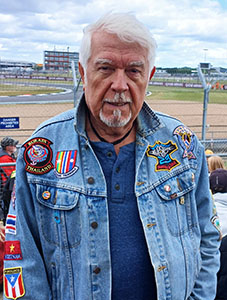
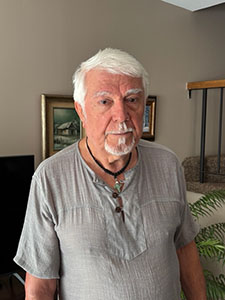
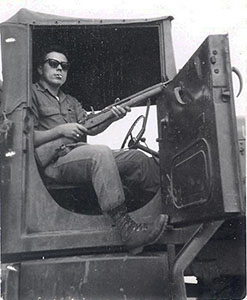
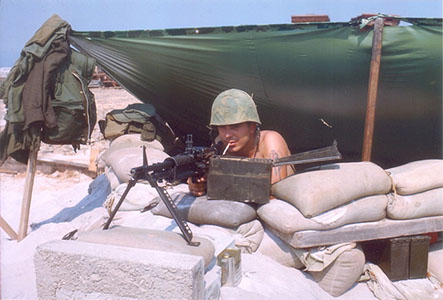
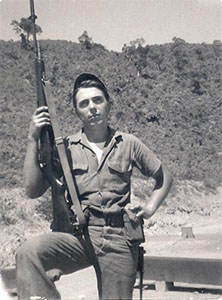
Gulych had already extended his initial 13 month tour by 6 months because of the Combined Action Group’s work in the villages. During that trip home to see his family, he told his mother he was going back, for another 3 months. That decision made his mother cry, but she understood his motivations. “I said Mom, I’m going back there to help the people. They need help,” says Gulych, ”It’s a little emotional for me because my mom and dad escaped from Ukraine and many people helped them along the way to get out of that situation. They were probably going to get killed in Ukraine or die of starvation. And I just wanted to help the people.”
Finally, in October of ’68, he came home to the US, finishing his last few months at Camp Lejeune. He turned down their incentives to re-up and got a job working supplies at a Chicago steel company while going to college part time to get a degree in Aviation. He married his first wife and had a son. He got hired by Midway Airlines, but he didn’t want to fly “a bus.” His dream was to fly pure jets. It took him two more years to meet the requirements of 2000 hours flying time and 500 hours of multi-engine time, and he was hired by Executive Air at O’Hare Airport, a firm that flew VIPs all over the world. It was the summer of 1984.
“That was the worst summer of my life,” says Gulych. “After two years of getting all the qualifications, I got the job, but I never got to do it.” The night after was hired he was riding his motorcycle down Archer Avenue when he was broadsided at an intersection by someone who blew the stop sign. Gulych hit a lamp post and turned his head just in time, but flew off the bike into a gas station. The crash severed his nerves, shattered his femur, and he spent 6 months in the hospital. “I spent a lot of time in a wheelchair. They transplanted a bone from my hip to my leg. I had a plate with ten screws and rods all wrapped with wire. I set off the metal detectors. But they saved my leg. It’s a little crooked and a little shorter, but I’m alive.” Needless to say, he lost his dream job. He got a job as a flight instructor at Midway airport, eventually becoming Chief Flight instructor there. But his life did not settle down.
A chance encounter with a wealthy individual looking for a pilot to fly him to the Cayman Islands led to a job house sitting in a five-bedroom mansion on Little Cayman Island for the next two years. He followed that up with 2 or 3 years living on a sailboat with his then girlfriend, sailing around the Caribbean. The relationship ended and he moved on, eventually signing on as a crew member with a Canadian boat captain going to Cuba. He met and married his second wife in Cuba, living there for five years and raising her two daughters. They eventually moved to Miami, but the marriage ended in 1999 and he headed to Costa Rica, working for the next 11 years as an independent flight instructor and commercial pilot. “I hate the cold,” says Gulych. ”It’s warm there. That’s one reason I go away.”
Although he no longer teaches flying he is still a certified pilot with all the certifications. He works for whoever hires him, wherever he is certified. Over the years, he has had at least two harrowing landing experiences. One involved a nose gear that would not lower, and a crash landing at Midway Airport that made the Chicago Tribune in 1986. The other one with his 10-year-old son on board with a broken leg. It was a flight home from Canada in subzero temperatures when oil starts splashing on the windshield. Knowing things could go bad all of a sudden he climbs to 12,000 feet and asks an air traffic controller at a nearby airport for guidance. At 12,000 feet, he’s 12 miles away and the airport is at 12 o’clock, straight ahead, but all he sees are treetops. He opts not to land on a snow covered lake beneath him. And then the engines quit and he is gliding. “I finally spot a tiny gap in the trees,” says Gulych. ”That’s gotta be the airport. I’m down to 3000 feet. I make a right turn and I see the runway right in front of me, and I put the plane down right on the numbers. It was 40 below zero and we had no heat in the plane. I wanted to kiss the ground.” Both happened decades ago, but are still fresh in his memory.
2010 took him to the World Cup in South Africa, and then to Thailand, which he called home base for the next 10 years. In 2011 he returned to Vietnam for the first time, and has been back almost every year since. The day his Thai residency expired in March 2020 he flew to Vietnam, and a few days later, COVID kicked in. He ended up staying for four months, before finally finding a flight home to the United States. To this day he has a motorcycle in Vietnam for his frequent visits. He has traveled Vietnam extensively since the war, staying several months at a time.
“The new generation of Vietnamese love Americans,” says Gulych. “They don’t know much about the war, they don’t care. They’re interested in prosperity and taking care of family. They’re very nice people.”
His work with the Combined Action group definitely left him with a more positive attitude toward his time in Vietnam. “I think it did some good,” says Gulych. “It felt good for me. It had to feel good for some people. Here are these Americans coming to help us and bring us supplies, and food and take care of us and giving up their lives to protect us from the bad guys. To me it was very positive.”