
Navy Vietnam War Round Lake, IL Flight date: 10/15/25
By David Adams, Honor Flight Chicago Veteran Interview Volunteer
Andrew C. “Andy” Reitz witnessed the “fireworks” of the 1968 Tet Offensive from his Seabee barracks at Da Nang. After five and a half years as a Navy Seabee and again a civilian, he personified the Seabee “Can Do” attitude as a journeyman carpenter, equipment operator and construction foreman. Shop at Woodfield’s IKEA and know he was Pepper Construction’s foreman responsible for building it.
Andy grew up with two brothers in Chicago’s Logan Square northside neighborhood near Monticello and Diversey. He graduated from Kelvyn Park High School in 1964. The next few months found him working a variety of jobs. His older brother was serving in the Marines onboard a ship. After overcoming resistance from their father, both he and his younger brother enlisted in the Navy in March 1965.
Navy basic and Seabee training
Andy completed five months of basic training at Naval Station Great Lakes. He quickly learned that, although in the Navy, he did not want to serve onboard a ship. Instead he chose to join the “Seabees”, the United States Naval Construction Battalions. The Seabee nickname is derived from the initial letters “CB” from the words “Construction Battalion”. He reported to its training program at Port Hueneme, California in about July. He learned there that the Seabees provide a wide range of construction in support of operating forces, including roads, bridges, bunkers, airfields and logistics bases and frequently perform civic action projects to improve relations within their area of operations. Andy successfully completed the approximate twelve-month program after which his orders read “Da Nang, South Vietnam”.
South Vietnam
In true Navy fashion he traveled across the Pacific from California to Da Nang via ship, the very mode of transport he wanted to avoid by becoming a Seabee. Upon arrival in the Port of Da Nang his means of disembarking was via nets suspended from the side. He was instructed to time his “leap” into the launch in conjunction with swells of the sea. He made it.
Arriving in September 1966 he reported to Seabee headquarters at Camp Adenir located at the foot of Monkey Mountain on a peninsula northeast of the air base. His screened-in barracks provided shelter but little else when the enemy launched attacks on the various Da Nang Air Base facilities. There was no bunker in which to seek shelter for him and his bunkmates. He learned that at Da Nang the Seabees, who first arrived in 1965, had built many temporary facilities which included strongback tents, mess halls, shops, sheds, bathroom facilities, and a water distribution system. Seabees built the all-important machine gun positions and bunkers for perimeter defense and rapidly rebuilt the entire base hospital complex after it had been destroyed by enemy shelling.
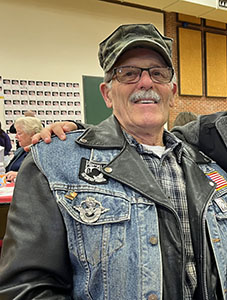
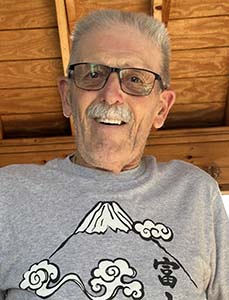
Andy was assigned to work in the motor pool. He recalls that while the Korean military serviced the trucks and other vehicles, the Navy Seabees operated them. The day he reported to duty he says, “I just got there and was asked if I could drive a truck”. Of course he had a driver’s license, but had not driven the kind of truck his Senior Chief boss asked him to drive. So off Andy went in the tractor designed to haul trailers. After half a day he mastered it. Then the Senior Chief told him to park twelve trailers lined up side-by-side. Although never having done this before he succeeded by the end of the day. His driving duties expanded to all the other vehicles.
One of his frequent transport routes was from the ammo dump to the air base via a road through a village just south of the runways. The village was known to harbor Viet Cong. Thus, he was told to keep the truck moving, as he says, “pedal to the metal”. Once he was dispatched to tow an Army truck stuck in the mud and tow it to the motor pool for maintenance. Upon arrival Andy found the Army driver in the cab. He refused at first to help Andy hook up his truck with the tow chains. That required getting under the truck in the mud. Andy said, “if you don’t help me, I am out of here and you can just sit in your truck cab.” He relented and the two of them got down under the truck—in the mud. Once at the motor pool and the safety of the base, the driver eventually “did say thank you”.
Andy recalls that he and his Seabee mates were prohibited from going into the city of Da Nang, which had a population of 140,000 at the time. At first he was unaware that it was a center of anti-government dissent and opposition. Chief among the anti-government populace were Buddhist monks. One day during an assigned route through the city he came upon a Buddhist monk seated in the middle of the road and on fire. Self-immolation had become an extreme method of government opposition. Andy reached for his weapon concealed in the truck cab to be sure it was locked and loaded just in case. Until the authorities cleared the road Andy had to sit, observe, and wait. Unfortunately, he saw three more monks taking their lives in this manner during his tour at Da Nang.
Andy’s nineteen-month tour encompassed the Tet Offensive, or just “Tet”, a series of attacks country-wide by the North Vietnamese Army and Viet Cong. Attacks on Da Nang began on January 29, 1968, and continued off and on through February 11. Enemy forces employed mortars and rockets causing what he remembers as a “fireworks display”. The principally night-time attacks focused on the air base and command bunkers which were fairly far away from Andy’s location. He was understandably relieved when the offensive ended.
Andy did eventually enjoy a seven-day R&R in Taiwan. Besides seeing the sites and feasting on Taiwanese cuisine he spent considerable time shopping in the Navy Exchange and shipping items back home. He returned to Da Nang to complete his nineteen-month tour in March 1968. Andy flew home to Travis AFB, CA, a step up from the ocean voyage he endured “going over”!
Stateside Navy
Andy reported to the Gulfport, MS Naval Construction Battalion Center where he served from May 1968 to June 1969. He was pressed into becoming an instructor on M79 grenade launchers. Firing the 40 mm munition they made quick work of targets. The targets Andy used were derelict trucks, every one of which he and his “students” dismantled time and again. Andy completed his active duty at Great Lakes beginning in July 1969 to his honorable discharge as an E-4. By August 1970 Andy had completed five and a half years of active duty.
Civilian life
Back in Chicago his service completed, Andy first joined the IBEW and then worked for a series of construction firms. He became a journeyman carpenter and a skilled equipment operator. For the twenty years before his retirement in 2010 he was a carpenter and a foreman for Pepper Construction. One of his largest Pepper projects was the IKEA store at Woodfield Mall in Schaumburg. Andy as Pepper’s project foreman was among the honored few at its opening.
Andy and Marilyn, married 57 years, have two children, three grandchildren, and one great-grandchild. They travel around the States to visit family and favorite sites in addition to a recent lengthy trip to Italy where Marilyn has family connections.
He assessed his Navy Seabees service in these words, “I loved what I was doing.” He did experience what so many veterans returning to the States from Vietnam did. “People didn’t want to talk to you.” Andy, rest assured that all the other veterans on your Honor Flight will be eager to talk with you!
You have more than earned your day of honor in Washington, D.C. Enjoy sharing experiences with the other veterans on your flight!