
Army Vietnam War Naperville, IL Flight date: 10/15/25
By Charlie Souhrada, Honor Flight Chicago Veteran Interview Volunteer
Some experiences leave a lasting mark. For Mike DeSmedt, his tour of duty in Vietnam is one of them. Still, he wouldn’t hesitate to do it all over again. “I had to do something I wouldn’t have volunteered for,” he says. “But if I had to do it all again, I would without hesitation.”
The second of Joseph and Margaret DeSmedt’s four children, Mike was born in Chicago on October 2, 1946. The family later relocated to Northlake, where he attended grade school and immersed himself in every sport possible – baseball, basketball, and football.
At Proviso West High School, he joined the school’s diversified occupations program, splitting his days between morning classes and afternoon work at a local print shop. It was more than a part-time job — it was the start of a career path interrupted when he got drafted in 1966, one year after his high school graduation.
Everyone around him knew it was only a matter of time. His older brother was already serving in the Navy, and with a father who had served in the Navy during World War II, it seemed natural Mike might follow that path. “Everyone assumed I’d join the Navy too,” he recalls. “But I wasn’t a fan of floating on water.”
Instead, fate intervened at the selective service office in Oak Park. “They lined us all up. The Navy recruiter took 10 guys from one end of the line; the Air Force guy took 10 from the other. I was in the middle—and the Army chose me; it was that random.”
Basic training at Fort Campbell, Kentucky, was unforgettable, it marked the first time he had ever been away from home, and the harsh, demanding treatment was eye opening. “I was just a grunt, and they worked us to death,” he recalls.
After completing basic, Mike was offered an opportunity to put his printing skills to use in Germany, but he turned it down. “They told me, ‘If you sign up for three years instead of two, we’ll send you to Germany. Where we could use a printer,’” he recalls. “But I figured even if I took the deal, they might send me to Vietnam eventually so I thought I might as well just get it over with.”
Instead of heading to Germany, Mike was ordered to report to Fort Jackson, South Carolina, for Advanced Individual Training in heavy weapons infantry. There, he spent eight intensive weeks learning combat tactics and weapons systems, including mortars, machine guns, and artillery.
After completing AIT, Mike returned home on leave, eager to spend time with his fiancée, Joan, a girl he met at My Sister’s Place, a teen dance club in Chicago.
In February 1967, Mike got his orders to ship out to Vietnam. “I flew to California for a few weeks of additional training,” he says. “Marching, shooting, and playing soldier, then they put me on a United Airlines flight for Tan Son Nhut Air Base near Saigon,” he remembers. The reality of the situation began to set in when the flight made a brief stop in the Philippines to let “non-essential” personnel get off the plane. “I thought to myself, ‘Why do all these people have to get off?’ Then it dawned on me, and things began to get real.”
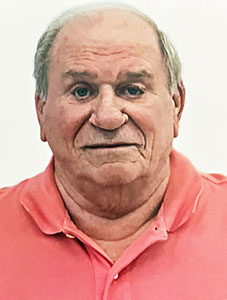
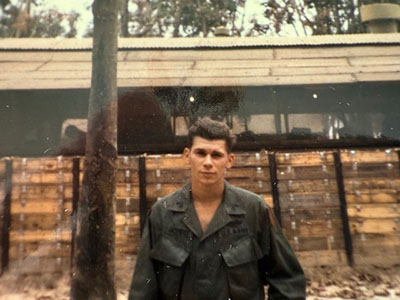
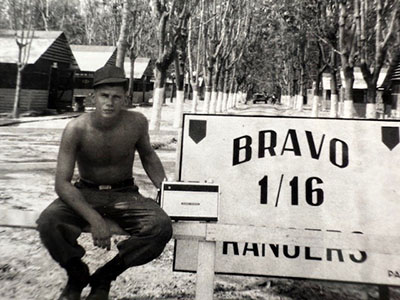
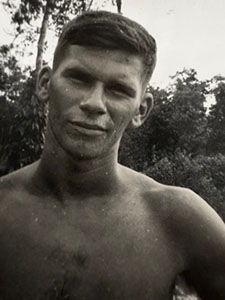
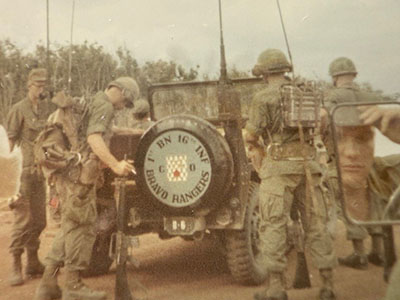
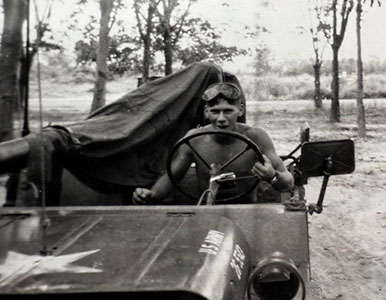
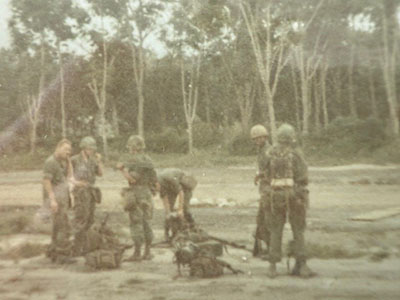
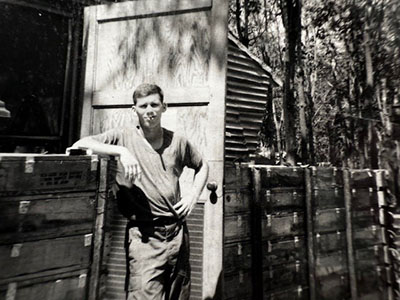
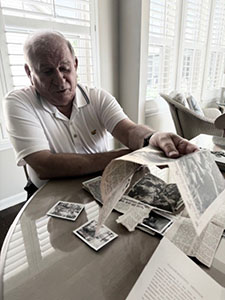
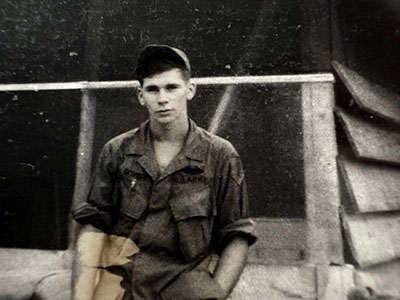
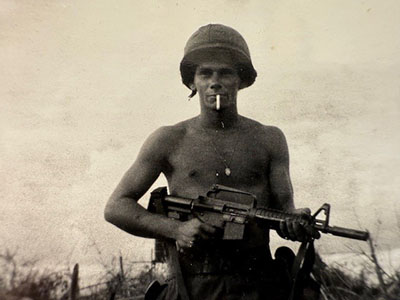
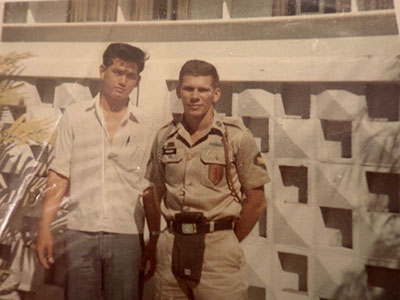
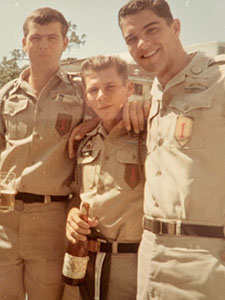
Upon arrival in Saigon, Mike had to straighten out some paperwork, then was immediately shipped to Lai Khe, his duty station in southern Vietnam, where he was aligned with Bravo Company, 1st Battalion, 16th Infantry, 1st Infantry Division. “I carried mortars, then radio for a while,” he says. “Then I moved into the mortar crew, firing the mortar when they needed it, then carried an M16 leading the platoon.”
During his time in the field, Mike recalls heating up World War II–era C-rations using a rather unconventional method – C4 explosives. “I’d crack open a claymore mine, pull out the C4, toss the blasting cap, and light a marble-sized piece with a match,” he says with a grin. “It made the food taste better and it scared the hell out of the younger guys!”
When he wasn’t on patrol or showing off his battlefield cooking skills, Mike spent time writing letters to Joan. Many of them arrived smudged with the red clay soil of Vietnam, a stark reminder of where he was. He admits those dirt-streaked envelopes made the war feel all too real for her back home.
Over the next few months, Mike rose through the ranks and reached the rank of Specialist 4th Class by the time he was wounded on June 17, 1967. “We were in the middle of a hellish firefight,” he recalls. “Sixteen men were killed, and thirty more were wounded. It was awful.”
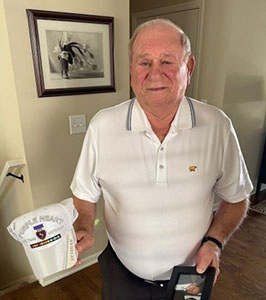
Mike was evacuated to a hospital in Saigon to recover from his injuries and was awarded the Purple Heart in recognition of the wounds he sustained. After a brief R&R trip to Bangkok, Thailand, he rejoined his unit and completed six more months of service in-country.
In January 1968, Mike received orders to return to the U.S., just days before the Tet Offensive erupted across Vietnam, throwing the country into chaos. “I was on base reinforcing the ammo dumps and other buildings with sandbags when my orders came through,” he recalls.
With no flights arriving due to the escalating conflict, Mike made his way to the 1st Infantry Division base at Lai Khe, where he waited two tense days for the next available C-130 transport. When the plane finally arrived, there was no time to waste. “They told me to ‘run like hell’ because it was going to be a touch-and-go landing,” he says. “That’s exactly what happened. I ran up, grabbed the straps, the door closed, and we went straight up as mortars were hitting the runway. It was crazy!”
Back at Tan Son Nhut Air Base, Mike spent a few more days waiting before catching a United Airlines flight back to the U.S. “I got lucky—there was a stop order on anyone leaving,” he says. “But I kept pushing, saying I had orders. Who was I to argue?” His persistence paid off.
In March 1968, after a brief visit home, Mike packed up his 1966 Ford Mustang GT and drove from Chicago to Fort Hood, Texas, where he reported for duty. Having earned the rank of Sgt. E5, he was given the rare opportunity to choose his own assignments. He opted to supervise prisoner transport and lead cleanup details on base and in nearby parks until his discharge five months later, when he returned to Chicago.
On October 6, 1968, Mike married his fiancée, Joan. The newlyweds settled into an apartment in Elmwood Park, and Mike resumed his career in printing, working at a series of local print shops. Along the way, the couple welcomed two children, Michael and Amy, into their lives.
In 1978, Mike responded to a Help Wanted ad and joined CN Railway, managing the company’s in-house print shop. As the printing industry began to decline in the early 1990s, the railroad offered him a new opportunity. “They asked if I’d be interested in managing hazardous materials,” Mike says. “I figured it was better than getting kicked out, so I said sure.”
CN sent him to the Security and Emergency Response Training Center (SERTC) in Pueblo, Colorado, where he was trained in hazardous materials handling and emergency response for railroad incidents. He served in this capacity until his retirement in 2011.
Four years later, he and Joan relocated to Naperville, where they embraced the next chapter of their lives—traveling, spending time with their growing family, and enjoying the rewards of a life well lived.
These days, Mike takes care of Joan, enjoys golfing with friends and is a proud R.O.M.E.O. — “That stands for Retired Old Men Eating Out,” he says with a laugh.
Welcome home, Mike, and thank you for serving. We hope you enjoy your Honor Flight!