
Army Vietnam War Vallejo, CA Flight date: 10/15/25
By Al Konieczka, Honor Flight Chicago Veteran Interview Volunteer
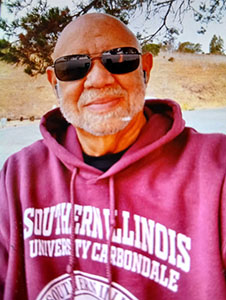
William Maxie Blair, who goes by Max, grew up on the south side of Chicago in the Englewood neighborhood. He has a younger brother who also served in the Army during Vietnam. Both brothers will be traveling together with Honor Flight Chicago in October.
After high school, Max enrolled in college at Southern Illinois University and initially started in the pre-med program. He quickly realized that medicine wasn’t a career he wanted to pursue. At the age of 24 he was drafted by the Army and plucked right out of college.
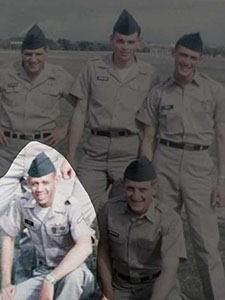
Max began his stint in the Army with eight weeks of basic training at Fort Leonard Wood in Missouri. “For me, it was kind of isolated. Not an area that I was used to. After basic I went to Advanced Infantry Training (AIT) at Fort Dix, New Jersey.”
Max recalled having a celebrity with them at Fort Dix. “And oh, I do remember a guy’s name that I was with at Fort Dix, and his name was Tony Dow. He was an actor who played the older brother Wally on the TV Show Leave it to Beaver. It was funny because he was a celebrity so they made him like a squad leader. I remember we all arrived at Fort Dix in deuce and a halves and he came in a station wagon. So we would go out for different training exercises and if something got messed up, we would all say, Gee, Wally, what do we do now?”
Max’s situation was a bit unique in the sense that he had two AITs. While he was at Fort Dix, he also applied for Officer Candidate School (OCS) and was accepted. “But then they canceled my specific class date. And they said that if I wanted to avoid being stuck in the infantry, I could choose a different MOS. That’s how I went from Fort Dix in infantry to Fort Sam Houston in Texas.”
Max had hoped to go in for a medical specialty and had specified dental technician because he thought it would keep him in a lab somewhere safe. “To my surprise, our training started with sucking chest wounds and applying tourniquets and all that stuff. I thought to myself, what’s this got to do with dentistry? Turns out I was being trained as a combat medic.”
After completing his training at Fort Sam Houston, Max went to Oakland Army Base where they were loaded on buses, transported to Travis Air Force Base and then flown to Vietnam, after a quick stop in Okinawa, Japan for refueling. Max landed in Vietnam in December 1967 and would spend Christmas more than 8000 miles from home.
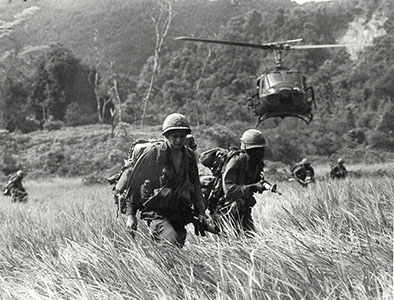
Max was assigned to the 9th Infantry Division as a medical specialist. They were primarily located in the Delta region of Vietnam near Rach Kien, west of Saigon and included the canals and rivers of Bassac and Mekong. This was the most fertile region of the country which also made it strategically important for both sides.
“For the majority of the time I was in the field, we were in the Delta. It was mostly walking through rice paddies, no jungle. We slept on the ground and we used our poncho liner. We marched around wearing jungle boots and we would take an extra pair of socks with us. We put our socks on top of our helmet and held them down with the little elastic band that held the helmet liner on. And we carried and ate MREs (Meals Ready to Eat). The only thing I can remember about them was the fruit cocktail was pretty good. Sometimes a helicopter would drop stuff off for us, and we would use a little chunk of C4 to heat up our meals.”
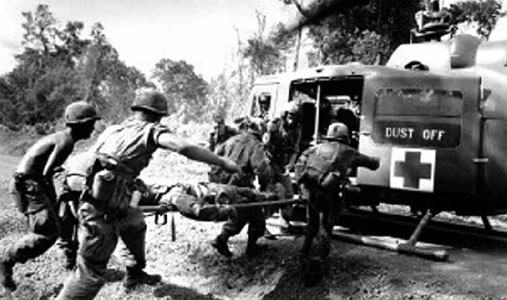
On any given mission, Max and his unit would fly out into the field on helicopters and then they would regroup wherever the assigned landing zone was. As the only medic with his unit, he would travel with the infantry and treat any wounded soldiers. “So my job was basically to stabilize them and get them on a chopper to get them out to a safe location. We called it a dust off. We would call in for an evacuation and they did a quick pick up and leave.”
Prior to going through his medical training at Sam Houston, Max had no real medical training whatsoever, other than a few pre-med classes while at college. Suddenly he was a 25-year-old kid, thrust into a combat setting, tasked with keeping wounded soldiers alive. While he was the only medic in his unit, there were several other medics in Vietnam he had trained with at Sam Houston, and one in particular whom he remembered.
“The only name that I can remember of anybody that I served with was a young guy that was also a medic and he was about three or four years younger than me. His name was Paul Belecheck and he was also from Chicago. Unfortunately, after about three months in country, he was killed. He was really kind of an innocent kid. On one of his trips home he met a young girl and I was helping him write letters to her. We didn’t have very much in common but I just kind of took to him as like a little brother.”
Max remained in the Delta region for most of his tour. He would treat gunshot wounds and shrapnel wounds from mortar attacks. He recalls being hit with mortar attacks more than anything else. Towards the end of Max’s time in the field, he was sent to the aid station back at base camp and attached to a unit working what they called the Brown Water Navy or River Runners. They lived and slept on a ship and patrolled the rivers and inland waters. They knew when they were served a steak dinner, they would soon be going out. So, they were loaded onto small landing crafts and accompanied by an alpha boat or lead boat, which had a pointed bow and a 50 caliber gun mounted on it. The landing craft would go into shallow water and lower the front ramp for the troops to exit as the boat approached land.
“I do remember one time we got to this riverbank, and then all hell broke loose with RPGs, and they hit the alpha boat. There was this one guy who was a sailor, because the alpha boats were manned by the Navy. They started screaming for a corpsman. Of course, there were no corpsmen out there because that’s a Navy term for a medic. So I had to go back out from shore to the alpha boat. This sailor’s leg was pretty much almost severed off, and he was down under the deck. I weighed probably about 145 pounds at the time, and I’m trying to lift this guy out. I didn’t want to let him see his leg because he kept saying, ‘My leg, my leg.’ I just said, Hey, let’s just get you out of here because I figured he’d go into shock if he actually saw it. So he reached up and pulled himself out through the hatch and I held his leg and pushed and kept it together and he was evacuated out. I heard later that he did survive. That was probably my most traumatic experience in Vietnam.”
Finally after exactly one year and eleven days in Vietnam, Max completed his tour and headed home. “So I left Vietnam on Christmas Eve 1968 and because of the time zone changes, we picked that day back up coming back to the States. I actually got home on Christmas Day. For the whole year, all you’re thinking about is getting back to the world. I remember taking a cab from the airport and I pulled up at my house and we had relatives over at my house for Christmas because my mother always had Christmas dinner there. And I came in and I said, well, I’m back. And that was it. I won’t say it was a letdown, but it was kind of a strange feeling.”
Max shared with me that his experience in Vietnam didn’t really change him much. He attributes that to the fact that he was a bit older and perhaps more mature than many of the other young men he served with. “I was 24 when I was drafted so I think my personality and my brain had probably developed a little more, because I made E5 in just 15 months.”
After the holidays Max went back to college and earned his Bachelor of Arts degree. Max had worked for the Chicago Transit Authority (CTA) during his years in college to help pay for school so he went back to driving a bus for a few years after college. He had a friend in California who convinced Max to move out to the San Francisco area for work. Max packed all his stuff in a trailer and hooked it up to a Peugeot that he had and drove to California. Shortly after arriving there he started his own printing business. He later worked as a property manager for senior housing and later as a project manager for a company that did the janitorial work for the convention center in Oakland. He changed job titles and companies several times but remained at the convention center until retirement.
Max was introduced to his wife Irene by the same friend that was responsible for him moving out to California. They have been married for 37 years and have one son. Max and Irene are both active in their church and volunteer with the local Rotary Club, as Irene is a Rotarian.
Max, thank you very much for your dedicated service and please enjoy your well-deserved trip to Washington D.C.!