
Army Vietnam War La Porte, IN Flight date: 06/24/26
By Al Konieczka, Honor Flight Chicago Veteran Interview Volunteer
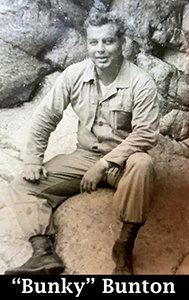
The Bunton Brothers grew up loving sports and their country. In 1930, the first son “Bunky” was born in La Porte, Indiana, to Jerry and Thelma Bunton. Their father, Jerry, worked for the Curtiss-Wright Corporation, a multinational manufacturer of highly engineered, technologically advanced components and services primarily serving the aerospace, defense, commercial nuclear, and industrial markets. Their father designed wings on aircraft and as a result, the family moved around the country quite a bit. The next son, Jack, was born in 1932, also in La Porte. When the family relocated to St. Louis, two more sons were born – Jerry in 1941 and Tom in 1944. Then in 1946, the youngest of the Bunton boys, Michael (or Mick), was born. The boys had several uncles who served in World War II and one of them, Uncle Harold, who was a Seabee, told Bunky he should join the Marines.
So while Bunky joined the Marines, Jack joined the Navy right out of high school. All of the boys looked up to Bunky as a kind of father figure, especially Jerry, Tom and Mick. The three remaining boys were all drafted into the Army during the Vietnam War. The boys all wanted to serve their country. According to Tom, “I think for us, it probably started with Bunky being a Marine. We looked up to him and wanted to follow in his footsteps.”
Tom and Mick believe that Bunky went through basic in California at Camp Pendleton. Tom recalled hearing stories from Bunky about his training. “In California the Marines made them jump off a cliff to prove they could swim. Bunky said they were very high up and they had to just jump into the ocean.”
When Bunky went to Korea, he played baseball for the Marines for the Air Wings. The US military maintained highly competitive, morale-boosting baseball teams during the Korean War, primarily operating under major commands like the Far East Air Forces (FEAF) and the US Marine Corps Air Wings.
According to Mick, “Bunky was in the sports division. He was in the entertainment sector. He played baseball and was assigned to the air wing and he ran the EM club too.” An EM (Enlisted Member) Club is a designated recreational and social facility on a military base exclusively for junior enlisted personnel.
According to Tom and Mick, their older brother Bunky was a great athlete. He was a catcher and played semi-pro ball right out of high school. Their father was an alcoholic so Bunky took on more of a father role with the 3 younger brothers. As Mick explained it, “Bunky would come home on leave and buy us boys baseball gloves, and he taught us how to play pepper. I got my chatter from him. He was quite the athlete and he passed it on to us.”
Because of their father’s drinking issues, their brother Jack stayed away from the rest of the family when he got older. But according to Mick, “Our next older brother Jack was a boxer. I had a picture of him at the YMCA, and the guy that was in the picture with Jack was a guy I worked with years later at the post office. All of us played softball and stuff, so we were all involved in sports.”
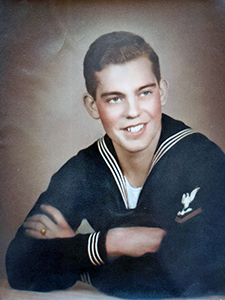
When Jack joined the Navy, he served on the USS Hornet in Korea. The Hornet was an Essex-class air craft carrier and one of the most decorated ships in US Navy history. Jack was an ordinance operator (officially called an Aviation Ordnanceman) and was responsible for handling, storing, and loading all aircraft ammunition and weapons systems. After his time in the Navy, Jack went to school to become an accountant and eventually comptroller at a large corporation.
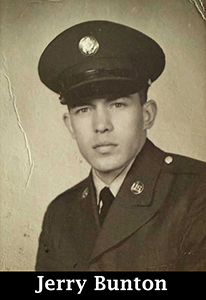
The middle brother Jerry was born on December 11, 1941, just a few days after Japan bombed Pearl Harbor. When Jerry got drafted, he did his basic training at Fort Knox. According to Mick, “Jack was infantry, but he went to OCS (Officer Candidate School) and trained. He had been in there for a while, but decided he didn’t like doing that. So he dropped out of that, but by then he had so much education in that he was already an E5. So the Army attached him to different basic training schools to perform training for new recruits. He worked at Fort Ord, California, and ended up at Fort Lewis, Washington.”
Jerry ended his tour in December 1965 and worked for a shoe company and then on to an accounting job for a few different firms. Jerry passed away on Mick’s birthday, on August 9th, 2008. Mick has a tattoo on his arm honoring his brother Jerry. “And it says, on eagle’s wings. I have this tattoo for him because it’s my birthday. So maybe when I get old and get dementia, they’ll ask me when my birthday is and I’ll say August.”
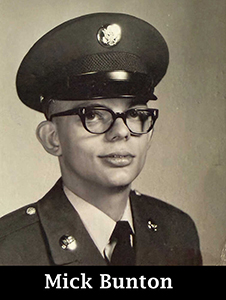
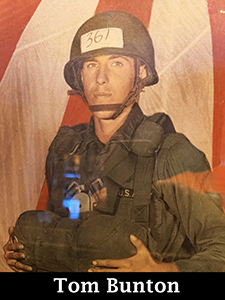
The two youngest brothers were next in line to serve our country. Mick was drafted in March of ’66 and Tom was drafted in April of ’66 and both did their basic training at Fort Polk, Louisiana. Tom’s MOS (Military Occupational Specialty) was with the military police. Tom told me, “Orientation week, when you first went in the Army they had 2 paratroopers there. They gave a little show and they said, hey, you want to go ahead and volunteer, go airborne, be a paratrooper. I thought, I would really like to do that. So I went from military police school at Fort Gordon onto a bus to Fort Benning to jump school. We thought we would then pretty much go right to Vietnam with the 18th Airborne Corps. Out of the 12 of us that went through basic training, military police school, and jump school, only 1 went to Vietnam.”
After another move to Fort Bragg, they found themselves in a nice big three story building but the place was empty. Tom recalled asking the First Sergeant what was going on. “I asked did they just start this company? He said, no, the 101st just came down here and took everybody. They took all the MPs and changed their MOS to infantry so we’re starting the company all over again.”
So little by little they built up the company platoon by platoon. And the guys coming in there were MOS military police. By the end of 1967 they had built back up to three companies and Tom thought he would finally be off to Vietnam. “So they came in and said, we need everybody that hasn’t been to Vietnam and that has over six months left. By that time, the original 11 of us that didn’t go to Vietnam the first time only had like 4 or 5 months to go. So we missed out again and they took everybody else except the original 11 of us. And by now Mick was over in Vietnam too so I couldn’t go anyway.”
After Tom left the Army he went to work at Modine Manufacturing making grading units for about 34 years until the business shut down. From there he went to Federal Mogul Power Train in South Bend, Indiana, where he set up, operated and trained people on computerized anodizers. Tom has a very strong work ethic as was evidenced by the stories he shared. “After I retired, they called me back to train their people. I came in and 1/2 the machines were shut off. They want me to train them to run it like I used to. I said, I can’t train someone to work hard. That’s what you’re missing is the work ethic. I can’t give that to them.”
The youngest brother Mick also began his time in the Army with basic training at Fort Polk. “Both of us were there at the same time, but they had one of us at North Fort and one at South Fort. I don’t remember who was where, but we never really got to see each other.”
After basic, Mick was sent to Fort Eustis, Virginia, to be a helicopter mechanic or just be a door gunner on one side of the Huey. “So, during the course of the training, we were supposed to go up in the Huey and shoot the machine gun. Well, the helicopter had a hot start, which means they had to get it down as soon as possible. So they just took us out and we shot the M60 pistol grip on a stand in the sand.”
Mick spent the next 6 weeks on KP duty and thought he really didn’t want to be a helicopter mechanic. His orders were then cut for Fort Carson, Colorado. “There was a unit forming at Fort Carson that was headed for Vietnam. It was December’66 and they said, if we don’t get this guy over to Nam, he’s not going to do his year. So they gave me orders to go to Vietnam, and I just missed the big snowstorm of ’67.”
When they were calling out names, Mick thought they called his name. “Well, I thought they called my name, so I went up there. They took me and I got there and it was the 173rd Airborne. The Sergeant says, what are you doing here? I said, I’m not airborne, I don’t know what I’m doing here. So they sent me to Pleiku. The guys in Pleiku all came over on a ship together and guess what, there’s no helicopters there. So I pulled guard duty in the bunker, set the Claymore mines out, and then I went on a few convoys, and I had to burn feces.”
From there Mick would be transferred to Chu Lai where their unit would take over for the Marines. “They wanted a door gunner, so I said, as long as I don’t have to be the crew chief, I’ll be the door gunner. But I didn’t get the assignment. And then, you know, it’s funny. Just last week I realized that the life expectancy of a door gunner, one in 20 doesn’t make it. At the time I was 20 years old and I never really thought about that.”
So by the time Mick arrived in Chu Lai he was about four months in. He never became a crew chief, he just worked on the Hueys. He would switch over from mechanic to the sheet metal crew patching bullet holes and performing other helicopter repairs. “The four bolts that hold that tail section on were cracking, so we had to make pieces and put them on there to reinforce that. The reason I switched over to that group was because the guy that was the head of it, when he rotated, the next guy got to be a Spec 5. So eventually I’d work my way up and I’d be a Spec 5.”
At the time, Chu Lai was located along the beach and offered recreational time for the soldiers. On his 21st birthday, Mick remembers going down to the EM club for a free hot dog and beer. That would be the start of medical issues that would ultimately get him sent back home. “So, we’re playing basketball, and I said, wait a minute, I got this splitting headache. So, when I got back to the hooch, I went outside and threw up in the sand. About two weeks later, I was walking around to ‘police the sand’ for trash and I said where are my ankles at? My ankles were really all swelled up. I had never been on sick call my whole time in the Army. They told me to get a couple sandbags, and put them on the cot and prop my feet up. The next day they took me to the hospital and ran some tests and a lady said, you’re lucky you’re not dead.”
Mick’s kidney filters weren’t working. The fluids were filtering directly into his body and not his kidneys. Even though he wanted to stay, he would soon be on his way home. They moved him to another hospital in Vietnam and had to carry him on a stretcher because every time he would sit up, his ankles would swell up. They finally moved him to Camp Zama, a US Army installation located in the Kanagawa Prefecture, Japan, about 25 miles southwest of Tokyo. “I spent the month of September there and came back home from Camp Zama on Columbus Day, October 12th, I remember that. I had to put in for a city, so I put Louisville, Kentucky and was taken to Ireland Army Hospital.”
When Mick arrived at the hospital stateside, he recalled a special moment with his mom. “At that time you couldn’t really make many phone calls. There were no cell phones or Internet and you basically communicated through letters. So they wheeled this phone over to my bed and said, make your call to whoever you want. So I called my mom and told her I was in the states and she didn’t have to worry about me anymore. That probably was both my highlight and probably her highlight too.” By then he was doing 24 hour urine tests and that’s all he did. He was sick, but he lived in the hospital. After months in the hospital, they asked him if he wanted to extend or get out. They eventually told him, just go home. When the discharge orders came back, the Army said he was 60% temporarily disabled.
So Mick got out of the Army and had the VA pay for two years at a business school in South Bend and he earned an Associate Degree in accounting. But after getting that degree, he remembered something from his time in the hospital in Japan. “When I was in the hospital in Japan, they had a Stars and Stripes newspaper. I saw in there that the post office was giving veterans and extra five points on the test, but a disabled veteran got 10 points. So in November of 1970 I took the test for the post office and in February of ’71 I got hired and spent the 30 ½ years working for the post office.”
All five brothers served our country with honor, married and had children of their own. Now in 2026 the two remaining brothers will travel to Washington to represent all five of the Bunton boys. This trip will be a fitting tribute to the service and dedication of all five brothers. I could tell from their stories that all five brothers were close, respected one another and especially looked up to Bunky. One passage from a letter Bunky wrote to his brothers from Korea in May of 1954 around Mother’s Day stood out to me. “We have the sweetest, kindest and best loved mother in the world, don’t ever forget it. She’s wonderful besides being a good cook for all I guess without a doubt she’s been the greatest referee for Jack and I now know you three boys. You’ll know one of these days what I mean.” Thelma Bunton certainly did raise five wonderful boys!
Tom & Mick, thanks for your years of dedicated service by you and your brothers. Enjoy your well-deserved trip to Washington D.C.!