
Marines Vietnam War Lake Forest, IL Flight date: 06/24/26
By David Adams, Honor Flight Chicago Veteran Interview Volunteer
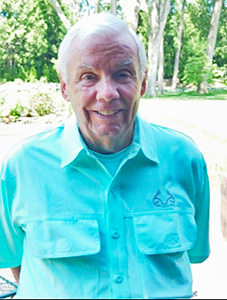
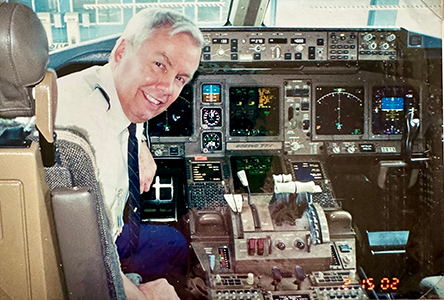
Everyone knows the infamy of September 11, 2001, but not the following. Four days later on September 15 some things had returned to normal. At Denver International Airport United’s Flight 564, after the cabin door was locked and the Boeing 777 was ready for pushback, the Captain spoke to the passengers and crew. “I want to thank you brave folks for coming out today. We don’t have any new instructions from the federal government, so from now on we’re on our own.” He continued by describing current airport security measures, the hijackers’ playbook, and the steps they could take to foil a hijacking. “Remember, there will be one of them and maybe a few confederates, but there are 200 of you. You can overwhelm them. The Declaration of Independence says, ‘We the people . . .’ and that’s just what it is when we’re up in the air: we the people vs. would-be terrorists. I don’t think we are going to have any problem today or tomorrow or for a while, but some time down the road, it is going to happen again and I want you to know what to do.” The then-anonymous Captain’s announcement went viral within hours. Philip M. Foss was that Captain, a Vietnam War Marine Corps veteran fighter pilot who knows how to take charge.
Phil grew up near Higgins and Talcott in Norwood Heights on the Northwest side of Chicago. He was the middle child of five, a girl and four boys. His dad, a carpenter by trade, was exempt from military service. He contributed significantly to the War effort by using his considerable skills building the mile-long Douglas Aircraft manufacturing buildings at Orchard Field. Douglas produced the C-54 military transport at what is now O’Hare Airport. Phil recalls his father’s wartime service with pride.
Living on North Rutherford his family home was just three doors down from John W. Garvey, his grammar school. When the school bell rang for classes, he could make it from home to class without being tardy. Phil graduated from Taft High School in 1960. Taft is otherwise famous as the inspiration for the Rydell High featured in Grease. The stage musical, which became a popular movie, was co-authored by Jim Jacobs. He and Phil graduated together and have known each other since they were five years old. Phil insists with authority that the real “Pink Ladies” at Taft were much tougher than those depicted in Grease.
He attended Bradley University, Peoria, IL from September 1960 until his graduation in June 1964 with a Bachelor of Arts in political science. Bradley had mandatory AFROTC when Phil enrolled in 1960. Shortly into his freshman year he approached a Marine Corps recruiter on campus. He learned that if he agreed to enter the Marine Corps PLC (Platoon Leader Class) he did not have to participate in AFROTC. “Ok, good, sign me up.” The PLC program required two summers at Quantico, VA where the officer candidates received instruction and indoctrination from the infamous DI’s, or drill instructors. During the summers of 1961 and 1963 Phil spent six weeks each at Quantico fulfilling the Marines’ Junior and Senior PLC course requirements. He remembers the DI’s did their “normal thing”; you know what he means! His PLC training was completed before his senior year so that upon college graduation he received his Second Lieutenant bars.
Marine Basic School and Naval flight training
With active-duty orders in hand Phil reported to Quantico on September 8, 1964. There he attended six weeks of Basic School required of all new Marine Corps officers. Now on active duty he learned that since he had selected PLC as a commissioning track, his four years in the program at Bradley counted for pay purposes. “Thank you, Marine Corps!” His flight pay for example was doubled. After a year in the Corps, he proudly repaid his dad for college!
Off to NAS Pensacola, FL. Pre-flight took about four weeks. Primary and advanced followed. Phil first mastered the piston powered Beechcraft T-34 Mentor. Then on to the North American Aviation T-2B “Buckeye” jet at Meridian, MS. He also trained in the Grumman F-9 “Cougar” at Corpus Christi, TX. At Chase Field, Beeville, TX logged 30 hours of air-to-air combat training in the Grumman F-11 “Tiger”. To earn one’s wings a student must satisfy carrier qualifications. Phil says, “hitting the boat” was “pretty exciting”. How exciting was it? He recites a study of pilots coming aboard a carrier in the Tonkin Gulf at night after a combat sortie over North Vietnam. Their heart rate was higher than at any time making weapons deliveries on enemy targets.
Most of flight school was “reasonably intense.” During flight school, in good weather, students flew a “couple of hops” per day. When lousy weather rolled in, training was delayed. Phil put on his wings in May 1966.
Vought F-8 Crusader–“The last of the Gunfighters”
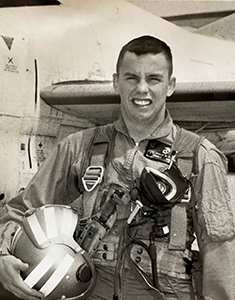
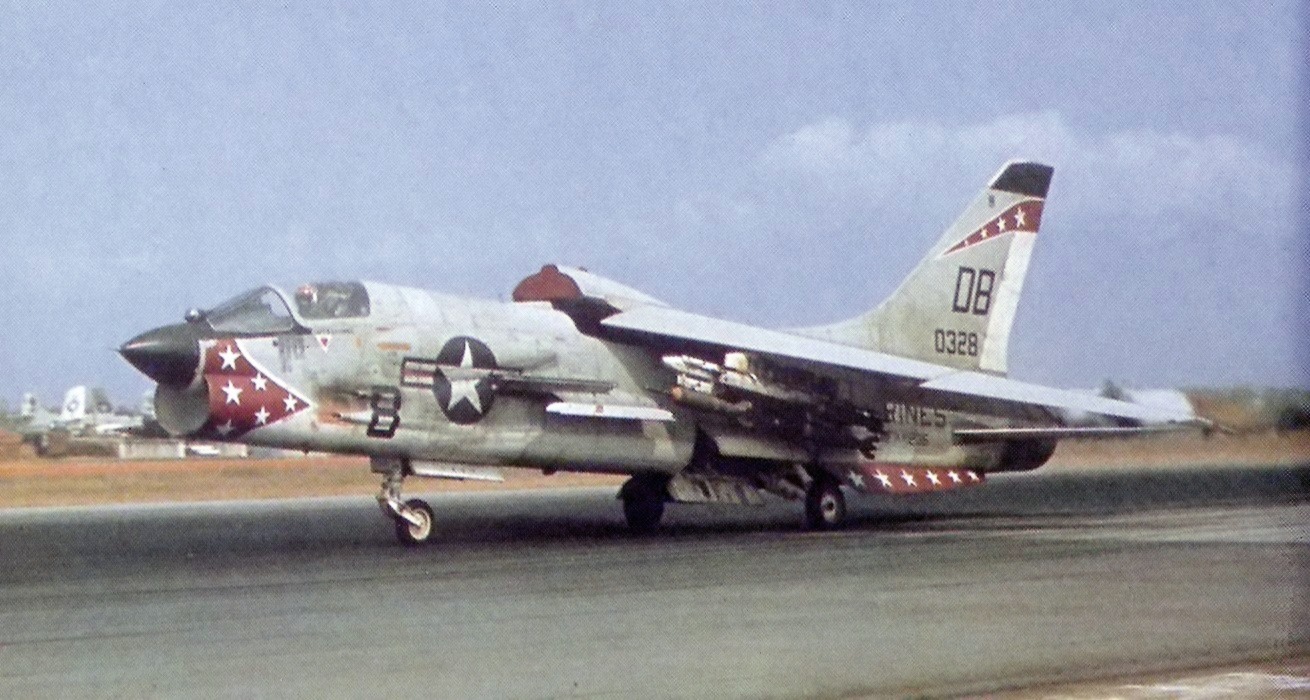
His flight training completed and wings on his chest, Phil reported to MCAS Beaufort, SC to join VMF(AW)-333, the “Fighting Shamrocks”. There he learned to fly the F-8 Crusader. It was a single-engine, supersonic, fighter for carrier and land-based operations. The F-8 was the last American fighter that had guns as the primary weapon, earning the title “The Last of the Gunfighters”. It is unique for having a variable-incidence wing, which pivoted out of the fuselage allowing for a greater angle of attack increasing lift without compromising forward visibility during takeoff and landing. (See photo of F-8 at DaNang with “Death Angels” livery.)
Phil flew with the “Shamrocks” until he got orders to DaNang AB, South Vietnam to join VMF(AW)-235 “Death Angels”. He logged 300 hours in the Crusader at Beaufort mastering his fighter pilot craft. Twice he deployed for a month each time to NAS Key West at Boca Chica Key, FL. Marine Corps fighters sat alert in response to potential Cuban hostile military activities. American Cuban relations remained fractured after the 1962 Missile Crisis. The airfield is 90 miles from Havana. Alert involved a section of two Crusaders on the “hot pad” which allowed the fighters to be airborne inside of three minutes. They flew from a runway dedicated solely to them. When military radar identified Cuban MiGs getting airborne the fighters launched and planned an intercept. Sure enough, the MiGs immediately returned to base. Phil launched between three and four times which was “exciting”. He admits, “we were young and stupid.” Maybe, but ready to engage!
Before deploying to DaNang, Phil attended the Survival, Evasion, Resistance, and Escape (SERE) School at MCAS Cherry Point, North Carolina. The school taught Marine Corps aviators and aircrew vital jungle and water survival skills for the Vietnam War.
DaNang AB, South Vietnam: 1967 – 1969
In May 1967 he boarded a military charter from Travis AFB, CA to Okinawa where he spent a few days at Camp Hansen before flying onward to DaNang. It was “hot and humid”, says Phil. Marines lived in “hootches”/tents, 10 to 12 on each side of a wooden sidewalk. Being built immediately next to each other, Phil thinks a rocket or mortar round hitting them could have wiped them out. While the Marines were quartered in tents Phil emphasizes that the Air Force flight crews slept in airconditioned trailers. During his first night on base the warning siren sounded meaning that an attack on the base was underway. He woke out of a sound sleep. He casually left the tent, looked around, and walked into the bunker, designed to protect personnel from enemy projectiles, etc. Inside he was “greeted” by a squadron mate with whom he trained in the “Shamrocks”. He was informed in a very colorful way that he was supposed to run, not walk, to the bunker when a siren went off. Lesson learned.
Phil’s new squadron had deployed to DaNang the year before. Twenty-four Crusaders constituted the “Death Angels” compliment of fighters. The squadron is famous for their iconic, red-nosed aircraft. Approximately 18 Crusaders were on the flight schedule every day. The F-8’s weapons included four 20 mm internal cannons loaded with 100 rounds apiece. It would carry a variety of air-to-ground weapons such as 250- and 500-pound bombs and rockets. The weapons load varied with mission requirements although the guns were always loaded. During the monsoon season instrument departures were mandatory. The weather was “clear and million” on top once the fighters left the clouds below them.
He flew the requisite Familiarization Flights which made him aware of the squadron’s general area of operation. The squadron theater of operation encompassed I Corps, the area from the DMZ to just south of Chu Lia. Phil says a typical in-country fighter sortie length was between 0.7 and 0.8 hours. Since Operation Rolling Thunder was still in effect in 1967, Phil and his mates participated in bombing sorties into North Vietnam. These sorties flown with four fighters and involved targets in all of the Route Packages including Packs 5 and 6. The latter included targets near Hanoi and Haiphong. According to Phil, “They were some exciting trips”. Rolling Thunder came to a halt effective November 1, 1968.
The Marines employed a “hot pad” at DaNang just as he experienced at Boca Chica. Two fighters were ready in minutes to become airborne and engage enemy forces wherever they may be. Ordinarily combat sorties were based on the daily frag received a day ahead of time. The hot pad, however, allowed Marine or Army ground troops to request close air support within minutes. Forward air controllers (FACs) controlled strike sorties. Some FACs were embedded with ground troops, and many flew small aircraft like the O-1 “Birddog”. These FACs identified targets and directed the fighters to deliver ordinance with reference to smoke from white phosphorus (Willy Pete) rockets. The squadron flew in support of Marines and other Allied troops during the Battle of Khe Sahn occurring throughout the months of January to April 1968.
After 6 months in the squadron, he could have been assigned as a ground-based FAC. Instead, he ended up in Wing. The then G-2 Intel briefer said, “come on over and let’s see if we can swap”. Deal made. Phil went to wing and current briefer to the Death Angels. Phil could still fly off the hot pad. Regarding scheduling to be on the hot pad, he told Ops, “don’t let me sit there very long.” So, he did fly often.
Later in his nearly two-year tour he also flew the C-117D, aka DC-3, flare ship on night sorties to illuminate an enemy engagement area with magnesium flares. This required flying a racetrack pattern about 10-15 miles in length. The flare ship employed a system of lights in its rear where flares were “kicked out”. The lights were red, then yellow, finally green for flare dispensing. Phil flew as the pilot and a flight qualified enlisted Marine in the right seat. From time-to-time, Phil entrusted the flight controls to his “copilot” so he could go to the rear and kick out the flares himself.
DFC flight
Flying in a two-ship toward the Con Tien area and approaching Dong Ha, just south of the DMZ, he observed what was an apparent heavy engagement with Marine forces. North Vietnamese artillery was pounding the Marines from the other side of the DMZ. Flight lead requested clearance to engage the enemy. After what seemed like a long time–Phil says was maybe five minutes–the flight was cleared in. Phil and lead made multiple runs. After the first pass the enemy opened up on them with AAA. He said it resembled WW2 flak. This kind of reception was uncommon on most of his in-country combat sorties in the F-8. With all weapons expended, Phil says, “We put “em out of business.” Intel revealed a substantial number of enemy casualties from their silencing of the North Vietnamese artillery. “This was my most rewarding combat sortie!”
During his entire tour he flew about 200-300 hours per month. You can appreciate he was exposed to enemy defenses frequently. He reports he would come back with his Crusader peppered with holes from small arms rounds. On one sortie a round or two punctured a fuel tank. He lit the afterburner and returned to DaNang as quickly as feasible to avoid running out of gas before he could put his Crusader back on the deck.
Tour extension. Phil agreed to an extension of seven months the end of which coincided with his active-duty commitment. He thus earned a thirty-day leave back in Chicago. For his last months he was assigned to the Headquarters & Maintenance Squadron as Assistant Operations Officer (Ops O). After 6 weeks the Major in the Ops O position had orders to return to the States. Phil moved up to his slot.
As the Ops O, he was assigned to fly the H-34, C-117 D (aka DC-3), and the Grumman C-1 Trader. Phil got checked out in both airplanes but not the chopper. He learned to fly the DC-3 from an Instructor Pilot, a W-4 who flew in WW2. It seems that even when Phil did something right, the IP said, “You’re the dumbest pilot I ever met.” According to Phil it seemed that flying this transport required doing “everything opposite of the F-8.” He spent a lot of time in the DC-3.
The C-1, twin-engine, high-wing aircraft, could carry nine passengers. One sortie is memorable. Phil was tasked to fly the Commandant of the Marine Corps, a four-star, to Phu Bai about 110 kilometers south of DaNang. The Commandant chose to fly in the right seat next to Phil. His staff accompanied him. Phil recalls that the airplane passengers wore a total of 22 stars. Off he went to Phu Bai. Shortly after takeoff the C-1 “lost an engine”. Phil insists that the airplane flies just fine on one engine and it does. After recovery at DaNang on one engine the Commandant and staff elected to use a four-engine C-130 transport for in-country transport. Phil remembers the engine did not fail, rather engine instrument malfunctions caused the mission to abort.
As part of his Ops O duties, he and the commander flew a C-1 to Cubi Point in the Philippines to pick up F-4 parts for the Marine sister squadron every Wednesday. So, eat a decent steak dinner, get a few hours of rest, then fly back to DaNang before sundown. During his extension, Phil also flew TPQ, radar directed combat sorties. The F-8 strike flight received radar vectors to the drop point controlled by the Marines FACs. Drop altitudes were in the range of 15,000 feet MSL.
His second tour came to an end in March 1969. He had been in-country from May 1967. He was honorably discharged as a Captain at MCAS El Toro, CA on March 28, 1969. Phil logged more than 300 combat sorties and holds the following awards and decorations: Distinguished Flying Cross, Air Medal (15 Awards), National Defense Service Medal, Vietnam Campaign Medal w/device, Vietnam Service Medal w/3 stars, Presidential Unit Citation.
Back in the USA
While still in Vietnam Phil submitted applications to become a pilot for United Airlines and other carriers. Before he returned to the States, he had an interview with United on tap. A couple of months later in May he began his career with United. He flew with United for two years before being furloughed. What to do? Law school of course. He enrolled in Chicago’s Loyola Law School. He was called back to United during law school only to be furloughed again. During this period Phil joined the Marine Corps Reserve fighter squadron VMA(AW)-543 “Night Hawks” at NAS Glenview. At first, he was assigned to the Headquarters Squadron where he flew the familiar C-1 before a fighter pilot slot opened. He remembers it as a “flying club”, a relief from nearly daily combat sorties in Vietnam. Phil flew one weekend per month and several Additional Flying Training Periods (AFTPs) weekly when available. Volk Field in Wisconsin provided air-to-ground training at its bombing range. In 1975 after about four years flying the A-4 he was discharged from the Reserves.
His law school studies behind him; he sought a judicial clerkship in Chicago. In January1975 he began a clerkship with United States Northern District Court Judge Alfred Younges Kirkland, Sr. Graduating from Loyola School of Law ranked number one in his class Phil, a Vietnam War veteran, found his time in the chambers of Judge Kirkland, a WW2 veteran, fulfilling. Seeking private practice he joined the Chicago law firm of Lord, Bissell & Brook in its Aviation Litigation Department. Over the decades Phil, all the time a United pilot, practiced aviation law across the country in state and federal courts and in several foreign countries.
Flying as a United pilot exposed him to many rewarding and some treacherous situations. One of the latter occurred on a flight to Miami in November 1982 where he and his captain disarmed a hijacker without incident. He received United’s Award of Merit for this feat. Later he was named Flight Crew Member of the Year for the year 1982 for his terminating the hijacking.
Phil and Deb have two children, three grandchildren, and one great-grandchild on the way. As a retired United pilot, they together enjoy the travel benefits United provides. He and Deb are fond of ocean cruises worldwide, decamping in winter months to Hawaii and Florida (Deb’s home turf), and visiting their foreign exchange high school student and “adopted” Thai son and his family in Bangkok. A long-time Lake Forest resident Phil served 11 years as a Police and Fire Commissioner. You can see that Phil’s life is one of service.
Reflections
“I credit the Marine Corps for all of my success in life! It took a ‘screwed up kid’ from the Northwest Side of Chicago and straightened me out!”
Phil, enjoy your well-earned Honor Flight to Washington, D.C. with other veterans who share similar experiences!