
Navy Vietnam War / Cold War Park Ridge, IL Flight date: 07/29/26
By Wendy L. Ellis, Honor Flight Chicago Veteran Interview Volunteer
Most people don’t realize they are a witness to history until long after the moment has come and gone. So it was for Lt. Ed Bales, CIC officer aboard the Destroyer Escort USS Beale, during the Bay of Pigs, and, 18 months later, the Cuban missile crisis. On active duty with the US Navy from 1961-63, Bales watched events unfold in the waters off Cuba for both operations, and has distinct memories of what went right, and what went wrong.
“The one unique thing about my service,” says Bales. “It covers both of those events. We never knew how close we came to getting blown up. It was a complete debacle.”
Bales didn’t get there by chance. The Navy granted him a full scholarship to ITT in electrical engineering, which meant each summer of his college years were spent on board ship. The first summer he was on the Battleship USS Wisconsin which took him down through the Panama Canal. The second summer he was introduced to the Marines and the Navy Pilot program. The third year he was aboard a destroyer searching for submarines near San Diego.
While being a Navy Pilot or serving on a nuclear sub appealed to him, it did not appeal to his future wife, Barbara. “Even then I listened to her,” says Bales. In the end he asked for surface vessels and was assigned to the USS Beale, part of the Navy’s Task Group Alpha. Established in 1959, the task group was designed to develop submarine warfare tactics in the Atlantic Ocean. It could not have been a more timely assignment.
In April of 1961, the USS Beale found itself headed to Cuba as part of the invasion force at the Bay of Pigs. The Beale, #471, and the USS Bache, #470, were the only two destroyer escorts assigned to escort a CIA owned merchant ship, the Sam Houston, to the Caribbean. Along the way Bales said they saw crewmen hanging over the sides of the ships painting out the number four so they could not be identified as US vessels.
“We didn’t know all the background,” says Bales. “We were just escorting this ship, filled with revolutionaries. We could look through our binoculars and see these revolutionaries in military garb just crammed onto the Sam Houston.” It was intended to be an invasion of Cuba, planned during the Eisenhower administration, but run by the CIA instead of the Marines. JFK had been sworn in only months before. As hindsight now tells us, Castro knew we were coming. In fact, Bales says, the Bay of Pigs was one of Castro’s favorite fishing spots.
“One dumb thing was they were doing this at night,” says Bales. But the Sam Houston wasn’t a landing craft, so the revolutionaries had to be taken to shore in boats with outboard motors, then jump out into the water with all their gear.
“The assumption was the Cuban population would rise up and join us,” says Bales. But that didn’t happen. ““I was the electronics officer and I had headphones on and I could hear the pilots from the carrier describing Castro’s army with tanks slaughtering the guys on the beach. It was communications between the pilots and the aircraft carrier. They’d say “these tanks are coming, we can stop them,” but Washington never gave them the go ahead to bomb. We need permission to fire, and they‘d say you cannot fire. They were killing the revolutionaries we saw on the ship.”
“The other dumb thing was they put all the supplies, the food and ammunition, on the Sam Houston,” says Bales. “And it sank. There was no backup at all.” In the end, thousands of revolutionaries were killed or captured, and Cuba remained under Castro’s control.
“I do believe because of this experience, Kennedy handled the Cuban Missile crisis totally differently,” says Bales. ”He was much stronger. Much better planned.”
Among his duties on the Beale, Bales served as the top-secret cryptographer officer. Any time a coded message came in, day or night, Bales was the one who had to decode it and take it to the captain. The message would come in on a coding machine as a bunch of random letters on a tape. “I would have to put it into the code machine that had a code wheel on it,” says Bales.
“Each day we would turn the wheel to find the day’s code word and then we would have to type in whatever was on the tape. Then it would be decoded and we’d get a print out. Well I can’t type. You make one mistake and it would come out all garbled. I’d have to go back and figure out where I started.” After berating himself for not taking typing in high school, Bales went to the ship’s office and asked if they had a book on how to type. “So I’d go up in the ships office where they had a typewriter, and I’d sit there during the day and teach myself typing.”
And that’s what he was doing in October of 1962, just a few days out of Norfolk and home, when the Beale received a coded message that said “Turn around and go back out. Further instructions to follow.” Those instructions took them back to Cuba and into the Cuban Missile Crisis.
For Bales and the USS Beale, it was a chance to do what they were designed to do, hunt for enemy submarines. “We had many more ships down there,” says Bales.” We had squadrons stopping ships. It was much better planned.” In fact, a ship from another squadron picked up sound from a Russian Sub. The Beale positioned itself above the sub and began dropping practice depth charges, tracking it as it moved. The idea was to drive the sub out of Cuban waters and send it home.
“The old Russian subs had no air conditioning, which wasn’t a problem if you were in 50 degree waters,” says Bales. “But the Caribbean is much warmer and it could get to well over 100 degrees inside those subs. That’s what really brought them up. The heat made them sick. We could see them crawling out of the hatch onto the deck.” The B57 sub was one of four Russian subs in Cuban waters at that time, but the only one to surface. The Beale escorted the sub away from Cuba and out to the Atlantic, effectively sending it home.
But that’s not the end of the story. What Americans did not know at the time was that the Russian subs were armed with Nuclear torpedoes. As things heated up in the sub, it is believed the captain ordered all torpedos armed and ready for combat. But a second officer refused to reveal his arming code, preventing what might very well have become World War III. That version of the story came from a book later published by the second officer’s wife.
“We were worried about the nuclear missiles on land,” says Bales. “We had no idea the subs below were nuclear armed as well. We never realized how close we came to getting blown up.”
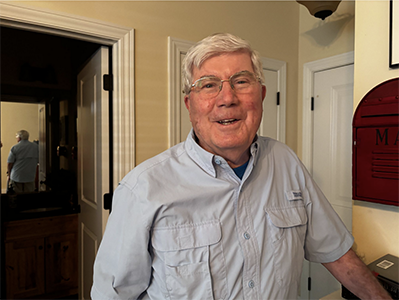
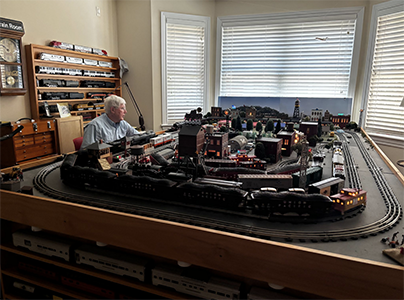
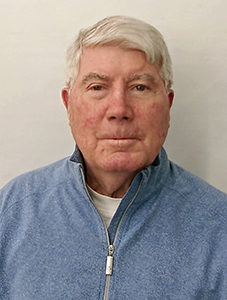
Less than a year later, in August of 1963, Bales left active duty and signed on with the Naval reserve until 1970. He spent 47 years working for Motorola in engineering, sales and marketing. He and Barbara were married for 61 years before she passed away in 2017. They raised their family in Park Ridge, where he has spent years perfecting his HO model train layout.
The years of the Cold War may have seemed slow to some, but not for Ed Bales. He still credits Barbara with helping him make the right choices all those years ago. “After Barbara’s considered opinion, I requested surface ships, aircraft carriers, cruisers, destroyers. I really liked Destroyers. They’re fast and it just seemed like a much more active service.” And being a witness to history isn’t too bad either.