
Air Force Vietnam War Indian Head Park, IL Flight date: 06/23/26
By Ginny Williamson, Honor Flight Chicago Veteran Interview Volunteer
Ernie Neely and his family lived in the Englewood area of Chicago. His dad was a Chicago policeman. In 1955, when Ernie was in the third grade, the family moved to the southwest side of Chicago. He graduated from Bogan High School in 1964, then worked at a savings and loan for $1.50 per hour. He thought, ‘I can’t buy a car or get an apartment on that little money.’
This was before the military lottery: if you didn’t go to college, you were drafted. Ernie was already registered (at 16). The only way to beat the deferment was to get married and have a child, but that wasn’t what he was ready to do. Ernie and Ginny, who is his current wife, met in high school and church. They were going steady when Ernie decided to join the Air Force, and they realized they had to break up.
At 18, he could enlist without his parents’ permission. Ernie selected the Air Force because, ‘fewer AF guys were sent to Vietnam.’ He went to his induction ceremony in downtown Chicago, and the military took him to O’Hare for his flight to San Antonio – ironically, this was Ernie’s first time on a plane. They arrived at Lackland AFB, which is where all Air Force recruits go through Basic Training. That was April 6, 1964.
At Lackland, he did his basic training and crypto maintenance training. Crypto work involved typing classified documents, sending those out in an encrypted format, and the receiving machine would decipher the message. However, Ernie did voice ciphony, which was spoken, not typed. Every 24 hours the codes were changed for the voice ciphony. Ernie talked to numerous voice ciphony machines at major Air Force bases, at the same time each day, to verify the code changes were correct.
While Ernie was in basic training, the FBI was in his home neighborhood, talking with people there. The FBI asked, ‘What do you know about him?’ This was part of the procedure for Ernie’s top-secret clearance. He did not know about this until several years after his Air Force discharge. For his clearance, Ernie was told, ‘Anyone who talked in their sleep was out.’ You never knew what they might share!
Once he had to interrupt the company commander who was sleeping in the same room where Ernie needed to change the codes. He got push- back from the commander, but Ernie told him he needed to exit the room because, “Sir, you don’t have Top-Secret/Crypto clearance.” Of course, that didn’t go over well with the commander, but he left the room – reluctantly.
Upon graduating from Crypto School and being promoted to E3, Ernie was assigned to McClellan AFB, California. He went to Sacramento, which was a Military Air Transport (MAT) base. He met someone there and they married. He had one and half years left of the four-year term. He thought, ‘it was safe to get married’. However, he needed permission from the company commander to get married. He got permission, and several months later he was sent to Vietnam!
The Air Force flew on commercial jets out of Travis AFB to Hawaii, then to Midway Island, Wake Island, the Philippines to refuel, and finally on to Saigon. As they approached Saigon, the pilot announced, “There is ground fire at the airport. We’ll be fine.” The civilian pilot put the jet into a steep dive and pulled it out just in time for a smooth landing!
He arrived in Binh Thuy AFB on November 14, 1966. Binh Thuy is in southern Vietnam in the Mekong Delta by Can Tho. The USAF went in after France left Vietnam completely, so there were a lot of structures already in place, left behind by the French.
When Ernie arrived in Binh Thuy, he was issued an M16 and a steal-box of ammo. His commander told him, “When the air-raid sirens are sounded, and you want to live, go to this point in the fence and defend it until death!” Being Air Force, Ernie thought it was the Army or the Marines’ duty to defend. However, he learned, it would be 20 to 30 minutes before the Army could come in. Ernie was also trained and qualified on the M-60 machine gun. That lasted about two months and, oh by the way, there was no crypto in Binh Thuy for Ernie to work on.
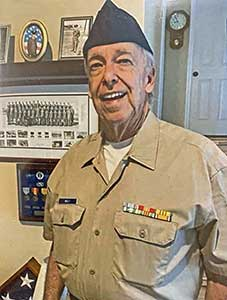
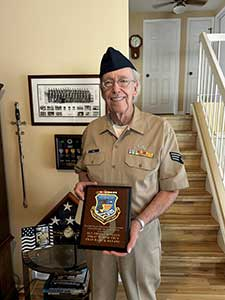
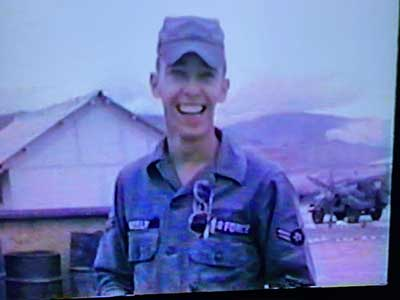
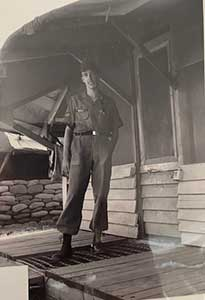
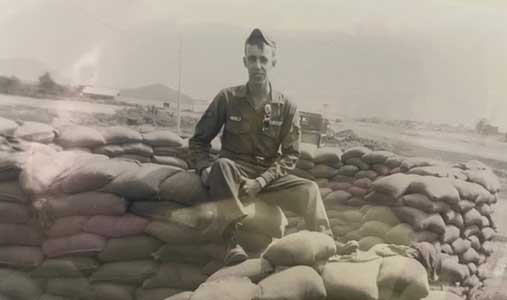
On January 8, 1967, Ernie was transferred to Phan Rang AFB – in the middle of the country, near the South China Sea and Cam Ranh Bay. The Army and Marines were also there. The F-100s were stationed there as well. Ernie and his guys lived in hooches. They had locals, Mamasans, who came to clean their boots, make their beds and do their laundry for $5 per week.
They had an airmen’s club and outdoor theatre there. It didn’t matter if it was monsoon season … Ernie and the guys put on their ponchos and headed over to the club. They worked eight to ten hours a day. ‘What else would we do?’ There were also a lot of card games going on.
On the base, the latrines were outside, and you had to wait for an opening for your turn. “We always had toilet paper though, since they made sure that was ordered!”
There were power lines on base, built by the Air Force for communications and power. The hooches and buildings and runways were also built by the Air Force. We ate using the old mess kits and took cold showers. Others squadrons had warm showers, so Ernie remembers sneaking into those areas for a warm shower.
Oh by the way, there was no crypto in Phan Rang either for Ernie to work on. So, any communication technology that needed repair, Ernie would dispatch the correct technician to handle the problem. At times, he would go up to the control tower and learned they used a large-light to send morse code to the pilots, in case the radios went out. The pilots were familiar with some basic morse code so that they could understand what was being sent to them.
Ernie was promoted to Buck Sergeant (E4) on February 6, 1967 when he was in Phan Rang. He saw his name in the Stars & Stripes Newspaper, and went to the First Sergeant who didn’t know anything about the promotion. A week later, the First Sergeant confirmed he was promoted and told Ernie, “If you can find stripes, put them on.” He was 21 years old, and could now vote and legally drink.
In Phan Rang, the North Vietnamese would conquer a small village and would take the men to serve with them, abuse the women, and the babies were used as weapons/bombs. As Ernie said, “Those protestors don’t get this. This is what the US military was fighting against.”
There were a lot of orphans in these areas as well. There were two Christian organizations – Catholic and Protestant – that were there to help and care for the orphans. Ernie connected with one of the groups to help out. These Christian organizations hosted the kids for the day and Ernie helped give them presents that were sent from the states, like dolls and trucks.
Ernie recalled his interaction with the kids as being so special. The girls would clutch the baby dolls so tightly. And for the boys, when they received their trucks, they clutched those as well as if they were baby dolls. Ernie had to show the little boys how to play with the trucks. These were probably the first toys these children ever had. It was a heartbreaking interaction.
The children returned to their orphanages after their visit with Ernie and his guys. This short interaction left a powerful and emotional memory with Ernie. And he knows this was another purpose of him being in Vietnam.
After two months in Phan Rang, Ernie was transferred to DaNang AFB – this was the biggest base near the DMZ. The Army was around the Air Force Base, and the Marines were around the Army, so Ernie and his guys were covered. A new chow hall was under construction, and Ernie’s barracks was next to the new construction.
During his eight months in DaNang, they were attacked by rockets and mortars 12 times. Prior to one of these attacks, Hanoi Hannah broadcast a warning, “You airman at DaNang will never use your new chow hall.”
The night of July 15, 1967, there was a major attack on the base which caused a lot of damage and loss of lives. Ernie came within 100 feet of dying during that attack when a rocket destroyed the new chow hall.
Word came down that DaNang was finally getting voice ciphony. Erine opened up the shipment and made it operational. He managed all the crypto work, so that kept him busy.
While Ernie was in DaNang, the Chaplain was looking for a choir director. Ernie was a student director in high school and directed a junior choir at church. So, he was hired to direct the DaNang Chapel Choir. Every Sunday evening, a special service was held; at the end of every service, all who came would get together and hold hands and sing, “God be with You ‘til We Meet Again.” There were never the same guys at next week’s service because some rotated back to the states, some were new at the base, some were in the hospital, and some were killed.
During the time Ernie was the choir director, a contest was organized to determine who had the best choir. His choir recorded three songs and sent them in for judging. ‘My all-male choir took first place in all of Southeast Asia!’
The piano player’s brother, back in the States, was writing Christian music. He sent several songs to Ernie which were taught to the choir. The Christian service, Ernie said, made his stay at DaNang worthwhile.
At the end of Ernie’s 12 months in Vietnam, he was to go back to Lackland AFB. Typically, the day before they were scheduled to depart, they would put the guys in the TDY (transient quarters). The closer the guys got to their leave date, the more anxious they were to go. For Ernie, there was an attack a week before he was to leave. There were six airmen killed who were in the TDY barracks. So, the TDY barracks remained closed when Ernie should have been transferred there.
The day Ernie and his guys were leaving DaNang, they were to fly with Flying Tiger Airlines. They boarded the plane. The engines shut off; they had a flat tire. Another delay for several hours.
When finally airborne, they landed in Japan to refuel and then headed to Edwards AFB, east of Los Angeles. They were told, as soon as they landed, to get into their civilian clothes. There were not many people in the airport, so they didn’t encounter too much backlash.
In Sacramento, they offered Ernie a $5,000 bonus to re-enlist and another stripe. At that time, he made about $325 per month. He decided not to re-enlist nor take the bonus because, Ernie said, “They did not treat me very well. They refused to give me a 90-day early out.”
His dad, who was then working for the Cook County Sheriff’s Police Department, asked the Sheriff to write an early-out request to the company commander. He said if he gave Ernie an early release, he could start working at the Sheriff’s Department. At the time, 80% of all new law enforcement officers were veterans. The commander agreed, and Ernie got his early out, an honorable discharge, on January 26, 1968, as an E4 Sergeant. He joined the Cook County Sheriff’s Police Department in February.
In 1968, there was a lot of turmoil in the US and Chicago … the Democratic Convention (where Ernie was part of the team driving the paddy wagons), and then four months earlier the assassination of Martin Luther King. There was a lot of criminal activity on the west side of
Chicago where Ernie was assigned.
Ernie was inactive reserve with the Air Force from January 27, 1968 until April 5, 1970. He retired from the Cook County Sheriff’s Police in December 31, 2005, as a Sergeant. His responsibilities with the department included Patrol Supervisor, Homicide Detective, Director of Records and Computerization of the Cook County Warrant Files.
After Ernie returned to the States, he attended a family function in Valparaiso, Indiana, where he met a young South Vietnamese family who had escaped Vietnam. The father was a young helicopter pilot and a Captain in the Republic of Vietnam Air Force. The US was evacuating South Vietnam officers and their families; however, only field-grade officers. The final day of liftoff, this young pilot planned to take his family out of Vietnam. He put on his uniform, and took his wife and kids to the liftoff location. The South Vietnamese Security told him he was not allowed on the liftoff; however, this young pilot threatened to shoot him if he didn’t allow him and his family to fly out. The young pilot took a helicopter and flew his family out of the area. The pilot found a US Navy aircraft carrier and landed on it.
After Ernie returned to the States in 1968, he and his first wife had three sons. Sadly, Ernie lost two of his sons in the same year, 2022.
In 2002, Ernie and his current wife, Ginny (whom he dated in high school) met again at a birthday party. They were both single again at that time. They dated for two years and were married on April 6, 2004 – the same day, 40 years later, when Ernie left Chicago and arrived in Lackland AFB after his induction ceremony.
Ginny has one son, one daughter, and 2 grandsons. Ernie has one living son, seven grandchildren and two great-grandchildren. Micah Neely, Ernie’s surviving son, will be his guardian on this Honor Flight. He knows that Micah will learn more about his dad’s service and experiences during his enlistment and time in Vietnam.
Ernie is looking forward to sharing more with Micah and those he will meet on the Honor Flight. And it will help with his continuing healing process, as well.
Ernie received the follow awards/medals: National Defense Service Medal, Vietnam Service Medal, Vietnam Campaign Medal, RVN Defense Commemorative Ribbon, Good Conduct Metal, and an Honorable Discharge Ribbon.
Ernie and his wife attend the Phan Rang (“Happy Valley”) reunion – for all branches of the military. They attended, most recently, the reunion in Ohio. He is an active member of the VFW #2801 in Villa Park, Illinois. Fun fact: This is the only VFW that has a shooting range.
Welcome aboard, Ernie. Enjoy your day of honor. And thank you so very much for your years of service.