
Army Vietnam War Naperville, IL Flight date: 10/28/26
By Charlie Souhrada, Honor Flight Chicago Veteran Interview Volunteer
After graduating from Morton West High School in 1968, Bob Kelly saw only a few paths ahead: get into trouble, find a job, or join the military. He chose to enlist, but there was one obstacle: he was just 17 years old.
Bob was born on August 22, 1950, in Chicago, but grew up in nearby Berwyn where he was raised by his father, John, an accountant, and his mother, Marian, a devoted homemaker.
As the third of six children, Bob understood early on that his family’s resources were stretched thin. If he wanted something, he would have to earn it himself. “There weren’t many opportunities to make money,” he recalls.
To bring in cash, Bob delivered newspapers, mowed lawns, and collected empty soda bottles to redeem for their deposits. At 15, he got a work permit and landed a job at a McDonald’s down the street. “I felt like a rich man with the money I was making there,” he says. “But ours was a tough neighborhood and we knew money was tight. We were all a strain on the family’s finances. I think that was one of the reasons my older brother enlisted in the Army, and I know it was a factor for me, too.”
For Bob, deciding to enlist was the easy part. The hard part was convincing his parents.
In 1968, 17-year-olds could join the Army only with written parental consent. When Bob approached his parents, they wanted no part of the plan and absolutely refused. But he didn’t take no for an answer.
He laid out his case, arguing that he would soon turn 18 and would no longer need their permission, that he would likely be drafted anyway, and that enlisting would give him more control over his military service.
“I basically gave them the recruiter’s pitch, and they fell for it. They reluctantly signed the paper, and I was on my way.”
Armed with his parent’s permission and his older brother’s advice, “Don’t give any lip, don’t try to be a hero, and don’t volunteer for anything,” Bob entered the Army in August 1968 and began basic training at Fort Leonard Wood, Missouri.
“I was just barely 18, on the small side, skinny, wore glasses, but I was fast, willing to try things and pretty streetwise,” he recalls. “It paid off. Some guys did a lot of extra pushups, but I knew how to keep myself out of trouble.”
Even so, Bob remembers one occasion when his platoon sergeant managed to outsmart the entire unit shortly before they graduated from boot camp.
“Our platoon sergeant was a huge St. Louis Cardinals fan, and they were playing in the World Series that year,” Bob says. “He stood in front of the barracks and said, ‘I’m looking for some people to go to a baseball game, but I can’t tell you who’s playing because I don’t want to give it away.’”
The sergeant found his volunteers. Instead of attending a World Series game, however, they spent one of Missouri’s hottest days standing in dress uniforms and providing crowd control for a donkey softball game on post for military families. “He pulled the wool over our eyes big time,” Bob says with a laugh.
The experience was not what Bob expected, but it reinforced his older brother’s advice about volunteering. “I didn’t want to tell him at first, but he was right,” Bob says. “From then on, his words came through loud and clear.”
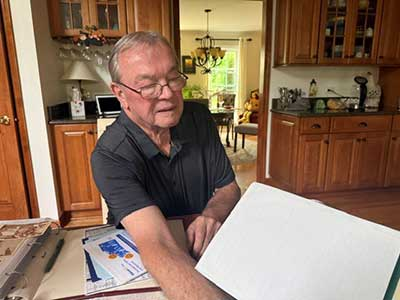
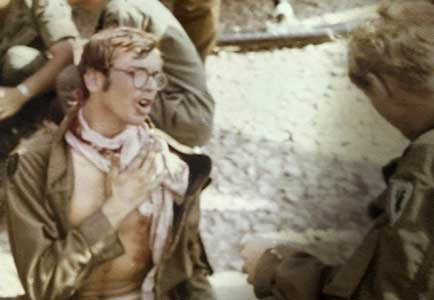
After completing basic training, Bob received orders to report to “L.A.,” or “Lower Alabama,” for Advanced Individual Training (AIT), at Fort Rucker, Alabama. There, he was assigned military occupational specialty (MOS) 67M20 and trained as a helicopter crew chief and mechanic for light observation helicopters, including the Bell OH-13 Sioux, and the Hiller OH-23 Raven.
“My MOS designation, 67M20, was the basic level of field maintenance,” Bob explains. “You identify the problem and, if it’s something you can fix, you fix it. If not, you hand it off to one of the higher-level mechanics.”
In January 1969, Bob arrived in Vietnam where he was assigned to the 108th Artillery Group near Dong Ha, just south of the Demilitarized Zone (DMZ). There, he joined a newly formed aviation unit created to provide critical air support and reconnaissance for artillery fire bases operating in the region.
“Before we got there, the artillery units didn’t have an aviation section of their own,” Bob says. “They had to rely on the 101st Airborne Division out of Phu Bai, which was probably an hour and a half or two hours south of us. If they needed support, it would take time to get it.”
Bob’s unit arrived to find little infrastructure in place and two Korean War vintage helicopters parked in mud. “They had nothing there,” he recalls. “We had to build everything: revetments, landing pads, maintenance sheds, everything.”
The work was demanding, but establishing the aviation unit gave artillery commanders quicker access to the aerial support they needed and helped close a critical operational gap near the DMZ.
After completing one year in Vietnam, Bob returned to the United States in February 1970, and was assigned to Fort Riley, Kansas. The transition proved difficult. There were no helicopters at Fort Riley, only tanks, and Bob felt out of place. When he wasn’t serving on a color guard, or escorting prisoners, he passed the time shining his boots and polishing brass just to keep busy.
Determined to return to aviation duty, Bob submitted six separate requests for reassignment to Vietnam. Each was ignored. Finally, with help from a senior enlisted soldier he had met in Vietnam, Command Sergeant Major James Smothers, Bob’s request was approved. In June 1970, he returned to Vietnam for a second tour of duty.
This time, he was assigned to the 175th Assault Helicopter Company (AHC), known as the “Outlaws,” operating throughout the Mekong Delta region of South Vietnam. Flying aboard Bell UH-1 Iroquois, better known as “Huey” helicopters, he served as both crew chief and door gunner on combat assault missions. The work was demanding, dangerous, and relentless. His unit conducted troop insertions and extractions, medical evacuations, escort missions, and emergency response operations across southern Vietnam.
“I started out as a rotating crew chief or gunner on slicks, which were used for troop transport, if somebody was on R&R,” he says. “There was never any down time.”
Bob’s skill and experience eventually earned him an invitation to join the company’s elite gunship platoon, the “Mavericks.” Known throughout the Delta for answering some of the region’s most dangerous calls, the Mavericks provided close air support to troops engaged with enemy forces on the ground.
One mission sticks with him. After a transport helicopter went down near a rice paddy, Bob and his crew were sent to help. Needing somebody on the ground, Bob was selected for the job.
“I’m standing on a skid, unplug my headset, and as I get ready to jump, a gust of wind rocked the helicopter and I went down into the paddy like a knife through butter,” he says. “I lost my .38, my glasses, my flight helmet was covered in gray, slimy mud. It took all I could to get back up and get above the water. Now I’m the rescuer who needed to be rescued!”
The mishap created another problem. Bob did not have a spare pair of prescription glasses and could not travel to Saigon for a replacement. Instead, he wrote to his parents who located a copy of his childhood prescription and mailed him a new pair several weeks later.
On April 1, 1971, during a combat assault mission, enemy fire struck Bob’s helicopter. A bullet tore through his shoulder and exited through his back, leaving him seriously wounded and ending his flight status. For wounds received in combat, Bob was awarded the Purple Heart. He also earned multiple Air Medals and numerous other commendations in recognition of the hundreds of combat flight hours he accumulated during his service.
“My first tour was in the mountainous region; my second was in jungle,” he says. “It was like two different wars.”
Bob was honorably discharged in June 1971 and returned home to Berwyn.
“My parents didn’t know when I was coming home so I caught them off guard,” he says. “My youngest brother, who was 8 years old at the time, was out in front of the house when he saw me walking the down the street carrying my bags and an enemy rifle I’d kept as a souvenir. He took one look at me, ran inside, and told my mom, ‘Bobby’s home!’ And that was it.”
Like many veterans, Bob found the adjustment to civilian life challenging.
“It was a strange feeling,” he recalls. “All of a sudden you’re back in the world and you can take a shower, eat normal food, use a refrigerator, all those conveniences you take for granted.”
He enrolled at Morton College in Cicero and pursued general studies but quickly realized that path wasn’t for him. Instead, he entered a carpentry apprenticeship and built a successful career in construction. Over the years, he advanced from carpenter to superintendent and project manager before ultimately joining an owner services group (OSG), where he served as an owner’s representative overseeing major construction projects.
In 1976, Bob married Dale Senese, whom he met while working on a construction project in Westchester, Illinois. Together they built a family, raising four children and later enjoying the company of nine grandchildren. Education has become a central family value and today, Bob proudly points to his children’s accomplishments in fields including education, counseling, and business leadership.
Retirement in 2012 did little to slow him down. Today, whether tackling ambitious home improvement projects, helping his children and grandchildren, or maintaining connections with fellow veterans, Bob remains as active as ever.
Two tours. One war. One remarkably resilient man.
Thank you for your service, Bob! We hope you enjoy your Honor Flight experience!