

Army Vietnam War Skokie, IL Flight date: 09/17/25
By Wendy L. Ellis, Honor Flight Chicago Veteran Interview Volunteer
In the Civil War they called it “Soldier’s Heart” then shell shock, battle fatigue, Vietnam syndrome. With each new war came a new name. It wasn’t until 1980 that PTSD became the official diagnosis for a traumatic condition that has haunted soldiers since war began. Even a decade before Post Traumatic Stress Syndrome got its official name, PFC Arnie Oskin was immersed in evaluating and helping traumatized soldiers coming home from Vietnam.
While earning his first Master’s degree in social work at St. Louis University, Oskin enlisted with the 21st U. S. Army Reserve General Hospital. He was assigned to duties at two VA Hospitals with additional training at Malcom Bliss Mental Health Center. “I was dealing with battle trauma patients at these hospitals,” says Oskin. “I was basically studying in the field.” After completing his Masters in 1969 he was sent to combat Field Training at Fort Sam Houston, finishing as a neuropsychiatric specialist. Instead of heading to Vietnam with the others, his specialty kept him in the states. He was assigned to William Beaumont Hospital at Fort Bliss in El Paso, Texas, working on rehab medicine and triage duty.
Working 12-hour shifts, Oskin and a nurse would greet the C-130s bringing wounded soldiers home from Vietnam in the early morning hours. “First off the planes would be on litters, next would be the ones in wheel chairs, and then the walking wounded,” says Oskin. “We had three tiers of patients. We would talk to the flight nurse on board, look at their charts and determine where each patient needed to go, depending on where the openings were at the hospital—a primary medical ward or a primary mental health ward. There were some that were medical and rehab. Guys that lost their limbs, half their face, guys with severe burns. These were the guys that were being offloaded.” Each plane brought in between 100 and 120 patients, and Oskin said they worked until they were done. There were only three PFCs doing triage at that point because the Army was sending most infantry and combat medics to Vietnam, so stateside they were short of qualified personnel.
“The first time I went out I was as nervous as I could be. The patients were basically stabilized, but they needed significant surgeries, significant trauma response, and significant mental health response.” Oskin also had malingerer duty, which meant evaluating soldiers who weren’t doing well in basic training. “Some of these guys were bed wetters, some had nightmares, some claimed conscientious objector, and my job was to screen them and recommend a final interview with a psychologist.”
Oskin said clearing some of these soldiers was a tough decision because he knew he was sending them into combat. “You want to have someone to be your combat buddy, who you can rely on. If you’re not going to have someone you can rely on, you might not want them to be along-side you in combat. I would have to screen and do mental health testing, assess their true-false scales. Some might be just telling a story and not be so truthful and we would have to determine who was telling the truth within what they were capable of saying.”
Even harder to deal with were the patients who came home so disfigured that their families didn’t want anything to do with them, something often shared in a letter. “These were very difficult letters to read, and to compose. It was trying times for them,” says Oskin.” I know I was not in their position but it was very hard for me to see them through. I would do my best to pick out music to help them through the night, or I’d read them to sleep.” Oskin admits absorbing all the pain these men went through was hard on him at times. There were some very bad nights for him as well.
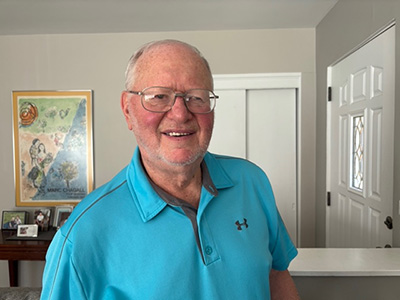
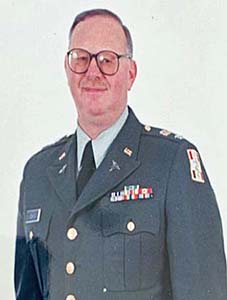
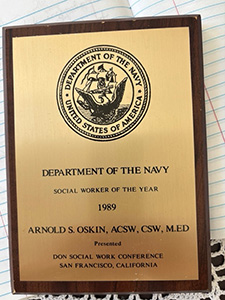
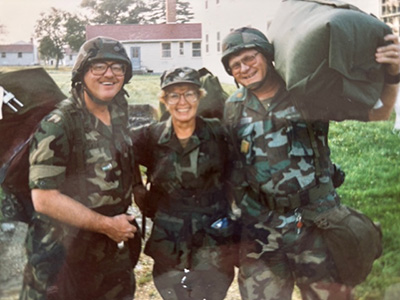
Oskin’s first stint with active duty ended in October of 1970, but he remained in the Army Reserves working as a neuropsych medical corpman until receiving his commission as a 1st Lieutenant in 1972. Meanwhile his personal life had taken him to Indiana, where he became a clinical supervisor at the LaPorte County Mental Health Center. At the same time, his reserve duty was at the 395th Medical Evacuation Hospital out of Gary. “So I had day treatment patients and night-time patients,” says Oskin. “Men and women suffering from severe depression, PTSD, schizophrenia. Day treatment were mostly civilians and I was providing direct treatment working with psychologists, and social workers that I supervised.” As for his reserve job, he was training medics and nurses being sent into combat zones to evaluate and put wounded onto planes to return home for treatment. Oskin says he used some of the cases he triaged off the planes at Fort Bliss to create scenarios for those he was training to go into combat as medics, who had trauma of their own to deal with.
“I had a patient who was a medic,” says Oskin. “He was bringing people out of buildings in the field, people with open chest wounds, trying to save their lives and he couldn’t save them. They died in his arms. He was so traumatized that he started stealing pharmaceuticals to treat himself.” The medic was given a dishonorable discharge and sent to prison, stripped of his uniforms and possessions. Oskin spearheaded an effort to get that dishonorable discharge reversed, get the medic reevaluated and rehabilitated. “He had needed help in the field and he wasn’t getting it,” says Oskin. “He was a disabled veteran himself.”
Oskin’s next stop was the North Chicago VA hospital at Great Lakes, where he worked on triage and mental health acute psychiatry for the next 8 years. During that time he was also completing his second Master’s Degree, in Psychology, at Loyola of Chicago. In 1982 he was hired by Great Lakes Navy Base as Deputy Director of the Fleet and Family Support Center. He and his team of 55 social workers, psychologists, nurses, chaplains and other personnel handled everything from domestic violence cases to suicide prevention. “I would review police blotters every morning with the chief of police of any domestic violence cases that were coming through and we would take charge of their case, whether child abuse, spouse abuse, sex abuse, assault. Whatever it was we’d evaluate and get them into a treatment program.”
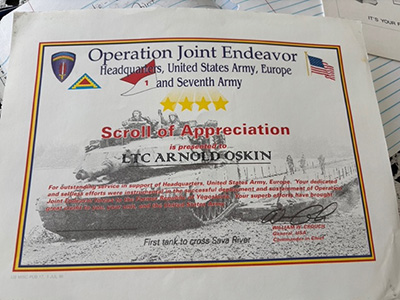
Oskin did go back into active military service briefly in 1996, as part of Operation Joint Endeavor. NATO forces, including Americans, were being sent into Kosovo and Yugoslavia to stop mass killings. Because Oskin had developed a treatment program for families suffering domestic violence, he was sent to Germany to coordinate support for families of soldiers being sent into combat zones, and for the soldiers themselves. Oskin had been promoted to Lt. Colonel in 1988, and became acting chief of Social Work at Wurtzberg Military hospital. Long before Zoom and FaceTime, Oskin was using satellites to treat troops in the field. He received a commendation for the treatment program for domestic violence, and developing a parent university for the families of those left behind. “I helped people share how to cope, how to mentor, how to run a boy scout or girl scout troop, sharing skills like crocheting and knitting with children whose parents had gone into the field.” He even started the first certified babysitting training for teenagers, which proved a huge boost to the command.
All in all, Oskin’s 35-year civilian career and his 31-plus years in the military intertwined so much that it’s impossible to count how many lives he touched, and how many touched him. Married in 1974 to his wife Faye, Oskin admits she carried much of the burden of raising their two children over the years. There were many late-night calls for help he was compelled to answer. Finally, from 2008 to 2012 Oskin worked as a case manager just with men and women coming back from Afghanistan and Iraq, who had suffered trauma. When he turned 67 he retired, but he never regrets choosing the career he did, despite the emotional commitment it took.
Oskin says the most important thing he offered these veterans was the knowledge that they weren’t alone. “An understanding of having been there before them. I wasn’t a civilian who didn’t know about many of the situations they were encountering,” says Oskin. As for Honor flight, he was reluctant to sign up. “I wasn’t actually in the field of combat myself, although I felt like I was. I didn’t think my service was honor eligible.” Sharing the burden of trauma with thousands of Veterans, from Vietnam to Afghanistan, is well worthy of honor. Thank you Arnie Oskin for your service.