
Navy Vietnam War Schaumburg, IL Flight date: 04/15/26
By David Adams, Honor Flight Chicago Veteran Interview Volunteer
Benjamin G. “Ben” Baldwin, Jr. was born in Syracuse, NY, in 1936. His dad worked in the insurance business. The family moved to the Chicago area a couple of years later. His siblings include a sister and a brother who served in Navy enlisted ranks. Like most Americans he remembers the announcement of the attack on Pearl Harbor. Sunday afternoon, December 7, 1941, found him lying on the living room floor in front of the radio listening to “The Shadow”, a vigilante crime fighter. News of the attack interrupted the program; he was somewhat annoyed. At just 5 and a half, “I was a little young for it to sink in!”
He graduated from Oak Park River Forest High School in June 1954. During his senior year his mother encouraged him to take the test for an NROTC college scholarship. Although admitting to being only a fair student, he passed the exam and enrolled in the University of Rochester in New York. The Navy officer program required the cadets to go on “mini cruises” after each of the first three years of university. Ben’s cruises included the destroyer USS Abbot (DD-629). On the Abbot he sailed to Rio de Janeiro. When the destroyer crossed the Equator he and many more underwent the traditional “Pollywog” initiation to become Shellbacks. Another “cruise” provided Marine Corps training on how to assault a beach. A third cruise was on the battleship USS New Jersey (BB-62). His duty station was in the engine room just below one of the 15-inch gun batteries. NROTC cruise program assessment: “It was great training. I enjoyed them.” He fit solidly into the Navy. Upon graduation in 1958 and commissioned as a Navy Ensign, Ben qualified for flight training. While ordinarily these events can be life changing, his meeting and marrying Maureen (“Moe”), a fellow student, outranked them all!
Flight training
He began Navy flight training at Pensacola Naval Air Station, FL. First, he trained in the Beechcraft T-34 Mentor. Ben, “It was a very forgiving airplane and easy to fly.” Part of the training syllabus included flying by reference only to flight instruments, or “under the hood”. On one instrument flight the IP told him to pull back the hood and asked, “tell me where we are.” He looked around and had no idea. Then the IP retook control, rolled inverted and said, “look down.” They were overhead the field. He next flew the North American Aviation T-28 Trojan. “A wonderful airplane, a good transition for landing on a carrier,” according to Ben. He completed his “carrier quals” with six landings flying the T-28.
Having successfully completed this flight training phase, he had a chance to select multiengine airplanes for advanced training. “I wanted to be part of a team.” Thus, he flew the Grumman S2F “Tracker” and completed more carrier quals at NAS Corpus Christi. Finally, he completed further instrument training in the twin engine Beechcraft SNB (“twin Beech”). In 1959 Ben put on Navy pilot wings after intensive, challenging flight training. He chose multiengine seaplanes as his operational airplane.
NAS Whidbey Island
Ben was assigned to VP-50 flying the Martin P5M Marlin. VP-50 was a long-lived Patrol Squadron established in 1946 and nicknamed the Blue Dragons. The squadron was stationed in NAS Whidbey Island, WA. He learned that the Marlin was a large sea plane with a crew of 10-12 including pilot, co-pilot, navigator and additional crew. Ben as a “new guy” launched immediately into a training regime for the Marlin. Shortly after Ben arrived at the VP-50 it was “trans-Packed” to Marine Corps Air Station Iwakuni, Japan where he would spend the next three years: May 1, 1960, to May 31, 1963. Ben states, “As an ASW [Anti-Submarine Warfare] squadron we were assigned to detect any enemy submarines in the Western Pacific and Sea of Japan.”
The movement of twelve squadron airplanes from NAS Whidbey Island to MAF Iwakuni provided an exciting experience for Ben and his crew. They flew first to San Francisco where intensive navigation training was completed while waiting for favorable winds for flight westward across the Pacific. He recalls that the P5M did not have a vast range. Next stop, Hawaii. His third stop was Kwajalein Atoll in the Marshall Islands. His seaplane needed parts, so it was stuck at anchor in the lagoon. There he learned his first son had been born back in New York. Now a new father and eventually with a fully flyable airplane he was off to Guam, Okinawa, and Iwakuni where he arrived in May.
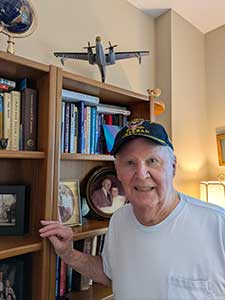
MCAS Iwakuni
Moe and son joined Ben at Iwakuni. They found that Iwakuni, located near the southwestern tip of Honshu was a great base. Together they explored, by motorcycle, the entire area which in 1960 was “pretty much old Japan”. He recalls that one could “get a steak dinner for $1.25.”
His squadron’s mission was aerial reconnaissance. The Marlin had better engines than the PBM which it had replaced, an improved hull, and a single vertical fin tail. It carried a crew of eleven or more, was faster, and had essentially the same weapons capability. It was also equipped with ECM (electronic countermeasures) equipment. A typical sortie involved flying between 50 and 500 feet above the waves. Collected were electronic intelligence and photos of all shipping along the coasts of Korea, China, and Russia. Additionally on each mission crew members took shifts monitoring the scope for indications that Russian or Chinese radars were “painting” the airplane.
On every patrol mission when a ship was picked up on the airplane’s radar the crew descended from altitude to essentially wavetop height for a single pass by the ship. A series of photos were taken for later intelligence analysis. Of importance to the Navy were the number of exhaust stacks representing engines capability, on-deck cargo, armament (guns), bow and stern construction, flags being flown, and how it rode in the water (low meant a full load of cargo). The goal of the flyby was to take three photos, or more.
Evidence of Russian subs was frequently collected. In addition to other intelligence devices, the Marlin used sensors which could detect the exhaust of diesel engines, used by the subs. On one sortie their Marlin detected not one but seven subs in the channel between Korea and Japan. He learned later that they had sailed to Indonesia for Sukarno’s Navy, joining many other Russian military ships and airplanes.
Submersed subs. The Marlin could drop sonar buoys when a sub’s presence was suspected. An array of buoys would allow a crew member to identify and locate the sub. Ben took his turn with the earphones and became adept at identifying a Russian sub by its engine noise which was distinctive from American sub engines. He recalls on a particular training sortie covering a 60-mile square patch of ocean he identified the location of the “target” American sub. “Good work, let’s go home”, said the aircraft commander. Ben: “Not so fast, there is another sub down there and it’s Russian.” It had been skulking near an undersea cliff. Squadron procedure was to drop a small depth charge to alert a sub that it had been found. The Russians left the area. Ben may remind you of scenes in The Hunt for Red October where Jonesy picks out a Russian sub from all the undersea noise.
Intercepts. One typical sortie included flying directly toward the Russian mainland. Ben says the Marlin started at altitude and gradually descended to a very low altitude. Its mission was to collect as much electronic intelligence as possible. Other air assets flew higher flight profiles collecting additional intelligence.. Did his airplane ever get intercepted by Russian fighters you may ask. Certainly. He describes the MiGs coming up behind the airplane and slowing down to take a look. Often the MiGs backed off, flew underneath the Marlin, lit their afterburner and gave it a “nose job”, flying vertically in front of his airplane. “You could feel the turbulence.” Even though Cold War adversaries, these Russian intercepts and maneuvers were professionally done and did not endanger the Marlin according to Ben.
Flight schedules. Ben flew once every seven to ten days. Sorties lasted about ten hours. In the winter flying over the frigid sea crew members wore “poopy suits”, anti-exposure rubber suits. Not for the faint of heart. His tour at Iwakuni over Ben and family, now including three children, headed to Washington, D.C.
Washington, D.C.
The Navy assigned him to a Naval Research office in the Navy Yard for the remainder of his service. There Ben assisted in and conducted research activities. His most memorable assignment involved the investigation of the USS Thresher (SSN-593) loss on April 10, 1963. The nuclear-powered attack submarine sank during deep-diving tests 220 miles east of Cape Cod, killing all 129 crew and shipyard personnel on board.
He maintained flight proficiency flying the T-28 from Andrews Air Force Base. The flights were single ship in visual meteorological conditions (VMC) ideal for sightseeing and “chasing clouds”. Flying “didn’t get better than that”, according to Ben. He received his honorable discharge in October 1964.
Civilian life
Ben and family returned to the Chicago area where he joined his father in the insurance business. He served as President of Baldwin Financial from which he retired in 2015. He and wife Moe have been married for 68 years. They raised four children, three sons and a daughter, and now have ten grandchildren and ten great grandchildren (with “two more on the way”, Ben proudly says!)
Summing up his Navy service, he says, “I loved every minute of it!”
Thank you, Ben, for your dedication and distinguished service. Enjoy your special day of honor in Washington D.C. with your comrades in arms and a splendid “welcome home”!