
Navy Vietnam War Woodridge, IL Flight date: 09/23/26
By Charlie Souhrada, Honor Flight Chicago Veteran Interview Volunteer
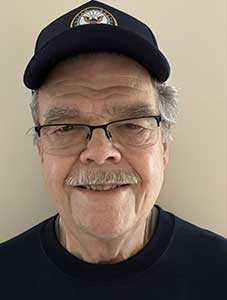
In 1963, Robert “Bob” Arthurs joined the Navy and broadened his horizons, carrying him from the smallest state in America to ports around the world aboard a “tin can” destroyer that became his second home.
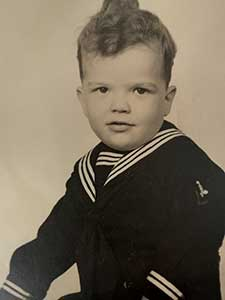
Bob was born in 1943 in Providence, Rhode Island, and grew up in nearby Johnston. His father spent 43 years with Bulova Watch Company and supplemented the family’s income with a second job as a security guard. His mother managed the household while raising Bob and his younger brother and working part time in Rhode Island’s thriving jewelry manufacturing industry.
Despite these modest means, Bob and his friends found ways to create their own fun. They carved baseball bats from scrap lumber and turned an empty neighborhood field into their own ballpark. “Our neighbor had a large field, and he let us kids use it to play baseball,” Bob recalls. “On Saturdays, we’d take a lawnmower, cut the grass and layout our own baseball diamond. If you had a real leather glove, wow, that was a Cadillac!”
During his high school years, Bob had a chance encounter on a ballfield that unexpectedly caused him to change the course of his education. While playing ball, he was approached by a student recruiting for the Vocational Technical School of Rhode Island. “This girl came around talking about Vocational Tech and she walked over to me while I was on first base. I told her: ‘Hey, how about getting out of the way, we want to play this game!’ She said she was recruiting for the school, so I told her, ‘Good, put my name down,’ just to get her out of our way.”
What began as an off-hand remark soon changed into a life-changing opportunity. The school followed up, one thing led to another, and Bob enrolled. The transfer got him into electronics and even spurred him to start his own television repair business while still in high school. “I got my own tube caddy, which cost a couple hundred bucks, and I made money on the side repairing televisions and cleaning transistor radios.”
After graduating from high school in 1963, Bob worked in the shoe department of a local retailer while considering how to gain some control over his possible military obligation. “I wanted to travel, and I wanted more education than I had,” he recalls. As he weighed his options, several factors drew him toward the Navy, including the spit and polish bearing of a local recruiter. In the end, however, a practical consideration helped seal the deal.
“In the Navy, I was getting what we called a ‘rack’ – the bed aboard ship – including a pillow, two sheets, and a blanket. That was a big difference.” Swayed by the promise of travel, education, and a more comfortable place to sleep, Bob enlisted in the Navy in August 1963 and was told to report to Naval Station Great Lakes, north of Chicago.
Boot camp was an eye-opening experience, beginning with his first airplane flight, from Boston to Chicago, and continuing through the moment he walked through the doors at Great Lakes. “I’m the kid from Rhode Island who’d never been out of state,” he recalls. “And they put us in a drill hall that was the biggest building I had ever been in my entire life.”
The hall, he remembers, seemed as large as a football field, with rows upon rows of bunks stretching farther than he could see. The recruits were instructed that once the lights went out, there was to be complete silence. “They told us they didn’t want to hear a thing,” Bob says. “And you didn’t. You could hear a pin drop.”
The next day marked another turning point. “We went into another huge building. They gave us a small bag and told us to strip down, fold our clothes, put them in the bag, and attach a tag,” he recalls. “Then they mailed our clothes home. I told myself, ‘There goes my civilian life!’”
Bob and his fellow recruits were then issued large sea (duffel) bags and went single file down a line where they were issued Navy gear, and instructed to label every item, right down to their socks. “When we got done labeling our clothes, we went to another area where they taught us how to fold them,” he says. “We learned that when we got aboard ship, we’d have a locker about 16 by 20 inches to store everything except our peacoats. If you didn’t fold things right, your clothes would end up on the floor. To this day, I still fold my t-shirts, underwear and even my socks exactly the way I was taught in the Navy.”
After boot camp, Bob headed home on a two-week leave. During the trip, he experienced a moment that has been etched in his memory ever since. “I was catching my plane home out of O’Hare when they announced over the PA system that President Kennedy had been assassinated,” he recalls. “Everybody stopped and looked at one another. None of us could believe it.”
Back at Great Lakes, Bob began advanced technical training, or “A School,” where he learned the skills needed to operate and maintain shipboard electronics. “Uncle Sam was very thorough,” he says. “I was surprised by how much we learned and how fast we learned it!”
As graduation approached, the sailors were asked to complete “dream sheets” listing their preferred duty stations. “We were told we had three choices and nobody ever gets their first choice,” Bob remembers. During the final week of school, the sailors gathered as their orders were announced. As the chief petty officer read through the assignments, Bob was stunned by what came next.
“The chief gets up front, looks at the paper, and says, ‘Arthurs, you’re the only sailor who got his first choice!’” The announcement was not exactly what it sounded like. Hoping to outsmart the system, Bob had listed Newport, Rhode Island, as his top choice, assuming the Navy would assign him elsewhere. “I had the longest face on me,” he recalls. “I didn’t want to go home, but that’s where I was ordered to go.”
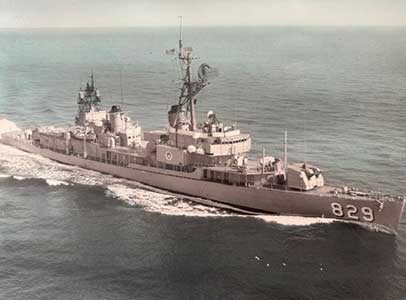
Rather than heading to a tropical duty station on the opposite coast, Bob was shipped back to his home state. Upon reporting to Newport, he learned his billet or duty station was aboard the USS Myles C. Fox (DD-829), a Gearing-class destroyer undergoing a major overhaul as part of the Navy’s Fleet Rehabilitation and Modernization (FRAM) program and was being reassigned to the Boston Naval Shipyard.
As part of this overhaul, the Fox was literally cut in two and lengthened by approximately 40 feet through the insertion of a new midsection. The modernization also included the installation of updated weapons systems, torpedo-launching capabilities along both the port and starboard sides, and new anti-submarine warfare (ASW) equipment and helicopter facilities to extend her service life. When the overhaul was complete, the Fox headed out for sea trials where the crew got their sea legs. “By sea legs, I mean not throwing up,” he says.
Over the next three years, Bob served aboard the Fox in a variety of technical and operational roles, including Combat Information Center (CIC) operations, radar and communication systems, air-control support, anti-submarine warfare support, and fixed-wing and helicopter control operations. He explains that because destroyers carried relatively small crews, approximately 300 officers and enlisted personnel, sailors often performed multiple duties and developed close working relationships throughout the ship.
The ship’s missions included carrier escort duties, naval gunfire support, and air-control operations. Although he was trained to perform multiple assignments, Bob’s primary responsibility was helping aircraft return safely from combat missions and monitoring operations within the ship’s CIC.
During his time aboard the Fox, deployments typically lasted six or seven months, with the ship moving from port to port or wherever it was needed. “We weren’t at sea all the time, but if we managed to pull into port, it wasn’t like a cruise line. We didn’t sightsee, we stayed where we were and out of trouble,” he says. “You had one strike and that was it. If a guy wasn’t working out, the next day he’d be heading home on a helicopter.”
Bob also experienced extended stretches at sea, including periods of more than three months without visiting a port, while enduring severe storms, typhoons, and demanding operational conditions. “One time, we pulled into port and three buddies and I went to a restaurant and all we ordered was fruit and milk because we didn’t have them often aboard ship at the time,” he says.
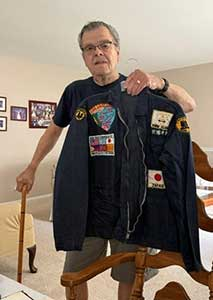
Bob’s naval service included numerous deployments that took him around the world, including Bermuda, Cuba, France, Greece, Italy, Japan, Philippines, Spain, and Vietnam, just to name a few. In 1967, he was aboard the Fox for a round-the-world deployment, during which he transited both the Panama Canal and the Suez Canal.
After completing active duty in August 1967, Bob returned home to Rhode Island but found that he missed Navy life and the friendships it provided. To fill the void, he joined the Naval Reserve, where he continued serving for approximately 13 more years. Reserve duty included regular drills and annual active-duty periods aboard ships. His reserve career ended in 1981 before reaching the 20-year retirement milestone due largely to relocations for his civilian career and the difficulty of finding reserve units near his new job locations.
Using his GI Bill benefits, Bob enrolled at Roger Williams College (now Roger Williams University) in Bristol, Rhode Island. This meant he not only juggled a full class load, and served as a Naval Reservist, but held down multiple jobs to pay the bills. In 1972, he earned a bachelor’s degree in industrial engineering technology. He later added a master’s degree in project management in 2008.
Early in his career at ITT Grinnell Corporation in Providence, a mentor recognized Bob’s potential and helped launch his civilian career in quality assurance and quality control. His work, which focused on auditing regulatory compliance, took him across the country and introduced him to opportunities far beyond Rhode Island.
One such opportunity came in 1978, when a business trip to the Chicago area led to a blind date with Carol. The couple got married the following year and went on to build a family with three daughters. Fittingly, for a man who had rarely ventured beyond New England before joining the Navy, each daughter was born in a different state.
Throughout his career, Bob worked for a series of engineering and technology-related organizations that evolved through mergers and acquisitions, including ITT and several successor companies. Those career moves took the growing family to communities across the country, including his native Rhode Island, Ohio, Michigan, Texas, and Illinois, broadening Bob’s horizons in ways he could scarcely have imagined as a child growing up in Johnston.
In 2013, after a long and successful professional career, Bob retired from Argonne National Laboratory. Today, he proudly describes himself as a “professional grandpa.” He and Carol stay busy helping with and cheering on their 10 grandchildren, spending much of their time at activities, school events, and sporting competitions.
In retirement, the couple continues to embrace new horizons. Recently, they achieved one of their longtime goals: visiting all 50 U.S. states together.
Welcome home, Bob, and thank you for your service. We hope your Honor Flight is a transformative experience for you!