


Navy Vietnam War Plainfield, IL Flight date: 07/23/25
By Wendy L. Ellis, Honor Flight Chicago Veteran Interview Volunteer
The ships just kept coming. It was April of 1975, the closing days of the Vietnam War. Aircraft carriers, destroyer escorts, freight vessels, even smaller fishing vessels were arriving in Guam loaded with thousands of evacuees fleeing South Vietnam and the approaching North Vietnamese Army. U.S. Navy Torpedo man Sgt. Cliff Struthers had been on Guam for six weeks when the people started pouring in.
“The first people out were the people that had money, so they came with luggage and all this stuff,” says Struthers. “We had ships bringing them in, airplanes bringing them in, everything you can think of bringing these people to Guam.” Navy personnel on the island had put up giant tent cities on two abandoned Japanese runways to house the evacuees while they figured out their status and what they were going to do with them. “The worst people were the Americans because they didn’t want to live in these tent cities for 2 or 3 days. The Vietnamese went with no problem. The last people out were the fishing people who had a stick with a stocking on the end. Everything they owned was in that stocking. It went from wealthy people to poor people in the end. And most of them were very grateful, very happy. That was probably the best six weeks I had because I was helping people.”
Guam wasn’t even on Struthers’ radar when he joined the Navy in 1971. Neither of his parents had had a high school diploma, so that was mandatory for him and his four siblings. But after that they were on their own. “I hated school,” says Struthers. “So I put myself through high school in 3 years. But I couldn’t get a job when I graduated because I was only 17.” The military seemed the logical choice. Why the Navy? He liked their uniforms, and the Navy would take him for four years. Every other branch wanted him for six. But even at 17 he needed his parent’s permission.
“I told my mother that she had to sign at 8 o’clock at night and she wanted to go down immediately and sign,” says Struthers.” I said no, they aren’t open ‘til tomorrow. So at 8 the next morning there she was standing in the door waiting to sign. She had three boys at home and they were driving her nuts. The best way to eliminate one of them was send them to the military!” Struthers opted for submarine duty because his uncle had served aboard a submarine during the Korean War, but he ended up on the USS Hunley, a sub tender, berthed in South Carolina. “That was great because I was getting married in two months, and we could drive to South Carolina and we could live there for however long I’m gonna be there.” Six weeks later the USS Hunley moved to Guam, and Struthers went with it. His first few months in Guam were fairly routine, but when the Hunley started its journey back to Washington State via Sydney, Australia, things got rough.
“We came through a typhoon on the way from Guam to Australia,” says Struthers. “There were 60-to-70 foot waves and they had bosun mates tied to the rails because you had to still go on deck to get to your work station. I’ve never been so sick in my life.” Struthers was working in the bow compartment, rising and falling 60 feet with each wave. They were so high they washed over the bridge. “It was pretty freaky for three days. I found out why they put lips on the tables, so the stuff wouldn’t roll off. Most people weren’t eating very much anyway. There were a lot of green people.”
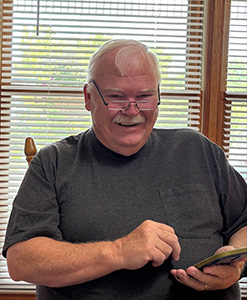
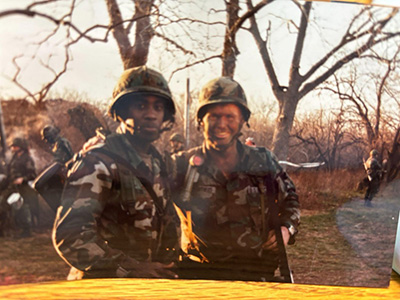

Once back in Washington State, Struthers transferred to the USS Nathan Hale, a nuclear-powered sub getting ready to go out to sea. Struthers was a torpedo man, arming and maintaining the 16 nuclear missiles on board. “One submarine has more fire power than all the ammo used in World War II,” says Struthers. “If you had to fire them you’d be a little nervous, but we only had to test fire them.” By the fall of 1974, there was a shortage of torpedo men on Guam, so Struthers was told he would be returning to Guam. He was assigned to the sub tender Proteus, and six weeks later, the evacuees started coming. It was called Operation New Life, and when it was over, Struthers returned to Washington State, mustering out in August of 1975. He spent two years in the Naval reserve before moving to the Army Reserve where he stayed until 1993.
“Going back to 1975 when Vietnam fell, people weren’t ready to discuss it.” says Struthers. “Best thing I did was stay in the service until ’93. Then it was a pleasure to go anywhere in uniform because people were very pleasant, very nice to you. Even out of uniform in the 70s they could identify us because we had short hair. Everyone else had long hair, but we had short. But I never let any of that bother me.”
Not one to be idle, Struthers spent 15 years as a letter carrier in Joliet, his hometown, before moving inside to clerk for five more years, and then becoming Postmaster in Batavia. After more than 40 years in the postal service, Struthers retired in 2012. He and Helen raised a son and a daughter, and for 11 years, Struthers was a special needs bus driver in the Lockport school district. “It was a very heartwarming and very fulfilling job, and it kept me busy,” says Struthers, who now spends as much time as he can in a cabin in Northern Wisconsin, where, oddly, many of the Vietnamese refugees from Guam eventually settled and started new lives.