

Navy Vietnam War Glen Ellyn, IL Flight date: 09/17/25
By Mark Splitstone, Honor Flight Chicago Veteran Interview Volunteer
David Yost was born in 1953 in the Jackson Park area of Chicago. His family had an extensive military background, with his father being awarded a Purple Heart while serving in the Korean War, and three uncles also serving in the military, two in the Army and one in the Navy – Vietnam. When he was about 10 years old, the family moved to Chicago Ridge, where one of his lasting memories is spending every summer day at the pool. He loved swimming and was very good at it, although at the time, he didn’t realize where this love of the water would take him.
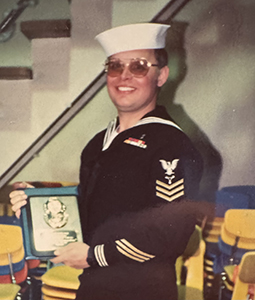
In 1971, Dave graduated from Richards High School in Oak Lawn. He wasn’t very interested in going to college and instead decided to join the military, driven by a strong sense of patriotism that had been fueled by his participation in the Boy Scouts. An uncle who was in the Navy convinced him that that branch was the best choice, so rather than waiting to potentially be drafted and not having a choice of branches, Dave enlisted in the Navy. On Halloween in 1971, he says he was trick-or-treating straight into boot camp at Naval Station Great Lakes. He chose an enlistment period that required two years of active duty followed by four years in the Reserves, but as it turned out, his time in the Reserves would be much longer than his initial commitment.
After completing boot camp, Dave spent 30 days leave at home before going to Pearl Harbor, where he was assigned to the USS Chipola. The Chipola was a World War II-era auxiliary ship whose purpose was to provide fuel, food, ammunition, water, and personnel to other ships in the fleet. Dave’s rating was Machinist’s Mate, and his role was to maintain the ship’s propulsion systems, steering system, HVAC & refrigeration equipment and other vital machinery. The Chipola was one of the oldest ships in the Navy, so there was plenty of work to keep Dave busy.
The Chipola spent the next nine months delivering fuel and cargo to the American ships in the South China Sea off the coast of Vietnam. The delivery process was known as “unrepping,” short for Underway Replenishment. They’d pull alongside a ship, and without either vessel stopping, would pass lines and hoses between them to begin the process of transferring cargo and fuel. They’d sail from ship to ship in the convoy, working until everything was unloaded. The unloading days were often long, with the longest one he can remember being 38 hours. After everything was delivered, the Chipola would return to port, usually Subic Bay, to reload and then head back to the fleet. While most of their time was spent going back and forth between the fleet and Subic Bay, they’d occasionally venture to other ports, including New Zealand, Hong Kong, Singapore, Australia, and Taiwan.
After nine months servicing the fleet off the coast of Vietnam, the Chipola returned to Pearl Harbor. The ship, thirty years old and a veteran of two wars, was deemed to be no longer seaworthy and was scheduled to be sold for scrap. The decommissioning of the ship involved months of disassembling and removing anything that could be reused or recycled. During this period, Dave heard about scuba lessons being offered at the base pool, and given his affinity for swimming, he decided to give it a try. He loved it, and from that point on, he took every possible opportunity to go diving. Not having a boat, he was limited in his dive locations, but he and a buddy would drive to different beaches around the island and walk into the ocean to begin their dives. Months later, he was assigned to the USS Ponchatoula, another auxiliary ship, which was scheduled to go to Guam for dry dock repairs. Once in Guam, Dave spent his free time diving, and this time he had access to a boat, allowing him to expand his diving locations. It was off of Guam that Dave had his deepest recreational dive of 183 feet. When Dave qualified as a 2nd class Diver he qualified at 200 feet.
While the Ponchatoula was still in dry dock, Dave’s two years of active duty ended, and he returned to Chicago. He found a job doing HVAC repair, a transition made easier because of his maintenance experience in the Navy. He also began fulfilling his commitment as a Navy reservist, which included one weekend a month and two weeks a year. He fulfilled these requirements at the Chicago Naval Armory, which was located on Lake Shore Drive. He and some other men would sometimes swim in the facility’s pool at lunch time, and one day they were approached by a captain who was working with the Navy to determine the feasibility of a Naval Reserve diving unit. Dave immediately signed up and was a member of this unit for the rest of his time in the Reserves (18 Years).
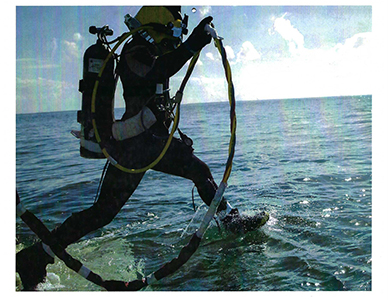
Training was much more rigorous than what was required for recreational diving. It began with assessments in the pool of basics like swimming and holding your breath (Dave could swim two lengths of the pool underwater, so this wasn’t a problem for him). Once they were scuba qualified, they began diving in Lake Michigan and eventually started doing underwater tasks such as scrubbing the bottoms of ships. They needed to know how to perform many different tasks in case they were called up to active duty, so it took two more years of training before they were fully qualified as a 2nd class Diver. They did scuba training at the Navy’s dive school in San Diego and 2nd Class Diver training in Washington DC Dive school. Dave says that the school’s active-duty divers were initially skeptical of reservists from the Midwest, but Dave and his team were able to impress them.
Once they were fully qualified, the fun started. On any given weekend, they might be flown anywhere in the country, sometimes working around the clock because of their limited time availability. During their annual two-week commitment, they could be assigned to more complicated projects, including working at Ellis Island and the Yorktown Naval Weapons Station. In 1979, the Navy was asked by the Smithsonian Institution to help recover parts from the SS Indiana, a historically important ship that had sunk in Lake Superior in 1856. Despite the wreck being five miles offshore in 129 feet of 32-degree water, Dave and his team were able to successfully retrieve the engine, boiler, propeller, and rudder, and some of these parts are now on display in the Smithsonian.
Another project took place off the coast of Maine and involved the dive team to find unexploded 500-pound bombs underwater. The area had been part of an aerial target range, and the bombs were those that had missed the target and sunk, unexploded, to the bottom. The divers would strap explosives to the bomb and bring detonation cord (fuse) back to the surface and attach it to a timer. Once the timer was activated then the divers and boat would get out of the area and wait for the explosion. The upside of this project was that they could then go back to the area of the explosion and pick up plenty of dead fish for dinner that night.
Dave also recalls a time when they were sent to Fort Pierce, Florida. During World War II, underwater obstacles meant to simulate what the Navy and Army would be confronted with in Normandy on D-Day had been placed offshore in Florida. These metal and concrete obstacles had never been removed and were therefore a risk to swimmers and boaters. Several different teams were dispatched to determine ways to remove them, but Dave is proud that his team discovered the best method and pulled out more obstacles in two weeks than the rest of the units combined.
The diving required by the Navy was very different from the sightseeing enjoyed by recreational divers. In many of Dave’s dives, he literally couldn’t see his hand in front of his face, to the point where it didn’t matter whether his eyes were open or closed. In these situations, his hands were his eyes, and he had to feel his way through wherever he was while also keeping a mental map so he could find his way out. Dave says that 99 percent of being a good diver is being able to remain calm in stressful situations. The first time he remembers being very stressed while diving was shortly after the movie “Jaws” came out, which he says messed with his mind a bit. The other time was when he was by himself underwater using a fire hose to clean mud-covered pipes. As he was doing this, a forty-foot pile of mud and silt collapsed on him. It would’ve been easy to panic but he remained calm and followed directions from topside and turned the firehose up in the other direction and used it to work his way out of the mess.
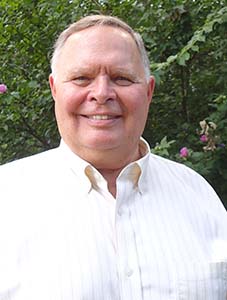
Dave ended up staying in the Reserves much longer than he originally planned, mostly because of the camaraderie and his projects were always fun and different. He left on January 1, 1992, after two years of active duty and eighteen years as a reservist. Both during and after his service, he’s had a wide-ranging career, including owning a company that focused on HVAC repair, then joining the Pipefitters Union and another one that performed home inspections. He finally retired from all these vocations in 2021 and now spends a great deal of his time taking care of his elderly mother. He and his wife, Sonja, have been married for 48 years, and they have two children and two grandchildren.
Dave hasn’t gone on a dive since 2000, when he did a recreational cave dive in Cancun. He looks back fondly on his days as a Navy diver and is proud of the fact that the unit of which he was an inaugural member is still in existence today. He recently planned and attended the 50th reunion of that group and still keeps in touch with several of the members, one of whom will be joining him on his Honor Flight.