

Air Force Vietnam War Flight date: 08/20/25
By Joe Kolina, Honor Flight Chicago Veteran Interview Volunteer
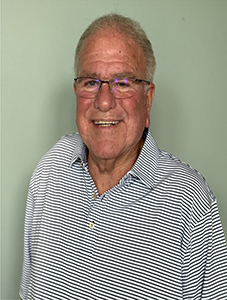
When Don Asher boards his Honor Flight to Washington D.C., it won’t be his first memorable trip. The Air Force veteran’s life has been filled with front-row views of history—a major plane crash, flying into the eye of a hurricane, taking pictures of the President of the United States, running local newspapers, and even acting in a movie with Johnny Depp.
The story begins on a hot, humid day in Puerto Rico, July 5, 1967, when Air Force public affairs specialist Don Asher found himself in the middle of a national news story.
Don and Scott Farley, his boss at Ramey Air Force Base in Aguadilla, just wanted to cool off during a busy work day. They ducked into a bar for a cold beer.
“All of a sudden there was lots of commotion,” Don says. “We stepped outside and saw this black plume of smoke, thin at the bottom and expanding as it went up. We started to hear some sirens. Since Scott and I were on the base newspaper we thought we better get down there and find out what’s going on.”
They didn’t know it yet, but a Strategic Air Command B-52G Stratofortress had crashed into the Atlantic Ocean a quarter-mile from shore minutes after take-off. Seven men were on board. Four died. Three survived—one, thanks in part to Don.
The two airmen ran to the beach as fast as they could. By the time they got there the smoke was gone. So was any sign of the massive B-52G.
“The only thing we could see was some fishermen in their tiny little boats,” Don says. “And inside the boats were three guys. We didn’t know a plane had crashed yet. But then we saw one of the survivors had an officer’s uniform on, so we figured it was a plane crash.”
Don and his partner beat emergency crews to the shore. They grabbed one of the survivors, put him on a stretcher, and began a mad dash up the incline of the beach. The sand was thick and deep and hot. They struggled to hold on to the stretcher and the seriously injured man.
“I didn’t know if we were going to make it to the top,” says Don. “Man, that was work. It was all we could do to get him up there. But we did. The medics took over and he survived.”
Don and Scott immediately became reporters, learning everything they could about what happened for the next issue of their newspaper, the Tropic Air. The base commander interviewed Don as part of his investigation. And Don answered questions from reporters for the San Juan Star and national newspapers.
The crash was just the beginning for Don. Something happened to him in the Air Force. Something clicked. His military service led to an award-winning, 40-year career in journalism. The irony is that journalism was the furthest thing from Don’s mind when he joined the Air Force.
From College Dropout to Air Force Reporter
“I was just bored with college,” he says. It was 1964. The Vietnam War was heating up.
“I left school,” he says. “Who knows whether I would have been drafted, but I didn’t want to take the chance. I figured the Air Force could be a good career.”
Don was right, but for an unexpected reason. After basic training, Airman Asher was sent to the Defense Department Information School at Fort Slocum, N.Y., for intensive training in reporting, writing and editing. Don’s attitude changed from disinterest to commitment.
“I’ll never forget one time I misspelled the word exercise,” Don says. “That sticks with me. I’ve never gotten over it. And I’ve never misspelled it since.”
His first assignment was at the home of the Strategic Air Command at Offutt Air Force Base, near Omaha, Nebraska. He got to witness nuclear war training alerts.
“Klaxons would start going off all over the base,” he says. “Flight crews would pile into trucks, race out to the flight line, fire up those engines, and take off, one after another, after another.”
It was a dangerous place.
“It was a mistake to be on the flight line during an alert,” Don says. “I remember one time I couldn’t get off fast enough. The B-52s were so loud. They would just scream. It hurt my ears.”
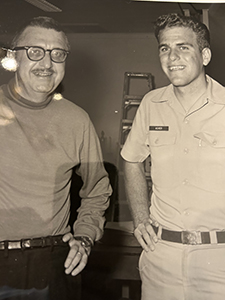
Flying Low in a B-52
Imagine what it was like to be inside one of those gigantic planes during a flight.
Don later transferred to SAC’s 72d Bombardment Wing at Ramey Air Force Base, where he went along on a simulated nuclear bombing mission for a story. Preparation began on the ground in an altitude chamber.
“We went in and they started sucking the oxygen out,” he says. “Then they’d test you with questions like who is president of the United States, and what day is it?”
The simulation was developed to help flight crews recognize a life-threatening danger.
“They wanted you to see what it was like when your oxygen dropped so far that you couldn’t think,” Don says. “They wanted you to be aware of it so you’d see it and know what to do if it happened.”
Don sat behind the pilot and co-pilot in a small cockpit. Eight engines powered the aircraft to speeds of up to 650 miles an hour and altitudes of 50 thousand feet. Don was fitted with a flight suit, helmet, oxygen mask and switchblade. Switchblade?
“Yes, an orange switchblade,” he says. “Part of it was a regular switchblade and the other end had a circle on it that was sharp so that if you had to bail out you could cut your parachute when it was time.”
The flight, including refueling in the air, went from the Bahamas to a practice bombing range 1,200 miles away near Binghamton, New York.
“You’d think they would fly at 35 thousand feet during a bombing run,” he says. “But no. We’d be 500 feet over the treetops, using terrain avoidance radar. You’d be going up and over trees.
“It was just like 20 Seconds Over Tokyo,” he says. “We’d climb a bit. The bomb doors would open. The pilots would pull down shades over all the windows, the bombs would be dropped, hypothetically, and the pilot would turn tight and start climbing as fast as he could so that the flash of a nuclear bomb wouldn’t blind the crew’s eyes or damage the plane.”
Into the Eye of the Storm
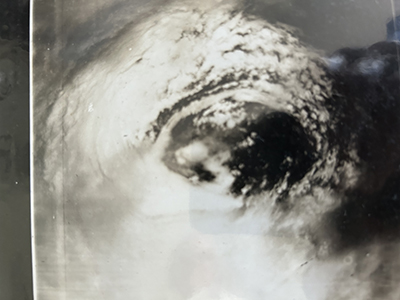
In September, 1967 Don joined a C-130 aircraft on a mission flying through the eye of Hurricane Beulah. It made landfall as a major Category 3 storm that devastated parts of Texas, Mexico and the Caribbean.
“We flew right through the wall of the hurricane into the eye,” Don says. “And then we flew around the eye, I don’t know how many times, and then back through the wall. A guy was sitting there gathering data from the airplane sensors.”
Don says it wasn’t exactly what he expected.
“I was prepared to get bounced around from one side of the plane to the other,” he says. “And it was bumpy going through the wall, but it wasn’t as violent as I thought it would be.”
A Presidential Visit
In March, 1968, President Lyndon B. Johnson spent three days at Ramey.
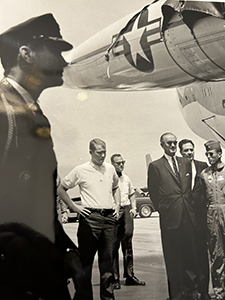
Don helped White House staff, reporters and photographers find their way around the base. And he took pictures of President Johnson on the B-52 flight line, leaving church with his wife, Lady Bird, and even playing golf.
Don also got his own tour of Air Force One. It was the same plane where Johnson was sworn in after the assassination of President John F. Kennedy.
“It was very nice inside but it didn’t seem extravagant,” he says. One thing he remembers clearly: “The seats were nice, not as crammed as they are today.”
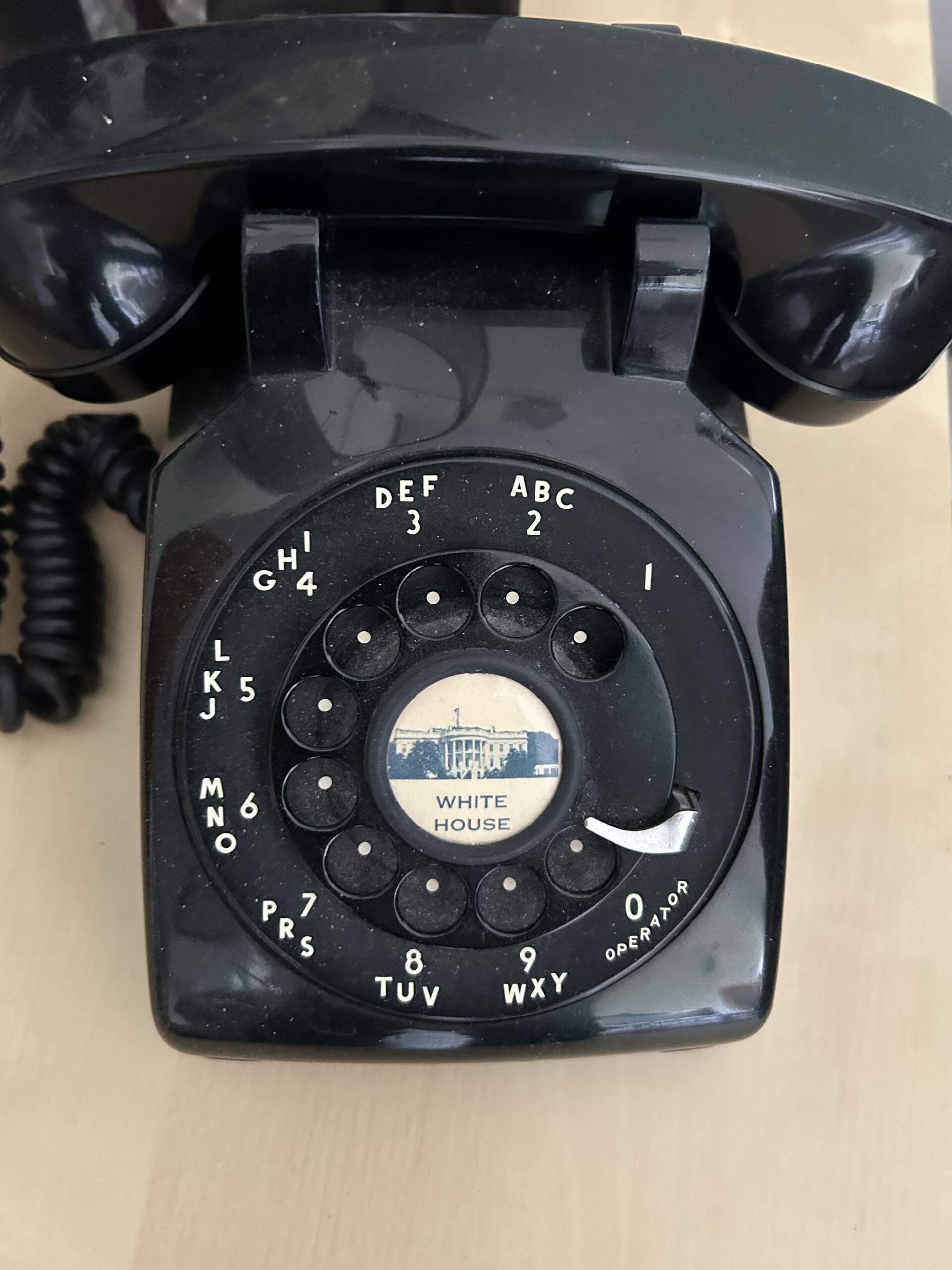
Don still has two mementos from the visit: an Air Force One matchbook, and black rotary phone from the White House communications set-up. It still works.
A Career in Journalism—and Acting
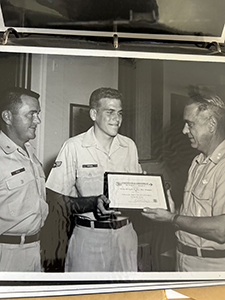
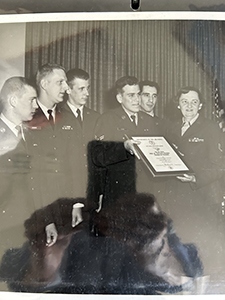
By the time his enlistment ended in 1968, now Staff Sgt. Asher had helped Ramey’s Tropic Air win “Best Newspaper in the Air Force” two years in a row. Before he left, he was transferred to Fairchild Air Force base near Spokane, Washington, to improve the newspaper there.
Don stuck with journalism after he returned home. His 40-year career included leading a major investigation of public access to government records in Indiana. Reporters from papers statewide uncovered irregularities that led to reforms. Newspapers in 30 other states have repeated the project.
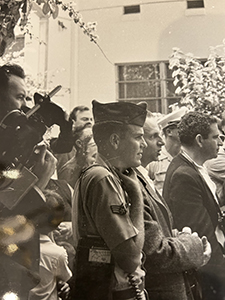
Then came Hollywood and a role in the 2009 Johnny Depp movie, “Public Enemies.” Producers were looking for real reporters for scenes in which John Dillinger talks to journalists. Don went to a casting call in Chicago on a lark and got a role. He’s in the famous scene where the Lake County, Indiana, prosecutor parades the newly-captured Dillinger before reporters.
“I had lines with Johnny,” Don says. “And my own room in a trailer with a washroom, a TV and a couch. I’m still a member of the Screen Actors Guild.”
Don’s scene was even used prominently in the TV commercials that ran nationwide. What was Johnny Depp like?
“He was a cool guy, and funny,” Don says with a laugh.
The Lesson that Stuck
Don credits his professional success to his Air Force mentor, Ramey NCO Paul Cole, and advice he never forgot.
“Paint a picture,” he says. “When I read your story I want to feel like I’m there. And that’s what I preached in my civilian life to my reporters.”
It’ll be quite a picture for Don to paint of his Honor Flight trip to Washington D.C.—a journey that will join a long list of unforgettable experiences.
Congratulations Don, and thank you for your service.