

Army Vietnam War Flight date: 09/17/25
By Lauren Jones, Honor Flight Chicago Veteran Interview Volunteer
For some, service is a choice; for Doug Vines, it was a calling woven into the fabric of his family. Guided by an unwavering sense of duty, he followed in the footsteps of his father and uncle, trading a college campus for the jungles of Vietnam in 1969. It was there, as a Sergeant with the famed 1st Infantry Division, that his path would be shaped by luck, courage, and an unbreakable bond with his unit, the “Big Red One”. From earning a medal for valor under fire to returning home as part of a special honor guard, Doug’s story is one of a young man who answered the call and looks back on his “two-year adventure” with pride.
Hay fever – who would have thought?
For Doug, serving his country was a family tradition and a call of duty he fully expected to answer. “I knew I would serve and thought it was part of my duty,” he recalls. “My Dad and Uncle were both in the Army during WWII. My Dad was stationed at Pearl Harbor after the attacks. They didn’t want me to go to Vietnam, but it was part of the family culture.”
Before the Army, however, Doug had his sights set on the sky as a pilot. As a senior at DePauw University in 1968, he took the Air Force ROTC pilot aptitude test and was one of only a handful to pass. He was scheduled for a physical at Rantoul Air Force Base, feeling confident his excellent eyesight would see him through.
“I saw guys flunking left and right, and they were sent home right on the spot,” he remembers. “I thought it was going well, but they asked me about the hay fever I had listed on my application. Unfortunately, that flunked me on the spot.”
Undeterred, he tried the Navy, thinking that hay fever couldn’t find him on a ship! But the result was the same. A Flight Surgeon explained that the rapid altitude changes could cause a pilot with asthma or allergy issues to black out. The answer was frustrating, but clear. With his dreams of being a pilot grounded, Doug turned his focus to his inevitable future. “Here I come, Army!”.
After graduating with a degree in Psychology, he found himself in limbo, unable to get a professional job with his 1-A draft status. So, he walked into a recruiting station and enlisted in January 1969. A recruiter informed him that this timing meant he would be discharged just before his second Christmas, qualifying him to spend only one holiday away from home; that seemed like a good strategy to Doug.
“This is gonna be a long year.”
Reality hit when Doug arrived at the Tan Son Nhut airbase in May 1969. He was flying from Oakland Army Base, where he received his big duffle bag “stuffed to the gills” with the equipment and uniform he would need in Vietnam. He had flown over Tokyo where the “lights went on forever” and landed at the massive airbase. “When they opened the airplane door, the combination of heat, humidity and bright sun took your breath away. The atmosphere was just startling compared to where we’d come from. We all got our duffle bags and had to walk all the way across the tarmac to get our next instructions. We walked for 20 minutes with these heavy duffle bags. I looked down and my uniform was half wet from sweat. I couldn’t believe in that short amount time it was that wet. I remember thinking to myself ‘this is gonna be a long year.’ That prediction came true.”
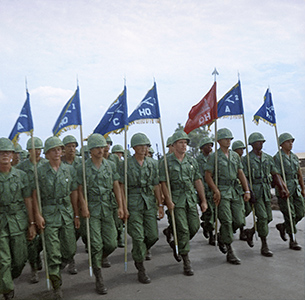
Doug was assigned to the 1st Infantry Division, famously known as the Big Red One (BRO), the oldest continuously serving active-duty division in the U.S. Army. It is still a point of immense pride. “I loved being part of it. It’s so famous; they were the unit at Omaha Beach on D-Day. It’s a special group. We always say, ‘If you’re going to be one, be a Big Red One’.”
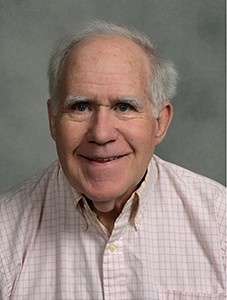
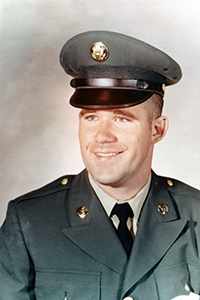
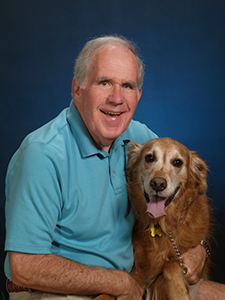

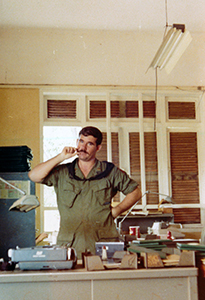
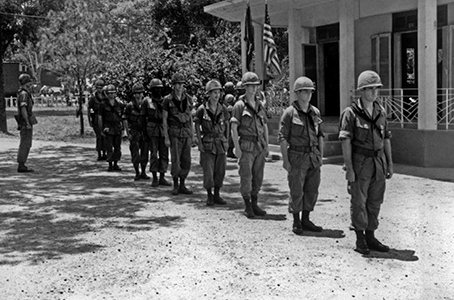


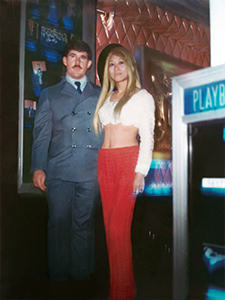
His arrival in Vietnam is a stark reminder of how much a soldier’s experience depended on timing and luck. There were several scheduled stops for a soldier heading to Vietnam, and typically, they would stay at each place for two to three days. However, when Doug was heading over there, he was transferred in “the blink of an eye”. He explained, “Once I got to my unit, I noticed that in our company, Delta Company, all of the guys were relatively new, which isn’t a good thing.” He continued, “What I learned was that two months before my arrival, my platoon was bombarded at night in a mortar attack. Nine soldiers died and 21 were wounded. That’s why I ended up there so quickly, to replenish the guys who were lost. Only four guys remained from the original platoon, and they were all kind of shell-shocked. “If I had gotten there two months earlier, we wouldn’t be talking,” Doug states soberly. “We eventually got back up to strength, but it was luck of the draw, like most of our time in Vietnam.”
Serving northwest of Saigon near the Cambodian border, Doug and his unit operated in the Michelin Rubber Plantation, a historically volatile area west of the Iron Triangle, which was an enormous underground bunker complex. “The Iron Triangle was the size of an underground city. It was unbelievable. That area had historically some of the biggest battles in the whole war,” Doug explained. “The goal was to take over Saigon, so if you go northwest of Saigon to the Cambodian border, that’s where the Ho Chi Minh Trail ended.” The conditions were grueling.
“It was tough, even aside from the danger of combat. You’re living outside, pulling guard duty at night, so you don’t sleep much. You lose weight because you’re eating C-rations, walking around all the time, and you don’t have enough water.
“Charlie wasn’t our only enemy”
The rainy season in Vietnam is May to September, which coincided with the exact time Doug was in the field. “You were never dry. It didn’t rain all day long, but almost every day. Your clothes were wet, and your foxhole was always wet. It was a bad time of year.” All the rain made the mosquitoes “relentless”, which Doug found to be the worst of all the bugs and critters they had to deal with, including leeches, red ants, and ringworm. The soldiers would put their rubber ponchos over themselves to sleep at night to block the mosquitoes, which made for really humid and uncomfortable sleeping conditions. Doug laughs, remembering a squad leader who exclaimed one day that the “mosquitoes here are so big, I saw one screwing a turkey!”
He also laughs remembering one time his entire company scattered because of hornets. They were walking through a woodsy area, when their top sergeant, whom they called Top Taggert, started running and screaming. “Top Taggert was a real good guy, and we all liked him. We were going along when all of a sudden in front of me, we heard all of this commotion and yelling and screaming. We were supposed to be quiet. Guys started running toward us, so we started running backward too. Top Taggert ran by me like nobody’s business, wiping his face and obviously in pain from something.” Turns out, one of the soldiers hit a hornet’s nest on purpose with the butt of their gun. Top Taggert was stung multiple times in his face and had to be airlifted by helicopter to get medical attention. “That wasn’t funny, but I laugh thinking of how we had to spend time getting the company back together since we ran all over the place!”
“But no one complained!”
As Doug’s time in Vietnam progressed, his situation improved. First, because of his ability to move up in rank, and also because of the Vietnamization Program in early 1970, which meant the South Vietnamese began to take over defending the territory.
“Our level of contact with the enemy was probably a lot less than it was historically. The combination of BRO and the 25th Division made it much safer. I know soldiers who were in contact with the enemy every day, but it wasn’t like that for us. That’s why all the Vietnam movies are so different; everyone had a different experience depending on where they were and when they were there.
“At first, I was an infantryman. But after that, I carried the M-79 grenade launcher. I made rank quickly, and in September 1969, I was promoted to SP4 and assigned to our Battalion HQ at Dau Tieng as a clerk, which I served from September 1969 to April 1970. My co-workers were a great group of guys – we all had college backgrounds and had served as infantrymen in the field, and then we got promoted to our jobs in HQ. We also had something else in common – we were damn-glad to be working at HQ and not in the field anymore!” he laughs. “We worked 12-hour days, but no one complained!”
During his time as a clerk, Doug’s battalion was headquartered in a small base with an airstrip adjacent to a village. They were in an old and large two-story French plantation residence. Doug imagines wealthy people must have originally owned it. He was on the first floor with around eight guys who all became great friends. They were assigned various paperwork for the battalion and worked hard. But they felt safe, slept in a dry place, and ate three meals a day. “To go from the field to that is the ultimate,” he recalls.
Doug’s job duties as clerk included being the supervisor of awards and decorations for the 1st of the 2nd battalion. He really enjoyed when a recommendation came in for a soldier to get an award with valor. A narrative had to be written regarding why the soldier deserved the award. Often, there wasn’t enough information, so Doug had to investigate, leaving HQ to interview others to complete the story. He explains, “Most of the time, the first sergeant was there, and I’d go with what he had. But sometimes, if I was lucky enough, I could talk to the company commander who was in the field and had the right information. I used the file copy for some of the verbiage, but I tried to find out what weapon he used and other details. I really liked to write the narrative and liked that part of the job. That’s such a special thing for someone and I wanted to make it as good as it could be.”
Army Commendation Medal with “V” device
Doug received several awards for his service and is most proud of his Army Commendation Medal with V device, which is awarded for acts of heroism or valor in direct contact with an enemy. In July 1969, just a couple of months into his tour, Doug’s platoon was leading the company through the field when the point man, a soldier named Brooklyn, suddenly stopped.
“And when Brooklyn stopped, I knew he stopped for a reason,” Doug recalls. Gunfire erupted. The enemy was hidden in the brush.
“Our M-60 machine gun had gotten jammed and stopped firing. I knew our machine gunner Shaw, and his ammo carrier Kelly, were sitting ducks. I thought I could help with my grenade launcher, so I moved up slowly but quickly.” He laid down suppressive fire with his M-79 grenade launcher, calming the attack and allowing his unit to regain control. “I think I shot one more round for good measure. We kept looking for movement, and there wasn’t any. The lucky thing is none of our guys got hurt. Kelly, Shaw and I all got medals.”
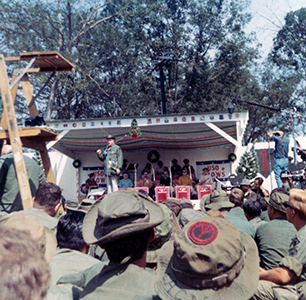
Before heading home, Doug was able to attend the Bob Hope Christmas show at Lai Khe, a large BRO base. He recalls the night being a lot of fun overall. He was pretty close to the stage, so when he Googled the event years later, he was stunned that there were 10,000 people in attendance. “I never knew that!” he exclaimed.
Life After the War
As President Nixon’s Vietnamization program began, the BRO was one of the first divisions to be pulled out of Vietnam. “We were so happy!” Doug remembers. In a special honor, his commanding officer selected him for a 40-man color guard to carry the BRO colors from Vietnam back to their longtime HQ at Fort Riley, Kansas. In April 1970, they were the main attraction at a large ceremony featuring the Secretary of Defense.
“I have always felt that was such a special reward, to come home from Vietnam the right way, with a ceremony.” With seven months left in his service, Doug was offered a choice: finish his tour at Fort Riley or be stationed with the BRO’s brigade in Augsburg, Germany. “I thought that would be a wonderful opportunity, so I grabbed it,” he says. He spent his remaining time working in an HQ office, and his nights and weekends exploring Europe. “I had such a wonderful time in Germany, paperwork during the day, chasing Fräuleins at night. I also took a two-week leave in October with a friend from our office, and we visited Amsterdam, Brussels, London, Paris, Zurich, and Munich.”
After being honorably discharged in December 1970, Doug used the G.I. Bill to earn his MBA in Marketing from the University of Florida. This led to a successful 25-year career in sales and marketing with the 3M Company before he retired and moved back to Illinois.
Today, Doug is active in the Veterans club in his community, which is how he learned about Honor Flight Chicago. He’s heard rave reviews from fellow veterans who have taken the trip. “The guys like it so much, they can hardly describe it,” he explains. “It’s a wonderful organization that gives guys the welcome home they should have gotten.” He looks forward to visiting the memorials in Washington, D.C. and sharing camaraderie with other veterans.
Thank you, Doug, for your dedication and service. We hope you enjoy your flight!