


Army Flight date: 07/23/25
By Joe Kolina, Honor Flight Chicago Veteran Interview Volunteer
It’s the silence that the old soldier remembers most vividly. The still quiet that hung like a cloud over the Tomb of the Unknown Soldier, whether hundreds of reverent visitors were passing by under the hot, humid, blue sky, or whether the soldier was standing honor guard all night long, alone in the black Virginia night.
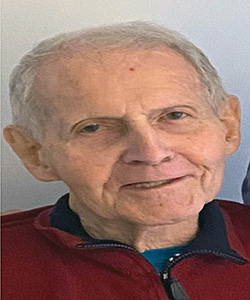
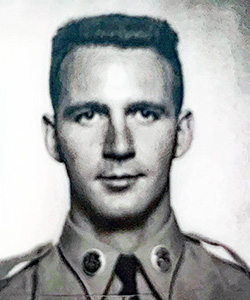
Ed Fitzpatrick is 91 now (or as he is quick to inform me, 91-and-a-HALF). It’s been nearly 70 years since he spent a remarkable time in his youth as a Tomb guard, or Sentinel. We’re sitting in the cozy front room of his home on a placid, tree-filled street in Oak Lawn, Illinois. A photograph of Ed as an Army private on duty at Arlington National Cemetery sits in a prominent place at the center of a table filled with family pictures. When I look at it I hear sounds from the stories Ed has told me of serving on the honor guard at funerals: the sudden crackle of rifle salutes, the sharp metallic click of the steel taps on their shoes, the haunting clarion tone of a bugle mourning, the clopping of horses’ hooves and the creaking of the slowly-turning wheels of a caisson carrying an American hero to their final resting place.
Ed still marvels at the irony in the story of how he came to join the U.S. Army’s 3rd Infantry Regiment, known as “The Old Guard.” They’re the elite of the elite of the Army’s ceremonial soldiers. Back in September of 1957, Ed had just finished college and was starting work as a Chicago schoolteacher.
“I was there about a week and got to thinking, why do I want to wait to get older and then get drafted,” he says. “So I went to the draft board and told them to push my number up. I thought I’d get it over with.”
Less than a month later he was Private Fitzpatrick in basic training at Fort Carson, Colorado.
“One day a bunch of us were talking, and a guy asked me how I got there,” Ed says. “When I told him he said that the Army was not drafting teachers then because there was a shortage. I really didn’t have to go.”
But Ed’s glad he did. What happened next changed his life. He got orders to report to Fort Myer, Virginia after basic training.
“The sergeant told me Arlington National Cemetery was near there,” says Ed. “He said you’ll probably be picking up leaves, and keeping the cemetery and the grounds clean.”
But when Ed arrived his superiors had something else in mind. They gave him a chance to take part in burial services. He says with humility that he doesn’t know why.
“It seemed like we were handpicked from basic training to end up there,” Ed says.
You can see the change from raw recruit to ceremonial soldier in that old photograph in Ed’s living room. He’s standing ramrod straight at attention. His eyes stare impassively ahead under a blue formal dress cap. He holds a rifle in “order arms position” in hands covered by spotless white gloves.
We all remember those immaculate uniforms from the somber funerals of our national heroes on television. The jacket is a fitted, highly tailored dark blue with silver buttons, a stand-up collar, and a polished ceremonial belt. The blue trousers have razor-sharp creases and stripes. The black dress shoes are buffed to a mirror shine.
“The uniforms had to be spotless,” Ed recalls. “They inspected you every time out. They wanted to make sure everything was perfect.”
The burial services had to be perfect, too. Ed served on one of the firing teams responsible for the legendary three-volley rifle salutes at Arlington National Cemetery services. I can imagine the scene as I look again at that black-and-white picture frozen in time. The precise movements as seven men march forward in unison. The order: ready, aim, fire. The crisp, startling crack of the shots as the team fires once, twice, three times.
Ed speaks with awe of the skill with which a single bugler slowly played the 24 melancholy notes of Taps. He remembers the cries from the mourners gathered around the graves. And the presentation to a family of a flag folded in a triangle, with only a blue field with white stars visible, along with the thanks of a grateful nation.
“There were seven a day,” Ed says of his team.” That’s 35 a week, 70 every two weeks, 140 every month.”
It was grueling work. But he says they had a job to do. And they wanted to give their best for every family.
“You kind of develop a relationship with people you never know,” Ed says. “Some people had thousands at their funerals. For others, there were none. Not that we tried to be any better for them, but we always had a feeling for the guy or girl who didn’t have anyone there.”
No one even knows the names of the soldiers whose heroism is enshrined in the Tomb of the Unknown Soldier, that most solemn American symbol of sacrifice and gratitude. One day about halfway through Ed’s tour at Arlington National Cemetery an officer called him in.
“He said, ‘Fitzpatrick, do you have any objection to a transfer to the Tomb of the Unknown Soldier?’” Ed says. “I felt fortunate.”
They’re called Sentinels. The National Museum of the Army says they must volunteer, prove their fitness and athletic ability, pass a rigorous training and testing program, and learn the history of Arlington National Cemetery.
The Tomb of the Unknown Soldier is a large white marble sarcophagus perched on a hill directly before the Arlington Memorial Amphitheater. Three marble slabs in front of the sarcophagus mark the graves of unidentified Americans who died in combat, one each from World War I, World War II, and the Korean War. The west side bears this inscription:
Here Rests in
Honored Glory
An American
Soldier
Known But to God
“It’s one of the most visited shrines in Washington,” Ed says. “Busloads of people came in every day.”
They waited patiently in lines, often for a long time, then approached slowly, turned toward the graves, paused for a moment and respectfully passed by the Tomb. One thing struck Ed the most.
“The quiet,” he says. “I remember how quiet they were.”
In fact, Ed can only recall one time he ever spoke to anyone during all the months he served as a Sentinel at The Tomb of the Unknown Soldier. There were silver posts strung with a fancy rope to separate the crowds and the shrine.
“One day a little girl about five or six started swinging at it,” says Ed. “I passed by a couple of times and then thought I had to do something.
“So I stepped toward the little girl and whispered out of the side of my mouth, ‘Would you please stay behind that rope with your parents and watch from there?’
And then I stepped right back.”
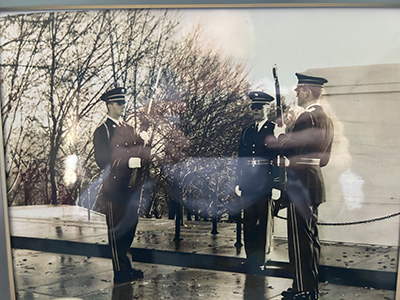
Ed and five other honor guards each marched alone in front of the Tomb in hour-long shifts. Four shifts in a continuous 24-hour period of duty before they were relieved. It required great physical strength and exceptional mental focus to perform the precise routine perfectly.
“We moved on a count of 21,” Ed says.
That number is richly symbolic. It stands for the 21-gun salute, America’s highest sign of military honor and respect. Every element of a guard’s routine reflects it.
The march is called “walking the mat.” Each guard marches 21 steps along a black mat in front of the Tomb. He turns and faces east toward the Tomb for 21 seconds and then north for 21 seconds. When he’s finished that, the guard performs a sharp “shoulder arms” move, placing his rifle on his shoulder closest to the visitors. That symbolizes that the guard stands between the Tomb and any potential threat. Then the guard marches 21 steps back in the opposite direction and repeats the routine until he’s relieved.
Guards stay on duty 24-hours-a-day, 365 days-a-year, no matter the weather, through the heat and storms of summer and the cold and snow of winter. It’s a point of pride.
“I heard about some guys who came after me who were on duty when a report of a tornado came in,” says Ed. “The order came in for those guys to leave. But they got together and said ‘we don’t want to go.’ They got to thinking about the guy who sacrificed his life. ‘He’s not leaving, we’re not leaving.’”
Ed pauses for a second, then adds: “I wouldn’t have left either.”
When he tells me that I am reminded of the The Sentinel’s Creed, which reads in part:
“In the responsibility bestowed on me I will never falter.
And with dignity and perseverance my
standard will remain perfection.”
He looks back on his service with pride. “I felt honored to be there,” he says. “I think how fortunate I was. I was part of something special.”
Ed received the coveted Tomb Guard Identification Badge, awarded permanently only after nine months of honorable service. The Army says less than 20-per-cent of Sentinels earn that honor, among the rarest in the U.S. Army. As of March, 2024, only 722 were awarded in the Tomb’s 100-year-history.
Ed Fitzpatrick has had a good life since leaving the Army. He was a teacher for 39 years and has shared his life with his lovely wife, Mary, their children, Colleen, Jim and Kathleen, and grandchildren Kerry, Riley, Ryan and Mya.
Ed gets around well at 91-and-a-half with the help of a walker. But I see someone else when I look at him as I say good-bye. For a moment, I see the young, strong, impeccably dressed soldier in that old picture standing at attention, a Sentinel doing his duty to honor America’s heroes.
Now it’s our turn.
Congratulations Ed, from Honor Flight Chicago, its many volunteers and supporters. Here’s hoping your trip to Washington D.C is memorable and meaningful.
Thank you for your service.