
Marines World War II Chicago, IL Flight date: 04/13/22
By Joe Kolina, Honor Flight Chicago Veteran Interview Volunteer
He has never forgotten them. A Vietnamese woman and her daughter. They were standing silently in the maelstrom swirling on the roof of the American Embassy in Saigon. It was April 30, 1975. Marine Sgt. Ed Piane was a gunner on a helicopter sent to rescue as many people as possible before the city fell to the North Vietnamese.
Ed remembers thinking that the girl couldn’t be more than 6 years old. She looked so pretty. But then, a surprise and shock.
“She turned around and I could see that her whole right side was burned,” he says. “It was recent. She was holding her mother’s hand.”
Remarkably, the girl was not crying. She seemed calm, almost happy, despite her burns and the chaos surrounding her.
“I guess her mother said, ‘They will take care of you on this ship,’” he says.
_____________________________________________________________________
“I’ve had nightmares about her.”
_______________________________________________________________
The memory haunts him.
“I’ve had nightmares about her,” he says.
Ed was just 22-years-old. He had dropped out of Morton East High School in Cicero, Illinois, to enlist. He chose the Marines after watching John Wayne in the World War II movie “The Sands of Iwo Jima” on late-night TV. Now, four years later, he was living a real-life role in a new war story. It was called Operation Frequent Wind, the final chapter in the long, troubled history of the Vietnam War.
The Last Flights From Saigon
Ed doesn’t remember how many times his CH-53 Sea Stallion raced back and forth between the USS Okinawa in the Gulf of Siam and the American embassy. It was a long, desperate day that grew more frenzied by the hour.
“It was not a cakewalk,” Ed says. “Flying in-country, we looked for puffs of smoke, which might mean a rocket was coming at us. We dropped flares that took any heat-seeking missiles away. We saw Saigon burning as we landed on top of the embassy.”
The first trips rescued well-organized groups of embassy staff and their families.
“I didn’t think the structure could handle that helicopter,” says Ed. “Sometimes the pilot just kept it from going all the way down and touching the roof. The ramp in the back went down, and the crew chief ushered people in.”
Later, wild scrums of terrified refugees battled for places.
“Civilians tried to pay the crews to get them or their children out,” he says. “People were crying and screaming. ‘I got money. Get me out of here.’”
Helicopter crews were ordered to take only people approved by embassy guards.
“It was solemn,” says Ed. “I just hoped everyone would be okay. I kept thinking this could be my wife and son. I was just glad that it wasn’t.”
The flight deck of the Okinawa filled up quickly with evacuees as Operation Frequent Wind continued throughout the day. But then unauthorized choppers started appearing, too.
“A lot of them were Air America, CIA birds,” he says. “We let them land. But it was getting really short of room on that flight deck.”
Desperate people kept coming. Vietnamese commandeered helicopters, loaded them with family or friends, and sought refuge on the Okinawa. It got so crowded and dangerous that the crew pushed those helicopters overboard after people got off safely.
A Dramatic Gamble
Ed remembers one episode in particular.
“It still gets me,” he says. “This guy had an old Huey; it was American at one time. He was told by loudspeaker, ‘No, you cannot land here. There’s no room.’”
The pilot wouldn’t listen. He brought the chopper down slowly, lower and lower, closer and closer to the deck. The crew screamed at him louder and louder. Don’t land, they yelled.
“His wife, carrying her baby and one other little person, jumped out of the bird onto the deck,” Ed says. “Then he just flew out away by himself.”
The chopper was over open water, but still close. Ed could see the pilot at the controls.
______________________________________________________________________
“That was a ballsy guy. That was really something. I was dumbfounded.”
______________________________________________________________________
“I saw him kick over the stick and then jump out the other way, 10 or 20 feet above the water,” he says.
The chopper ditched into the sea. A rescue boat picked up the pilot bobbing in the water.
“That was a ballsy guy,” Ed adds. “That was really something. I was dumbfounded.”
The Okinawa kept jamming more refugees aboard. But there were always more hoping for a last-minute miracle.
“When it was done, there were still people who wanted out,” he says. “We filled up the ship. We just couldn’t take any more.”
The Long Road Home
Ed remembers difficult conditions on the Okinawa during the week-and-a-half it took to drop off the refugees in the Philippines.
“We were displaced,” Ed says, referring to the Marines on board. “We slept in our choppers or on the flight deck.”
The Okinawa also began to run out of food.
“Milk went to the children. The refugees got this and that,” he says. “They could bake some bread. There was a store of questionable hamburgers. Not good.”
He’ll never forget what they had to drink.
“I cannot stand green or purple Kool-Aid to this day,” he says.
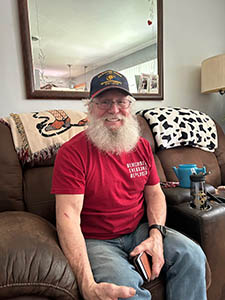
Ed Piane drove a truck after leaving the Marine Corps. He retired from a job at the Illinois Department of Transportation. He’s a friendly guy with a ready smile and a puckish, self-deprecating sense of humor. Those traits are on full display in a self-published autobiography entitled A Boomer’s Tale or I Ain’t Dead Yet. It’s quite an achievement for a man who quit high school early, in part, because he had trouble reading.
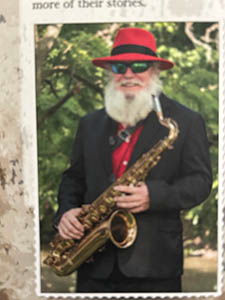
He sports longish hair, wire-rimmed glasses, and a bushy, full white beard that makes him an annual favorite to play Santa Claus at Christmas time. Ed’s a lifelong musician who was good enough to qualify for the Marine Corps Band. (His commanding officer wouldn’t let him go. He was too much in demand for chopper duty.) He still plays the blues and classic rock in a local band called The Southside Soul Kings.
The War Comes Home
But Ed’s Marine Corps service has stayed with him for more than 50 years. It has been hard sometimes. His wartime experiences, including helicopter service transporting the bodies of men killed in action, can weigh on him.
“I’ve had nightmares, dreams that were disconcerting,” he says. “My wife would tell me I was flipping and flopping all night.”
Sometimes he’d wake up in the middle of the night in a sweat. It often happened after he had to pick up roadkill in his job with IDOT.
“I would withdraw, get moody, didn’t want to be around people at all,” he says.
His wife finally convinced him to go to the VA.
“The doctors said, yeah, you have PTSD,” he says. He’s gotten treatment.
Honor And Remembrance
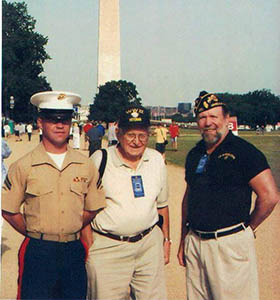
Service in the armed forces also has been a source of pride for Ed’s whole family. His son is a Marine who served in the famous Seal Team Six counterterrorism unit. His dad fought in World War II. Ed planned a trip for the three of them to Washington, D.C. for the opening of the World War II Memorial. It was unforgettable.
_______________________________________________________________________
“I think it was the first time my dad learned he could hug another guy in public.”
_________________________________________________________________
“My dad got very solemn,” Ed says. “I think it was the first time my dad learned that he could hug another guy in public.”
Now Ed will return to Washington with other veterans on the latest Honor Flight Chicago trip to the nation’s capital. He’s looking forward to re-visiting the World War II Memorial. He also wants to see the Vietnam and Korean War Memorials and the Lincoln Memorial.
Ed, here’s hoping this trip to Washington, D.C. offers you fellowship, support, and, perhaps, a measure of peace.
Thank you for your service.