

Navy Vietnam War Chicago, IL Flight date: 07/23/25
By Marilyn Lucas, Honor Flight Chicago Veteran Interview Volunteer
Franz Perfect, one of six children, grew up in Chicago. Like so many of his generation, he chose to join the service after graduation from high school to serve his country during the Vietnam War. In order to avoid being drafted into the Army, Franz enlisted in the Navy. He attended boot camp at Great Lakes Naval Base in June of 1963 where he enrolled in radar school, finishing second place in his class. For amusement, during one of his tests, Franz answered all the questions in pig Latin. Fortunately he had 100% on the test, but was cautioned by the teacher to never do it again.
“Radar Man” was a critical job during the Vietnam Era. Surveillance and intelligence were paramount in tracking enemy movements. Locating potential ambushes and guiding gunship attacks were part of the mission of the radar man. They played an important role in search and rescue missions directing helicopters to downed pilots at sea. They were crucial in identifying enemy radar locations. In many cases air traffic control systems were unavailable, so radar operators would provide ground control thus assisting aircraft with landing and takeoff.
Franz was particularly interested in sharing the explanation of the radar “SAR” synthetic aperture radar system. He explained it was a radar system used to create a two-or-three dimensional reconstruction of objects such as landscape. It provided finer spatial resolution used for reconnaissance for intelligence operations, allowing one to see through trees. This particular innovation was extremely useful in locating potential ambushes and targets. The terminology “radarman” no longer exists. They are now referred to as Operation Specialists with expanded responsibilities.
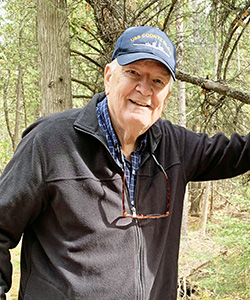

Following Boot Camp, Franz was assigned in 1964 to the USS Coontz. As a Petty Officer Second Class, Franz was a skilled technician and leader, responsible for both technical tasks and for guiding and managing junior enlisted personnel. The USS Coontz, named after Admiral Robert Coontz, the US Navy’s second chief of naval operations, was deployed to WestPac (Western Pacific and Indian Ocean). The specific mission of the USS Coontz in 1966 was search and rescue. The ship was equipped with a newly installed helicopter landing and handling capability making it the first ship of its class to deploy with a UH-2 helicopter. This enabled the ship to participate in rescue missions for downed pilots.
Franz mentioned how important the SAR was in these particular rescue missions. To keep the crew in shape and active they found an interesting use for the glass balls used by the Vietnamese fisherman in order to weight their nets. Some of these balls would be left behind by the fisherman. Once a ball was visible to the radar, they would send the signal “man overboard”. The crew would use this as an opportunity to practice rescuing pilots. To Franz’s amusement, he was awarded one of these glass balls by his commander.
Franz shared many stories concerning his service on the USS Coontz. The Tonkin Gulf episode is by far the most impactful on expanding the Vietnam War. In July 1966 the USS Rogers and the USS Coontz were attacked by three North Vietnamese torpedo boats, while on a search and rescue operation. Carrier aircraft subsequently sank all three of the attacking torpedo boats, with the Coontz rescuing 19 North Vietnamese sailors, who were later exchanged for American prisoners of war. Franz talked about how friendly the North Vietnamese were because “We treated them kindly.” Creating this comfortable feeling with the enemy resulted in them sharing a tremendous amount of information regarding enemy intelligence and naval capabilities.
The increase in the war effort also led to increased usage of Agent Orange. Franz was considered a “Blue water sailor”. These sailors served on ships operating in open waters off the coast of Vietnam typically beyond the 12 nautical mile territorial limit. Their mission returning the prisoners to Da Nang, however, would take them within the 12 mile limit. This distinction played a significant part in Franz’s health issues developed later in life because of exposure to Agent Orange. Fortunately, the Vietnam Veterans Act of 2019 extended the presumption of herbicide exposure to those who served within 12 miles of Vietnamese Coast. Franz was later diagnosed with Parkinson’s which was attributed to his exposure to Agent Orange while aboard ship.
Franz and his brother both served on the same ship. An interesting fact, after World War II no two family members were allowed to serve together in a war. When asked why he was able to serve with his brother he responded “Vietnam was considered a police action not a war“. He quipped “Two PERFECT men were on radar while another sailor with the last name of “LORD” was the navigator. I guess that meant safe travels!
Like so many men leaving Service during the Vietnam War, they were forced into six months of Reserves. The reserve service was due to the shortage of men and the fact the war was ongoing. During this period Franz was at the Armory in downtown Chicago. As luck would have it, he met the love of his life, Peggy, at the Armory. She laughingly told the story of how when they first met he introduced himself as “I’m PERFECT”. Of course, Peggy’s disbelief cautioned her to verify his crazy approach. They married in 1969 and have three children and three grandchildren. His admiration and respect for his wife was more than impressive, as they battle Parkinson’s together.
Franz has been attending Navy reunions. He feels they have helped him to share his Vietnam experiences with his wife. He, like so many Vets from Vietnam, came home not wearing his uniform and feeling like an outsider. According to Franz, education of our children about this period in history is long overdue and the Honor Flight is one avenue that brings public awareness. After leaving the Navy, he joined the Chicago Tribune work force, where he held the job of night operations for the entire paper until his retirement.
Franz took a great deal of time extolling the amazing care he is receiving at Hines Veterans Hospital. He is saddened by the number of veterans that don’t make use of this deserved opportunity. Both he and Peggy spoke about their first encounter, and how overwhelmed and somewhat confused they were when they entered the hospital. A gentleman approached them and literally walked them through the entire experience of registering. They praised both the doctors, nursing staff, and volunteers for their kindness and professionalism. “I always said yes to the Navy” and now they are saying yes to Franz for his service.
In closing he had to share his response to those who say “thank you for your service.” “I respond, No, thank you for paying your taxes.” Franz is extremely excited about the upcoming trip to Washington DC. and the opportunity to explore the city with fellow vets. He sends a big thank you to Honor Flight Chicago!
Franz, thank you for your years of service to our country. Enjoy your day of honor as you experience Washington D.C. … And we look forward to WELCOMING YOU HOME!