

Army Vietnam War Huntley, IL Flight date: 10/15/25
By Mark Splitstone, Honor Flight Chicago Veteran Interview Volunteer
Growing up, Gilbert High dreamed of being a journalist or perhaps a teacher, and while he didn’t envision the Army being the key to achieving those goals, that’s exactly what happened. Gil was born in Indianapolis in 1946, and then he and his family moved to Columbus, Ohio, in 1952. Upon graduating from high school in 1964, he moved to Illinois and enrolled at Aurora College (now Aurora University), where he studied Literature and Education. Even though he was a full-time student, he also worked as a truck driver and as a reporter for the Aurora Beacon News.
By the spring of 1968, he needed only a couple of courses to earn his degree and decided to transfer to the University of Georgia to complete them. However, on the same April day that he received his acceptance letter from Georgia, he also received his draft notice, since his draft deferment had run out. He reported to his local recruiting station, where a recruiter gave him a sales pitch about the Army Security Agency (ASA). The way he described it, it sounded like Gil could basically be a spy, which was interesting to him. The catch was that for him to get this role, he’d have to volunteer rather than be drafted, and in doing so, his commitment would be six years instead of two. Gil volunteered and entered a delayed entry program, which allowed him to wait to start basic training until January 1969. Gil had gotten married by then, so he and his wife moved to Georgia, where Gill did freelance writing assignments while waiting to start basic training at Fort Jackson, South Carolina.
By the time he began basic training, Gil was 22 years old, significantly older than most of his fellow recruits, and not that much younger than his captain. In addition to being older, he also had more life experiences. His journalism and truck driving experience came into play at Fort Jackson, as he’d often be pulled from training exercises to help with tasks where his skills could be useful. This made basic training easier for him than for many of the other men. After basic training, he was sent to Fort Devens, Massachusetts, which was the training base for the ASA. He had to wait nearly four months for his security clearance to come through, during which time he became a driving instructor and also taught a typing class for some of the recruits.
After receiving his security clearance, Gil spent the next few months learning about spying, cryptography, and electronics. His specific role within the ASA was in Communications Security (COMSEC). Rather than monitoring enemy communications, this group monitored the communications of Americans to ensure there was no carelessness with sensitive information. At this time, there was a heightened focus on communications security because an American general had recently been killed in an ambush in Vietnam, reportedly caused at least in part by a breach in security.
His next few years were marked by a good deal of moving around and more than a little confusion on the part of the Army. He was initially scheduled to go to Vietnam, but at the last minute, they switched him to Camp Humphreys in South Korea, where he was sent in February 1970. He spent his days listening to and transcribing Army communications, usually from units stationed close to the DMZ, looking for weaknesses and highlighting risks. After six months in South Korea, he was sent to Vietnam, where the Army’s confusion continued. When he arrived, it became apparent that he had been misclassified and that the role they had planned for him wasn’t suitable for a COMSEC monitor. While the Army tried to straighten it out, he was assigned to other jobs, such as being an MP. They eventually found a position for him, and he was assigned to several different posts, including Camp Evans, Camp Eagle, and Saigon. He recalls an occasion when he was sitting in a hut transcribing communications about a base that was being hit by enemy fire, and he recalls thinking that the base was getting hit really hard. He didn’t realize until later that the base being hit was the one he was sitting in and that the fight was going on right outside his door.
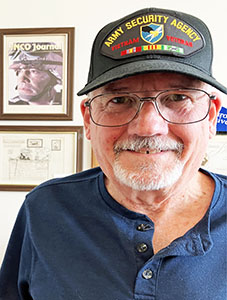
After six months in Vietnam, as US forces were being drawn down, Gil was sent to Fort Ord in California. He had served less than two years of his six-year commitment, but at Fort Ord he was handed his discharge papers and told to report to his local National Guard unit to serve out the rest of his commitment. The National Guard, though, told him that they had no use for him and that he was therefore released. Gil started looking for a job, but a month later, he received a notification saying that he was supposed to be in Germany and asking where he was. Unfortunately, the confusion didn’t end there because when he arrived in Germany, they didn’t know he was coming and had no use for him. Gil’s NCO realized the situation wasn’t Gil’s fault, so he was able to find various temporary duty assignments to keep him busy for the three months that it took to clear things up. Several of these assignments were quite interesting, such as when some important Germans in East Berlin disappeared and had potentially been kidnapped. The Army had hours of recordings of phone calls involving these Germans, and while most of it was in German, some was in English, and Gil was assigned to transcribe these portions. Unfortunately, he never found out what happened to the missing Germans.
In January 1973, Gil was once again sent home. The Army had too many COMSEC monitors, so Gil was released from his commitment, four years into his six-year term. Other than completing his degree at Aurora College, this was a tough time for him. Returning soldiers weren’t treated very well, he had a difficult time finding steady work, and his first marriage ended. In 1974, though, Gil received a call from the NCO in Germany who had helped him out back then, asking if he’d like to return to the Army. Gil wasn’t especially happy with the direction his life was taking, so he said why not. He signed up for a four-year commitment and returned to Fort Devens to be an instructor, which was one of the careers he had wanted to do all along. Since the last time he had been there, technology had changed, and the Army was trying to figure out things like how to monitor cell phone communications. Monitors would sometimes practice by listening in on the cell phone calls of civilians in nearby Boston, although they’d always immediately destroy the transcriptions.
Gil spent three years at Fort Devens before being transferred to Hawaii. During that time, he had met and married a woman named Lynn, and she accompanied him there. One day, someone overheard Gil mention that he had worked for a newspaper in civilian life, and several days later, he received a message asking him to see the base commanding officer. When he arrived, he was told that the officer wanted him to prepare an educational newsletter for his base in addition to the communications that the public affairs office was already providing. This seemingly simple request, sparked by a random overheard conversation, led to a new career for Gil.
He was able to change his MOS to begin working with the public affairs office, and decided to stay on beyond his four-year enlistment period. After three years at Fort Monroe in the early 1980s, he was once again sent to Germany, where he ran his base’s newspaper and internal communications. From there, he was recruited to be the managing editor of Soldiers magazine, which was based near Washington. He had several interesting assignments during this time, such as witnessing the fall of the Berlin Wall and being present for the start of the first Iraq War. While in Saudi Arabia for the war, he received orders to return to the US, where he was tasked with starting up a new magazine called the NCO Journal. He moved to El Paso, which is where the magazine was based, but after successfully getting the magazine off the ground, he retired in 1992 and moved back to the Washington DC area.
Now a civilian, Gil was hired by the Department of Agriculture, but he wasn’t yet done with the Army. A former colleague recruited him to come back to Soldiers magazine as an assignments editor. Before long, he became the Editor-in-Chief. His last job with the government was as the director of internal print communications for the Army. He retired at age 62, and eventually he and Lynn moved back to the Chicago area.
Spending parts of four decades in the Army, Gil was a witness to huge transformations. He enlisted near the peak of the Vietnam War and saw the decline in morale and capabilities in the late 1970s, but was still involved as things improved throughout the 1980s, culminating in victory in the first Iraq War. He’s amazed by the education and technical knowledge of today’s soldiers, which is significantly more advanced than it was when he first joined. His only complaint, after spending decades starting up, writing for, and editing various Army periodicals, is that today’s soldiers don’t read enough magazines.