
Army Vietnam War Flight date: 09/23/26
By Joe Kolina, Honor Flight Chicago Veteran Interview Volunteer
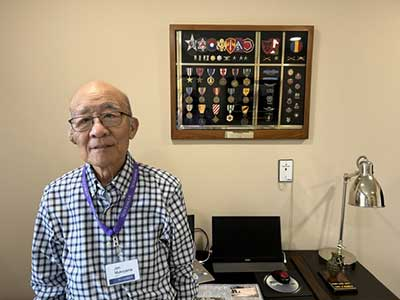
Jim Mukoyama’s life changed forever on a battlefield in South Vietnam. The young Army Captain had just led his men to victory in a fierce, bloody battle against Viet Cong guerillas. He noticed the bodies of three enemy fighters as he inspected the smoldering scene. Suddenly, something made him stop. He turned around and looked again at the three lifeless figures at his feet.
“I realized that they were children of God,” he says. “They were fighting for things I was fighting for. I’m in their backyard and I’m treating them like they’re bumps on the log.
“I remembered Jesus’ Sermon on the Mount. He told us to pray for our enemies. So I did. I prayed for them and their families. But I know I was praying for myself as well,” he says. “It’s been a very impactful moment in my life.”
On that day, Jim Mukoyama began a remarkable journey that he’s still on nearly 60 years later—one that combines his Christian faith with helping the brotherhood of combat Veterans heal the hidden wounds of war.
Jim, who is the son of first-generation Japanese immigrants, thinks of himself as an American Samurai. He loves the Army, the American flag, and the soldiers he led. But the collision of his lives as a warrior and a man of faith is just one of many contradictions in his military career.
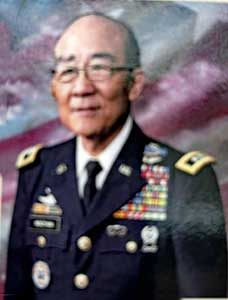
Jim’s family included members who were rounded up and sent to internment camps for Japanese-Americans during World War Two. Yet he became the first Asian-American in Army history to command a division.
He needed height and health waivers to get his commission as a second-lieutenant. Later, he was the youngest Brigadier and then the youngest Major General in the Army.
Jim made his initial mark in the Army as a manager, a highly efficient, desk-bound staff officer. But he also fought at the side of a legendary commander in Vietnam, a maverick who taught him innovative strategies and tactics to win battles, as well as how to treat and motivate infantry soldiers.
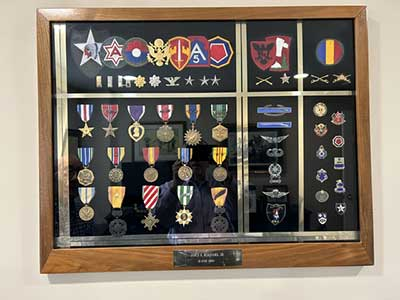
Jim’s home office has a wall dominated by an impressive display of his many medals, including a Purple Heart, a Silver Star and three Bronze Stars. Still, he sometimes felt the Army didn’t nurture his ambition. And his 30-year-career ended before he planned due to a public disagreement over a matter of conscience.
A Soldier’s Education
One word keeps popping up as Jim tells the story of his life as a soldier. It’s there through the triumphs, the challenges and the disappointments.
“I’m a focused guy,” he says.
You can see it going back to his Chicago boyhood. Once he decided on a military career he pursued it with passion. ROTC in high school and at the University of Illinois provided intensive infantry training, including firearms. He chose every college class and extracurricular activity to prepare him for military leadership. That included a surprising choice for his major.
“I asked myself what would best prepare me to lead soldiers,” he says. “I chose English Literature. There is a constant theme of human nature that comes out at you. If you can recognize those, you can understand what motivates people. And reading the best writers of all time could also help me explain myself when I was talking to people.”
Jim completed a Master’s degree before reporting for Army duty in 1966. He immediately asked to go to Vietnam. Instead, the Pentagon sent him to South Korea. He led patrols along the DMZ. It didn’t get much attention but tense face-offs with elite North Korean units could turn deadly.
“One of our patrols had nine out of ten guys killed,” he says. “That was on page 54 of the Chicago Tribune, one paragraph. If that happened today it would be a worldwide event.”
Jim wanted to stay on the front line.
“I was living a dream,” he says.
When he tried to turn down a promotion to battalion adjutant, saying he would be happier in a combat role, he was disappointed again.
“My commanding officer said ‘I’m not looking for happiness,’” says Jim, who was promoted later to brigade adjutant.
When his tour in South Korea ended Jim asked for assignments at Fort Benning or Fort Bragg. U.S. Army Infantry School, Airborne School, Ranger School and Special Forces were run at those bases. A posting there meant a young officer was on a fast track for an important career.
Learning To Lead
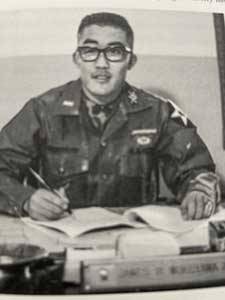
Instead, now Captain Mukoyama was assigned to Fort Lewis, Washington, in another desk job. Secretary to the General Staff was important duty but not the job he really wanted. He immediately maneuvered to get an assignment as a company commander. The decision was confirmed when Jim met the most influential figure of his entire career.
One day Lieutenant Colonel David Hackworth arrived for a meeting with the commanding general at Fort Lewis. Hackworth was a battalion commander renowned as a battlefield leader of unusual bravery, creativity and success. He ultimately received eight Purple Hearts in Korea and Vietnam, as well as 10 Silver Stars.
“The first words out of Hackworth’s mouth were, ‘What are you doing sitting behind a desk? If you want a company I’ll give it to you,’” Jim says.
Hackworth was known for having an uncanny knack for evaluating soldiers within seconds.
“You were either a stud or a dud. There was nothing in-between,” Jim says.
He thinks Hackworth, whom he had never met, was impressed by his look.
“I was pretty sharp,” he says. “I was very proud of being an officer. I wanted my soldiers to know that if I expected them to have standards for themselves and their uniforms then I needed to model that.”
Jim got his wish for an infantry command and ultimately served in Vietnam under Hackworth. He called Mukoyama “Mook” because he had trouble pronouncing the name. They fought Viet Cong guerrillas.
“They looked for targets of opportunity,” Jim says. “They were outmanned and outgunned. They did not want to engage us because they knew they would lose.”
Hackworth developed strategies and tactics to counter them. He called it “out-G-ing the G.” Small, disciplined units relied on mobility and deception—ambush, camouflage, night movement, snipers. Hackworth wanted to force guerrillas into open battles, only then using superior American artillery, firepower and helicopters to move forces aggressively, resupply and evacuate the wounded.
Jim remembers one battle in particular. He joined Hackworth in a command- and-control helicopter above the scene of developing action.
“It was like watching an orchestra conductor,” he says. “He had set up the battlefield and as things developed during the day he moved units or did whatever he had to do to fight the battle. As it turned out, it wasn’t really a battlefield. It was a turkey shoot.”
Hackworth was also a master motivator. For example, he had unusual names for units. Companies were called Alert, Battle, Claymore and Dagger. The platoons were Red, White and Blue.
“The pride and uniqueness of it set us apart,” Jim says.
Hackworth wasn’t afraid to disregard orders to get a job done right.
“Sometimes you have to break rules, stupid bureaucratic things that hamper an operation,” he says.
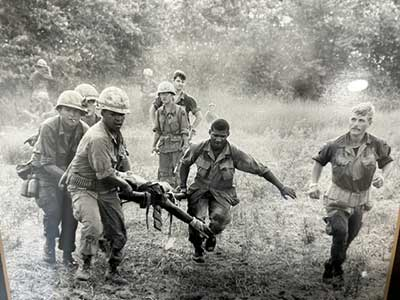
Jim applied these ideas in his own commands. But he also developed his own leadership style. He calls it Care, Balance, Example. You can see it in a UPI picture that was transmitted around the world.
Soldiers are carrying a wounded comrade on a stretcher. They’re in a field of dense brush and thick trees. Smoke drifts upwards, covering the scene in a haze. In the middle of the picture stands their commander, Jim Mukoyama, personally supervising to make sure the evacuation was successful.
Years later, at a reunion of his “Hardcore” Battalion, one of his soldiers got up and said he had a gift for “General Mook.” It was an old copy of Stars and Stripes with that picture on the front page.
“That is the depth of love and selflessness that bonds Veterans of all ranks, services and eras together,” General Mukoyama wrote in his book Faith, Family & Flag.
The Hidden Wounds of War
Jim has been a dedicated leader and supporter of many Veterans groups. One is especially meaningful for him. It’s called Military Outreach USA. The organization comes directly out of Jim’s experience praying for those Viet Cong guerrillas. And it includes another searing battlefield memory.
When he was a young captain Jim was on an inspection tour with a Command Sergeant Major with 30 years of service. A Viet Cong unit staged a surprise attack. A rocket-propelled grenade killed the Sergeant Major. He died just one day before he was due to go to Hawaii to meet his wife to celebrate their 25th wedding anniversary.
“I outranked the Command Sergeant Major. I could have ordered him not to go on that inspection tour,” he says. “I didn’t do that, and I can’t tell you the survivor’s guilt that I carried for a long time.”
These are examples of what Jim calls “moral injury.” It’s what happens when the warrior code of the military clashes with a soldier’s own moral code.
“You might have to participate in activities or operations that violate your personal moral code, such as killing,” he says. “You don’t have to pull the trigger. You can be a witness or feel you should have prevented it. Or you see innocent civilians have been killed or handle body parts.”
Soldiers don’t have time to stop and reflect on these events.
“So what do you do? You bury it,” he says. “And it becomes unresolved guilt and shame. Then you come back to the States to a community that doesn’t understand what you’ve been through.”
Military Outreach USA helps those men cope with feelings of anger, guilt, and depression.
“The main approach for moral injury is not a medical doctor with prescription drugs,” he says. “It is the forgiveness and grace of a loving God, the counseling of clergy and sensitive therapists, and the support of a community offering hope and help.”
Jim retired from active duty after five years, disappointed that he could not get assignments he wanted to develop his career. He joined the Army Reserves, where he had significant commands and earned promotions to Major General.
A Matter of Conscience
But his career in the Reserves ended unexpectedly. In the wake of Desert Storm, the Army had to downsize. Jim thought the plan for doing that compromised Reserve readiness, and put soldiers’ lives at risk. He faced a dilemma. Should he accept the Pentagon decision silently or speak out on behalf of his fellow reservists?
After much thought, he decided to testify publicly before a congressional committee, not as a General, but as President of the Army Reserve Association.
“A year later I was history,” Jim says, noting that he was passed over for commands he was well-qualified for.
A friend urged him to lay low and wait for the controversy to blow over.
“I said no, the Army has sent me a message,” he says, “that I’m not considered vital anymore to the success of the Army, so I’m out of here.”
Despite how it ended, Jim loves the Army and is proud of his service. He’s especially grateful for the people he met along the way. And he looks forward to meeting other veterans on his upcoming Honor Flight Chicago trip to Washington D.C.
“I want to say thank you to the oldiers, marines, and sailors who are going to be on that flight,” he says. “Whether they were in combat or not, they have served our nation honorably and I appreciate them.”
Welcome Home, Jim
One thing Jim says he has learned working with Vietnam veterans is that they need something more than a thank you. They want to feel welcome in the country they sacrificed for.
So, General Mukoyama, Honor Flight Chicago, its staff, volunteers and supporters have this message for you:
Welcome home, Jim.