
Navy Vietnam War Era W. Suffield, CT Flight date: 10/28/26
By Al Rodriguez, Honor Flight Chicago Veteran Interview Volunteer
James ‘Jim’ Bottomley was a senior in high school when he decided to join the Navy as a corpsman. Corpsmen are Navy medics that help sick and injured sailors and Marines. He said ‘I liked helping people.’ He also got the idea about being a corpsman from his mother, who was a World War II Navy nurse helping the injured sailors and Marines coming back from combat. That’s how she met his father who was a World War II Marine Infantry Rifleman in the Pacific. He honored them both by volunteering with the 3rd Marine Reconnaissance Battalion as a corpsman in Vietnam.
Jim was born in Hartford and was raised in West Suffield, Connecticut. He’s the oldest of six siblings. You can say that the Bottomley’s are a Navy family. His Father was a Purple Heart Marine who served in the South Pacific during World War II. His mother was the Navy nurse who took care of her husband-to-be when they sent him stateside to heal. Jim had two younger brothers that also joined the Navy. Jim said he grew up a farm boy working in the family dairy and tobacco farms. But he said there was still time for him to be a Cub and then a Boy Scout. He also ran track and field at Suffield High School. When Jim was a senior in high school he met with a Navy recruiter and decided to enlist in the delayed entry program as a corpsman. This guaranteed him a corpsman spot in the Navy.
On January 4, 1966, he took his first plane ride from Bradley Field Connecticut to O’Hare Airport in Chicago for boot camp at Great Lakes Training Center. He said boot camp was easy for a farm boy who was used to hard work, but Connecticut had mild winters. He wasn’t ready for the bad, cold winter in Illinois. In boot camp Jim was a member of the Great Lakes drill team but because of the snow and cold they did their marching and close order drills inside.
After finishing boot camp Jim stayed at Great Lakes for Hospital Corpsman School. He said he studied first aid and beyond, patient care, anatomy, pharmacology, suturing and practical clinical skills. His training had him working in the hospital treating sailors and Marines with different injuries and illnesses. He also spent time with the doctors in the operating room. He remembers sewing up many cuts on patients including when he cut himself. He was also schooled in last rites for all religions. He received a book with the prayers to comfort dying men. After this 16-week training he became a Hospital man and was sent to Newport Naval Hospital in Newport, Rhode Island, coincidentally where his mom and dad met. He was promoted to an E-3 – Seaman.
At Newport Naval Hospital he had ward duty, taking care of patients and their needs. He said they had the same responsibilities as a ward nurse. Jim remembers delivering over 100 babies. As fulfilling as this work was, Jim wanted to do more than hospital work and applied for Field Medical Service Training. He was accepted and was sent to Camp Lejeune at Jackson, North Carolina.
At Camp Lejeune he was taught field medical skills, anything that could happen in combat. This included combat trauma management, dressing wounds, patching, and splintering and pain management. After finishing this training, he doesn’t know if he was just young and dumb, but he volunteered to be a Marine Reconnaissance corpsman. Corpsmen were badly needed in the growing Vietnam War. He trained with the 2nd Reconnaissance Battalion at Camp Lejeune. The main goal for a reconnaissance unit was the gathering of intelligence deep behind enemy lines or ahead of the main force. A perfect mission meant that they gathered information and left the area without being seen and without firing a single shot.
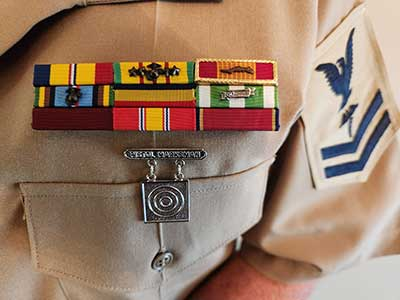
Even though he was a Corpsman he went through the same combat training as the other Recon Marines. This training required extreme physical endurance. They learned small-unit tactics, and specialized insertion skills. Their training sent them to different locations. They went for airborne training at Fort Bragg and scuba and amphibious training at Coronado, California. They were sent to jungle settings at Vieques P.R. and Panama for long range patrolling and surveillance training simulating they were deep behind enemy lines. This was the equivalent training that the Navy Seals go through today. After completing this training, he was promoted to an E-4 – 3rd Class Petty Officer and received orders for Vietnam.
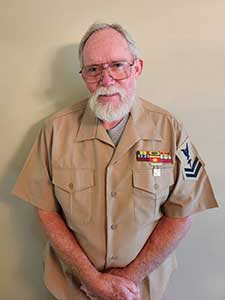
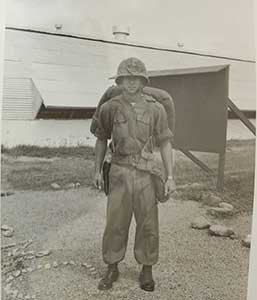
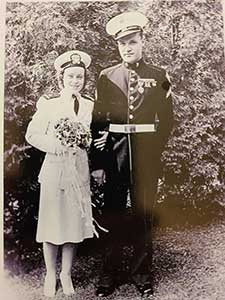
Jim received a 30-day leave and his girlfriend, Denise, joined him in Jackson, North Carolina. They were married and returned to Suffield, Connecticut. Jim adopted Denise’s daughter. When his leave ended he flew to Naval Station Treasure Island, near San Francisco, California, for his flight to Vietnam.
On December 1967 he and four other corpsmen landed in Danang, Vietnam on a C-130 Hercules airplane during the monsoon season with low visibility. After they deplaned with their gear, two CH-46 Sea Knight helicopters collided after landing on the runway. A piece of one of the rotors broke off and severed the foot at the ankle of one of the corpsmen walking with him. Jim immediately went into his corpsman role and stopped the bleeding until the man could be transported to the hospital. Welcome to Vietnam.
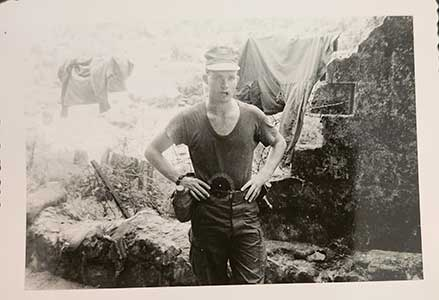
Jim was assigned to the 1st Marine Division, 3rd Reconnaissance Battalion, Charlie Company at Phu Bai. Phu Bai was located about 40 miles south of the Demilitarized Zone that separated North and South Vietnam. Jim was transported on an M-35 truck, trying to stay dry until they got to the Phu Bai Combat base. Everything there was flooded including the underground bunker that he was assigned to. It had water sitting above the pallets that served as the floor. Jim received the gear he would need as a corpsman and a Marine. As he was introduced to the rest of the company they gave him the nickname of Doc Jim.
He said that C Company travelled on helicopters, trucks or ’humped’ (walked) to patrol their reconnaissance missions. In December 1967 and January 1968, these recon patrols generated 77% of all enemy sightings for that area. Recon teams spotted hundreds of uniformed North Vietnamese Army soldiers moving in broad daylight through the Co Bi-Than Tan Valley toward the city of Hue. The city of Hue was important to the Vietnamese people primarily because it was the historical, cultural and intellectual capital of Vietnam and thought to be a safe haven.
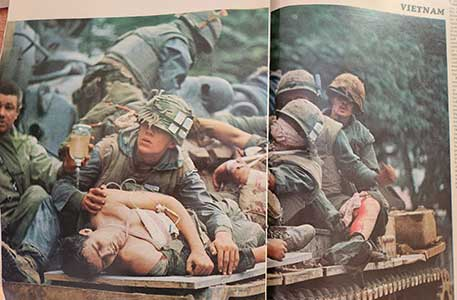
The Tet Offensive started on January 30, 1968. This was a coordinated enemy attack on U.S. and South Vietnamese military bases and cities launched simultaneously throughout South Vietnam. In the northern region, the NVA rockets and mortars struck the Phu Bai airstrip and the NVA and Viet Cong attacked the city of Hue. After realizing the extent of the threat to Hue and Khe Sahn near the DMZ, General Creighton Abrams established MACV Forward at Phu Bai in February 1968 to direct northern I Corps operations. The U.S. Marines which included the 3rd Reconnaissance Battalion played a central role in defending and operating out of the Phu Bai Combat Base in the battle of Hue. U.S. forces and the South Vietnamese Army (ARVN) battled the enemy block by block to recapture the city. For about a week the American forces were cut off from medical and food supplies. Jim spent most of his time at Hue helping with the minor and critically wounded. Moving from man to man he said ‘the bullets were kicking around you’. Photojournalist Catherine Leroy took a picture of Jim’s wounded being evacuated. The picture was published later that year in Life Magazine. For the men he couldn’t help he hopes that last rites gave them comfort. The city of Hue was cleared of enemy combatants by March 2nd.
After the Tet Offensive the 3rd Recon was sent to observe enemy troop movements throughout Northern Vietnam that took them close to the Laotian and Cambodian borders. Jim said they were in Vietnam but near the Laotian border when they came across a POW camp. They got near enough to the camp that they could see the prisoners. He says one of the prisoners saw them, but they did not have the fire power or wherewithal to get them out. He said walking away was one of the hardest things they had to do. Their one consolation was that they could report the camp position… On one of the Recon missions far north of the Demilitarized Zone a small platoon was issued AK-47 rifles that if fired would confuse the enemy. Jim said that the enemy knew they were there and when the acknowledgement click on their radio that told them to leave the area, the enemy knew their location. They ran for 26 hours back to the designated spot in the North China Sea where the PT Boats were waiting for them. He says he thinks it was fear and adrenaline that kept them going. They were so tired they could hardly swim through our own mine infested water to get on the boats to return to Phu Bai.
Jim says on any given reconnaissance mission they would get into skirmishes with the enemy. He credits his Marine backpack, his camera and a can of peaches for saving his life. After one encounter he opened his pack and found it wet and sticky. There was a bullet hole in a can of peaches and his camera was destroyed. Considering what might have been, he said he didn’t mind the mess.
It wasn’t all death and destruction in Vietnam. Jim delivered four babies for local village women.
After ten and a half months of being out in the field, Jim was sent to the 1st Medical Battalion Hospital in Danang. He worked with the wounded on their way home or back to the field. The most unpleasant job he had to do was making eighteen copies of the fingerprints of one hand of the killed in action soldiers and Marines. He attached one copy of the fingerprints to the death certificate for shipment home. If the hand was waterlogged they would pull the skin off the fingers and attach it to the death certificate. He said there was no shortage of bodies. The helicopters sometimes came in stacked 5 to 6 bodies high. Jim was promoted to an E-5 – Second Class Petty Officer.
To the amazement of his C.O., three days before his tour ended he volunteered to fly out to the site of a helicopter crash. They found one wounded Marine and four dead. They recovered the men and blew up the helicopter. Before flying back to the U.S. everyone was given the standard going home physical. They found four pieces of shrapnel in the left side of his body. He didn’t realize that he had this shrapnel. He thinks they came in through the armhole on his flak jacket when an RPG came in the window of a room he was in. The shrapnel weren’t in any critical areas and he pulled two of them out on the spot. The other two gradually made their way out over the next few years. Because of these wounds the doctor told him he would start the paperwork for a Purple Heart, but Jim said no. He was in a hurry to get home to his wife and three-month-old daughter, Christine. His wife had given birth to her while he was in Vietnam.
On January 1969 Jim flew out of Danang on a civilian airliner that was much nicer that the C130 plane he arrived in. He was happy to leave Vietnam, but really happy to see his family. He also would finish his enlistment at Newport Naval Hospital in Rhode Island. Airport arrivals at San Francisco and Bradley Field Connecticut were uneventful. A high school friend that was a Suffield police officer met him at the Bradley Airport and drove him home. After introducing himself to Christine and still in uniform, he and his wife went to a local Suffield restaurant. Unfortunately for him, four drunken college students began harassing him about being in uniform and going to Vietnam. Fortunately for him the owner was a Korean vet and kicked the students out and gave him and his wife a free meal.
After his leave in Suffield, Jim found an apartment for the family in nearby Fall Rivers. He reported to Newport Naval Hospital and because he was a short timer he was assigned rudimentary work on the day shift with no patient care. Sometimes they made him an ambulance driver. On January 1970 he was honorably discharged and the family moved to a Fall River, Massachusetts, apartment until they bought a home in Taunton, Massachusetts. Jim joined the Navy Reserves and was promoted to E-6, First Class Petty Officer during his six years in the Reserves.
Jim’s first job as a civilian was as a Business Repair Technician. He completed this training and worked for a company that sent him throughout Connecticut to fix every type of business machines, typewriters, copiers and commercial adding machines. In 1971 he started his own home improvement and repair business that he worked at in his free time. His son Michael was born in 1972. Jim decided to quit his job and work full time with his home improvement company. He didn’t enjoy working at a large company. He said his bosses didn’t understand what he had been through in Vietnam. The explosions in Vietnam caused him a hearing loss and he found it difficult to work with a large group of people. Working with his home improvement company he made a lot more money than fixing business machines. His company built homes, additions and any kind of remodeling. Jim and his wife divorced in 1973.
A few years later Jim met a woman on a Caribbean Cruise and they were married. She developed a serious illness and, since she grew up in Northwest Indiana, wanted to return home to be close to her family. In 1985 they moved to Hobart, Indiana. Jim opened the Grand Manor Home Improvement and Repair Company in Indiana. His wife died in 1992.
Home improvement’s need various construction parts. Jim used Menards as his parts provider. He was attracted to one of the cashiers, Mary, and worked it out to always be in her line. They married June of 1996. Jim says Mary should have been his first wife. Mary had two children, Art and Michelle. They are a blended family now with 5 children, 17 grand and 8 great grandchildren. Jim worked until he injured the tendons in his arm during COVID. He was not able to get the surgery he needed, and his arm didn’t heal well. He retired in 2024.
Jim says he likes tinkering with antique cars and tractors. He has a 1928 Nash sedan he’s trying to finish but can’t find parts for it. He did finish a Ford 9N classic tractor built between 1939 and 1942. The tractor came in bushel baskets and he put it together and got it running. Another of Jim’s hobbies is riding a motorcycle. A few years ago he was at a local Indiana event called the Victory for Veterans Memorial Ride. A veteran there called out, ‘Hey Doc Jim’. The guy introduced himself and told Jim he saved his life in Hue. Jim didn’t recognize him, but he remembers treating the injury—he was shot in the neck.
Jim says his wife feeds him well and makes him feels like a young 80 years old. After his time in Vietnam he has hearing issues, tinnitus and cancer. He’s not as jumpy and doesn’t wake up in cold sweats as when he first got back. The VA takes care of most of his issues. He and his wife enjoy traveling throughout the U.S. and Europe. Two weeks ago, they were in Las Vegas for a family wedding. With all his travels he has not been to our national capital to see the veteran’s memorials and is looking forward to his flight to D.C.
Jim no one will thank you more than the people you saved in Vietnam but we will try our best to show our appreciation for your service to our country! Enjoy your day!