

Navy Vietnam War Chicago, IL Flight date: 09/17/25
By Marilyn Lucas, Honor Flight Chicago Veteran Interview Volunteer
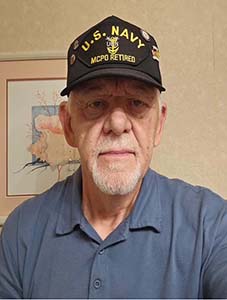
John Stajic was the only child of immigrant parents. John‘s mother immigrated from Borning, Germany and his father from Yugoslavia. The Stajics immigrated to the United States after John was born in Germany. While John was not a citizen, he was able to join the United States Navy in 1967 where he served until 1971. Citizenship was not mandatory. Our country was looking for a “few good men“ to serve during the Vietnam war.
Graduation from high school led to working in the steel mills. In 1967 the country was experiencing an aggressive draft of young men to serve in Vietnam. Like so many young men, John, wanting to avoid the Army, decided to enlist in the Navy at the age of 19. He went for an interview at the enlistment center on Van Buren in Chicago in the month of May. Not realizing he had signed papers committing to the Navy, a month later he received his notice for Boot Camp. He served boot camp at Great Lakes, Illinois. Due to the shortage of men for Vietnam, normal Boot Camp of nine weeks was shortened to eight weeks.
Excited about the opportunity to serve in the Navy, and of course, wanting a ship assignment John was disappointed when he was told he was too tall. He was assigned to honor guard duty for one year of his service. Honor guard duty focused on ceremonial tasks such as performing military funeral honors, presenting and guarding flags, rendering rifle volleys and taps at ceremonies, and participating in military and memorial events like change of command ceremonies. His particular honor guard buried up to two soldiers a day.
After one year John was sent on to Vietnam to ICORP in Da Nang. ICORP was the primary tactical zone for fighting the north Vietnamese and Vietcong in the north. Da Nang served as the headquarters for ICORP naval and air support activities and was a critical logistics hub for Allied forces. Due to its proximity to the DMZ and the VC infested area this region experienced intense fighting throughout the war. Upon arrival part of John‘s training was S.e.r.e. (Survival, evasion, resistance, and escape). They were forced into the woods to survive for three nights. John‘s description of this training… “Special forces men would chase you around and capture you. They would put you in a makeshift prison camp. Often, we were slapped around and punched in the gut, and verbally abused. This would go on for nearly 12 hours. By the end of the day you are in your underwear walking in feces, and then lined up with the intent to salute the VC flag. Instead of raising the VC flag they would raise the American flag, which would bring us to tears.”
In order to keep these special forces from being too aggressive in the training there were at least three guys in the training session to keep them in tow. Quoting John “what you experience is emblazoned in your brain.“
John and four others were told to take a helicopter to Hue. They sat all night waiting for this helicopter, which never arrived, and then we’re told to just take a truck. “No food, no blankets, no bathrooms, no guns, and advised not to travel at night. “Upon arrival John was assigned to manage a forklift taking ammo off boats and placing it on trucks. Thirty men lived in a hut guarded by the Marines. They were warned about hearing a loud warning “incoming“. This warning would often come between the hours of four and five in the morning. They were instructed to run out of the huts into ditches to avoid being killed. On a positive note, the local Vietnamese cooked and cleaned for the sailors. John commented on how kind the Vietnamese people were, most of them being of the Buddhist religion.
An interesting event involving a general resulted in a disciplinary trip to Da Nang for the LTJG and a few sailors. Upon the arrival of the general in a jeep a sailor jumped out and yelled “fall in“. The general proceeded to yell at the sailors for not saluting. The LTJG responded to the general saying “don’t salute without a cover” (meaning without a hat)… Thus the disciplinary trip to Da Nang to see the admiral. Everyone forgot their weapons but remembered their cameras. John, along with several others took this opportunity to find a beach, where of course women were sunbathing. To the surprise of everyone, these women were nuns from John’s hometown of Chicago that ran the local orphanage. The orphanage consisted of 300 to 400 children that were left in the rice patties because they were of mixed race. The sailors formed a kindred with the nuns and went twice a month to give their time to the children. John continued to have contact with the sisters after the war and has maintained a great friendship.
John was later assigned to the USS Halsey as a supply clerk. He was appointed to the Missile House Guard. No one was permitted into this area without a badge. On one occasion the commander arrived at the door requesting entry. John sheepishly refused the commander entry because he did not have the proper identification with him. Another officer was called to challenge John‘s refusal to the commander. John held his ground. In the end, he discovered the request was a test. Had John allowed the commander to enter without proper identification, he would have been court martialed.
For R&R John chose Hawaii. The trip to Hawaii afforded him the opportunity to become a United States citizen. An interesting fact John shared regarding citizenship while serving, If you are killed in a US war, you automatically become a US citizen posthumously.
Because of his fascination with water, John now in his late twenties, having returned from Vietnam reenlisted in order to attend a three-year diving school training. His assignment was to recover a propulsion system for the Smithsonian Institute. Currently, there is a photograph in the Smithsonian Institute of this recovery.
After returning to Chicago John continued to serve in the Reserves for 28 years. He attained the rank of E9, the senior most enlisted rank. One might say he had water in his veins. Serving was a part of his life, so John decided to take the Police and fire exam in Chicago. In 1977 he was accepted into the police department and assigned to a squad car. John quickly made a switch to the marine unit in Chicago. This was a dream come true. 28 years of service to the city of Chicago on the water.
John’s closing comment “I served to stop the spread of communism“ but “not sure what we did achieve during the Vietnam War.“ “We should not have been there“ it was a “political war.”
John, thank you for your years of service to our country. Enjoy your day of honor as you experience Washington DC.