

Army Vietnam War Chicago, IL Flight date: 07/23/25
By Al Rodriguez, Honor Flight Chicago Veteran Interview Volunteer
At 17-years-old Juan Sandoval was academically bored with high school and looking for a change of scenery so he enlisted in the Marines. For over 50 years his military career offered him plenty of that in hot spots like Bosnia and Iraq.
Juan said he has always lived in South Chicago, from his birth in 1956 at South Chicago Community Hospital, to schooling and retirement, he has never left, except when he was otherwise occupied by the military. He came from a family of ten children. In elementary school he was skipped a grade and started at Marsh High School at 13-years-old. In his senior year with an A average but low attendance, a couple of the teachers threatened to hold him back. A Marine recruiter visited the high school and he signed up. Because he was 17-years-old, he had to get permission from his parents to enlist for three years. With nine other kids at home his dad was happy to sign.
In November of 1973 Juan flew to Camp Pendleton in San Diego for basic training. He excelled in academics and physical fitness and finished basic training as a meritorious Private First Class. He was sent to Redstone Arsenal in Huntsville, Alabama, for Missile and Munitions training as an Ammunition Storage Specialist. They taught Juan how to check the stability of ammunition and munitions. He would take bullets and grenades apart to see if they were still viable, that the powder was dry and there was no resistance problems with it that would slow down the motion of bullets or grenades. He completed this on April of 1974.
Juan was ordered to the 3rd Force Service Support Group at Camp Henoko in Okinawa. This was a restricted base that handled all the munitions sent to the Indo/China region including the Marines still stationed in Vietnam. Okinawa was a training island for the Army and Marines. They would stage mock amphibious landings. They supplied the ammunition used by the Marines. Any ammunition not used was sent back to them. They had to verify that it was still functioning because they didn’t want to ship faulty ammunition to the troops. They blew up most of the claymore mines because there was no way to test them. Juan got his GED soon after arriving in Okinawa. After one year he was reassigned to Camp Pendleton in San Diego.
As a corporal at Camp Pendleton he was assigned as a supply change specialist. The Marine Corp was computerizing its parts inventory and Juan’s job was to make sure that the data entry matched the inventory. During basic training Juan never got a pass to see San Diego but now on his time off, he was able to see all the sights. He said he and a buddy would hitchhike everywhere. Once on leave, Juan hitchhiked all the way to Chicago. He also attended Chapman College while there. Juan was honorably discharged in November 1976, bought a motorcycle and rode it home to Chicago.
When Juan got home he went to work full time with the Pullman Company. He didn’t like the work and quit. For the next few years he worked many part time jobs. In 1978 using the G.I. Bill he decided to attend Chicago State University. With the encouragement of a friend he joined the Indiana Army National Guard in Hammond, Indiana. After about a year he decided to join the Illinois Army National Guard, 1903rd Engineer Aviation Battalion out of Midway Airport. They flew helicopter missions throughout the state. His training took him to Corpus Christi Army Depot in Texas to learn how to work with sheet metal for helicopter rebuilding and maintenance. The National Guard is part time work and pay, except two weeks in the year or if your unit is activated.
In 1982 the Chicago Police were recruiting for new officers at Chicago State University. Juan passed the entry test. He completed the Academy and was assigned as a Patrol Officer to his neighborhood in Chicago. He said that ‘he earned the respect of the people, even the bad guys’. This was his first full time job. On his Police application he stated that he was a member of the Illinois National Guard and would be called away for training. His intention was to be a Police Officer for about a year while he attended college. He came to love the job and the steady paycheck. The overtime pay was enticing and good money. One of the overtime jobs he worked was at one of Chicago’s Auto Pounds. He said it was easy duty. People would go there to pick up their cars when they were ticketed and towed by the city. No one ever shot at him there.
After being in the National Guard for a few years, Juan thought about being an officer and applied for Officer Candidate School. He was accepted and graduated in 1986. A year later he was commissioned as a 2nd Lieutenant. He was sent to the Aberdeen Proving Ground in Maryland for training as an Ordnance Officer in charge of heavy equipment, tanks, troop carriers, etc.
Since Juan was working as a Police Officer and serving in the National Guard, he could only go to college part time and in 1988 he graduated from Chicago State University with a Bachelor of Arts degree.
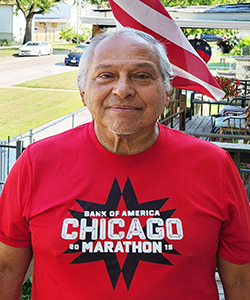
In 1991 he changed his Army organization and career. He joined the Illinois Army Reserves. They were looking for Public Affairs Officers and he was accepted. He was sent for training at Fort Meade Maryland. A Public Affairs Officer’s duty is to provide positive stories about the Army. He’d go out into the community near a military base to uncover good humanitarian stories about the soldiers stationed there. After Juan edited them for content, they would send them to the local and the military Stars and Stripes newspapers for publishing. In 1993 he was sent to Bosnia for nine months to cover the war. He had a journalist and an interpreter assigned to him and went out in the country for stories to send back to the U.S. When his tour ended he returned to Chicago. The Police Department told him he no longer had a job with them. Past practice in the Police Department was that they would hold jobs for people returning from active duty in all branches of the military. He sued and got his job back.
After 9/11 and the War on Terrorism, the demand for soldiers increased in the military. The National Guard and Reserve units were activated to fight in Afghanistan and later in Iraq. The people who served usually had civilian jobs that they left behind for long periods at a time.
The Army was in short demand for Civil Affairs Officers and Juan volunteered. He was sent to Fort Bragg, North Carolina, for training. A Civil Affairs Officer works with the local population to win their hearts and minds. In 2003 he was sent to Iraq. Since he was a police officer, initially he was assigned as a Police liaison Officer but since those positions were filled, he was assigned as an Antiquities Officer. His assignment was to preserve, document and archive the historic arts and monuments in Iraq. He was in a team of four that were assigned an interpreter.
Their first responsibility was to recover the art that disappeared from the Baghdad Art Museum that was bombed during the war. They brought back the curator who hid some of the art in his house. With the help of the other museum workers they found most of the art. The FBI helped in recovering some of the items. They drove to other sites in Iraq to make sure they were intact and that the art was still there. Although the Iraqi forces had surrendered there were snipers and insurgents that would shoot at their military vehicle as they drove through the towns. He was involved in many firefights. Juan received a Bronze Star.
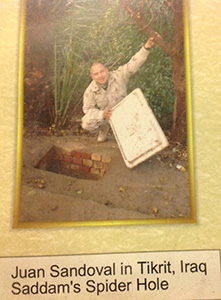
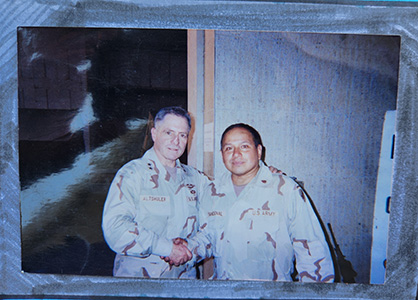
General Altshuler who was in charge of the Army Civil Affairs and Psychological Operations Command stopped by to thank Juan for his work and dedication. When Saddam Hussein was captured, the antiquities team was working in the town of Tikrit and was sent to investigate Saddam’s hideout. Juan had his picture taken next to the entrance. His 9-month tour ended and he returned to Chicago. Almost immediately, Juan was ordered to Fort Bragg, North Carolina, to help the Operations Officers in notifying Army Reserve units throughout the U.S. that they were being activated for service in Afghanistan and Iraq.
El Salvador had a civil war in 2003 and an ongoing conflict with Honduras. The U.S. kept a military presence there and in 2005 sent Juan as a Civil Affairs Officer. He was assigned to help the local government to maintain peace and stability. He traveled throughout the country with his interpreter. When his 9-month tour ended, he returned to Chicago.
In 2007 Juan received orders to go to Kosovo. Kosovo was having post-war stability problems politically and economically. He worked with Special Forces to distribute money to different villages to stimulate their economies. Other countries were there trying to influence them with their own political or religious reasons. He spent 9-months there and went back home.
In 2009 he was sent for training as a Provisional Reconstruction Officer. After completion, he was sent to Iraq to help rebuild the country and to promote democracy. Six years after the start of the war the country was devastated with the U.S. still fighting hostiles. He was assigned to the Al-Kut village about five miles from the Iranian border. During the war, Al-Kut had sustained significant damage to its infrastructure which presented health problems for the people.
In 2010 when he was transitioning to leave Iraq he felt sick but didn’t think anything of it. When he reached Kuwait on the next leg of his trip back to the U.S. he found that his feet were swollen. The local hospital recommended water pills but they didn’t help. The doctor recommended that he needed help from a specialized military hospital like the one located in Germany. Juan opted to go back to the U.S. instead. He said he was so weak they had to carry him on the plane. When he got back to Chicago, he went to several hospitals that could not find the problem. One hospital removed his gall bladder with no success. Juan was hospitalized at Jessie Brown V.A. Hospital and by chance a Northwestern doctor was performing rounds. The doctor order testing and found that Juan had an auto immune issue with his pancreas. He put him on immune suppressant drugs. In the meantime with his weight loss and weakness he could not work. He received a disability retirement from the Chicago Police in 2012. He received a medical discharge as a Lieutenant Colonel from the Army Reserves in 2015. The immune suppressant drugs have helped because he is healthier and stronger but he still has health issues. The V.A. has now acknowledged that Juan’s illness is service-related.
Juan didn’t let his illness keep him down and has stayed busy. Throughout the years, his hobby has been real estate. He buys houses to refurbish that he rents or sells and does most of the maintenance for his properties including a bar that he rents out to groups. He is a substitute teacher at the neighborhood schools for 2nd and 3rd graders and also teaches his family and friends how to perform minor car repairs. As a board member on his Vet’s Park neighborhood committee he helps to address neighborhood issues and to keep it safe, stable and to maintain their quality of life. He is the Vice Commander of Disable American Veterans Local 17. Also, he volunteers at the O’Hare USO and used to volunteer at the USO at Navy Pier until it closed a few years ago. He has three children and three grandchildren. Two of his children live out of town but his daughter Juanita lives nearby with her son and daughter. Juan has a pool and his grandchildren love to swim in it. He had previously heard about Honor Flight but while attending a veteran event at his local library that included an Honor Flight Chicago table, the volunteer manning the table convinced him to fill out an application.
While in the military, Juan has been to D.C. many times but never had the time to go to the memorials. He’s really looking forward to going to D.C. and seeing them now.
Thank you Juan for your decades of service! Enjoy your day in D.C.