

Army Vietnam War Lockport, IL Flight date: 07/23/25
By David Adams, Honor Flight Chicago Veteran Interview Volunteer
Larry Pluhar was born in Chicago but for his first decade or so lived in North Carolina. In 1959 his family returned to Chicago in time for him to start 6th grade in Evergreen Park. He graduated from Evergreen Park High School in 1966.
He has four siblings, a sister and three brothers. Larry is the proverbial middle child. All the “boys” served in the military: his older brother in the Navy, the younger one in the Marines, and youngest in the Air Force. Only Larry “made it” to Vietnam.
As was customary for an eighteen-year-old, Larry reported to the draft board in Harvey in late October 1966 just after his birthday. Seated in chairs he looked around and spied a rack of pamphlets each featuring Army service options. One caught his attention: “You can learn to fly.” “Good idea,” Larry thinks flying would surely be better than the infantry. He stepped out of line to call the Army recruiter. Taking a battery of tests, which he passed with “flying colors,” he got helicopters.
Basic and flight training
Larry enlisted in January 1967 but his entry on active duty was delayed. He had to be 19 when he graduated from flight school. He took basic training at Ft. Polk beginning in April 1967. An enduring memory is that there he “learned to drink coffee.” Overall he “got it easy” in basic. Why? His drill sergeant had just gotten back from Vietnam and wanted to get his “rocker.” The sergeant took several recruits headed for flight school under his “wing.” So, no KP, on the softball team roster, and forming a band. Larry played bass guitar. The one song he performed was appropriate for the times: “We Gotta Get Outta This Place” (recorded by The Animals).
Larry’s primary flight school, Warrant Officer Rotary Wing Aviator Course, located at Fort Wolters, Texas spanned July through December 7, 1967. Ft. Wolters was home to over 1,000 helicopters including the Bell OH-13 (Sioux). In Larry’s mind all the instructor pilots (IPs) were very good. Larry reminds that he is left-handed. One IP said, “you won’t make it” because of this. He had never seen a left-handed helicopter pilot. Flying a helicopter requires the pilot to grasp the collective by the left hand. The helicopter cyclic, on the “other hand”, needs constant, precise input. Pilots say that you typically can’t let go of it, ever. Larry would prove this IP wrong in primary, mastering helicopter flying then, and for the next 47 years.
December 1967 to May 7, 1968, found Larry in advanced flight training at Hunter AAF, Savannah, GA. There he learned to fly solely on instruments, an essential skill needed for combat in South Vietnam. He succeeded in flying the UH-1 Huey and logged an extra 50 hours in it. He found this additional training paid off. Tactics schooling occurred at Ft. Stewart, GA. Students lived in the field learning formation flying and how to haul external loads on a sling beneath the helicopter. Larry was awarded his Wings and appointed a W-1 Warrant Officer on May 7, 1968.
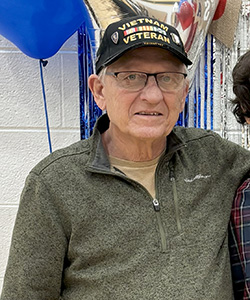
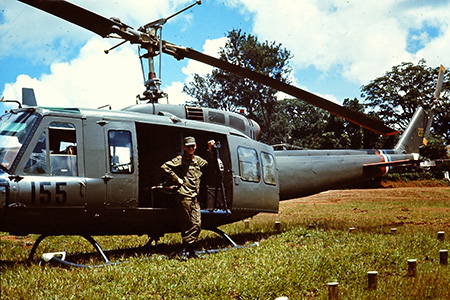
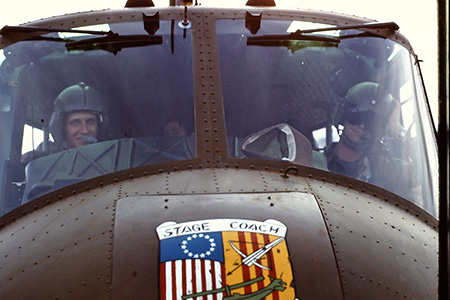
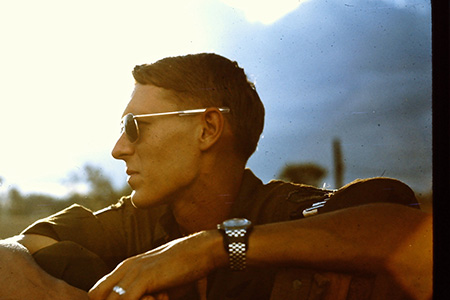
Ft. Riley 1968
Next he reported to Company C, 158th Aviation Battalion, 101st Airborne. Ft. Riley, KS. “I didn’t want to fly a helicopter that shoots at the enemy—they shoot back.” This battalion solely flew the “slick,” a Huey crewed by two pilots, a crew chief, and a door gunner. In contrast the Huey gunship is what the name implies, “wall-to-wall” weapons. The crews honed their skills in preparation for combat supporting the division. He deployed to Vietnam the next January.
Vietnam 1969-70
Larry arrived in Vietnam in January 1969 with 300 flight hours. His immediate task was integration into helicopter operations required by the 101st. He reported to Camp Evans which was north of Hue in I Corps. Attached to B Company for two weeks, Larry became “combat ready.” After the requisite number of familiarization sorties he was “kicked out of the nest,” so to speak. He was assigned to the 17th Aviation Brigade, 17th Aviation Group (Combat) at Nha Trang Air Base.
Arriving in South Vietnam in the monsoon season he soon discovered that cloud bases were about 1,000 feet above ground level (AGL). Instrument flight was needed to get “on top”. Depending on mission requirements, flight altitudes ranged from 1,500 to 2,000 feet AGL which Larry remembers is customarily “above the range of small arms fire”. Larry is among the nearly 100% of Huey pilots who “didn’t think of getting killed!” How could a pilot do his job otherwise? Formation flight by slicks was “loose” to and from an LZ. How close to fly into an LZ depended on how big it was, i.e., could it accommodate five Hueys or just one? Close formation meant within one to one-half a rotor disk apart.
A Shau Valley
During his five months at Nha Trang, the 101st conducted combat operations in the A Shah Valley. The valley was a major supply and staging area for the People’s Army of Vietnam (PAVN). Laos was to the immediate west. For days and days Larry and his helicopter brigade stood by “loaded up” waiting for the order to launch. Then the 101st finally gave the “combat assault” launch order. Larry led a five-ship formation and was among the 100 slicks involved. Troopers, or grunts, in each slick numbered six or seven, each with his 100 pound “ruck.” Overall Larry says, “a substantial load.” After inserting the troops at an LZ landing zone, the next missions involved resupply of ammo, water, gas and food.
When supplying the troops with ammo, the pallets were kicked out the door as the slick hovered. Merely seconds hovering in an LZ was a long time. Larry received ground fire frequently. But on just three missions did rounds hit his Huey, or as he put it, “got it aired.” He remembers that during helicopter ops in Vietnam the “most important thing to know—where is my fuel”. He refueled at various LZs between troop insertion point and main bases such as Camp Evans or Nha Trang. He was part of resupplying the 101st during the battle of Hamburger Hill, Hill 937.
Ban Me Thuot
After five months at Nha Trang and now a CW2, Larry joined the 155th Assault Helicopter Company at Ban Me Thuot in II Corps. This change was because most of the 17th Huey pilots had the same DEROS (Date Estimated Return From Overseas). To keep from sending all the brigade pilots home more or less at once, about one half got staggered dates and new assignments in-country. He would spend the last eight months of his tour at Ban Me Thuot. Once he accumulated 700 hours total time he became an IP and Aircraft Commander. He continued to fly day and night sorties. He took part in SFOD B-50, Project Omega, a cross-border operation into Laos and Cambodia for the purpose of conducting reconnaissance and intelligence. He inserted Special Forces troops then returned to a safe LZ to await notification to extract them.
October found Larry and his wife in Hawaii on R&R. A welcome visit to this tropical paradise coincided with his 21st birthday and just over a year after their marriage.
The volcano
The Central Highlands feature several extinct volcanoes. In the history of the 155th Assault Helicopter Company one stands out and is referenced only as “the volcano.” He and his unit frequently supplied troops located there. Larry remembers, and unit history records, his mission on December 4, 1969. He calls it “the worst flight I ever had.” They had confronted a “tactical emergency.” All slicks were ordered to land immediately and team up with Huey gunships and Cobras to resupply troops in the volcano. He maneuvered up and into the caldera. He saw the landing pad, hovered, kicked out the ammo, and loaded three wounded on stretchers, and four or five walking wounded. As Larry flew out a NVA soldier fired his AK-47 at his Huey. His copilot was seriously wounded. He was administered first aid to stop the bleeding. Larry then landed where further first aid was administered. Larry flew him to a hospital for additional medical care. He survived. The after-action analysis showed that, when matching up where the rounds entered and exited the Huey, at least one round narrowly missed Larry.
Logging 1,200 combat hours over his 12-month tour he returned to the States in early February 1970. He reported to Ft. Mead, MD, to become the assistant airfield operations officer. There he flew the H-13 and Huey. Larry was honorably discharged from active duty on November 30, 1970.
Returning to the States after Vietnam, his “welcome home” was at his Chicago home with just family. Posted to Ft. Meade and surrounded by military and government installations and agencies he did not experience what many other Vietnam veterans have reported, for which he is grateful.
Illinois Army National Guard 1972-1997
In 1972 he joined the Army National Guard flying out of Midway. He flew the UH-60 Blackhawk and CH-47 Chinook. At first he served part-time and later full time from 1989 to 1997. Deployments included one to Alaska for Operation Brim Frost, a series of large-scale, biennial, joint military exercises primarily focusing on arctic warfare and training in cold weather conditions. They spent three weeks in the arctic tundra with their helicopters. He also participated in various deployments to Panama and Germany. He retired as a CW4 on the last day of 1997.
EMS 1999-2017
In 1999, almost immediately after retirement from the Guard, he was hired by EMS operator Air Evac Lifeteam. He began flying the Bell 206 from the Quad Cities. When he started with the company it had just eight operational bases. He remembers that it was a good place to fly because it was “where everybody knows your name.” He opened the company’s 145th base before he retired in 2017.
Larry flew for 29 years in the military and for 18 years with EMS, a grand total of 47 years in helicopters. Among his numerous awards and decorations are these: Air Medal with numeral “8”, Vietnam Service Medal, Vietnam Campaign Medal with 2 stars, and Republic of Vietnam Gallantry Cross Unit Citation.
Married now for over 56 years to Etta, she and Larry have a son, daughter, and four grandchildren. Larry volunteers in the ER of Silver Cross Hospital in Joliet. He is a Life Member of both the Vietnam Helicopters Pilots Association and the Vietnam Veterans Association. At VFW Post 725 in Mokena he is the current Junior Vice Commander.
Regarding his Vietnam in-country service he says, “I loved it. Flying in Vietnam was a job. I wanted to make flying my profession and be the best at the task.” He would ask, “what’s the job today? Let’s get it done!”
Larry, you have more than earned your Day of Honor in Washington. Enjoy every minute!