

Army Vietnam War Fontana, WI Flight date: 08/20/25
By Al Konieczka, Honor Flight Chicago Veteran Interview Volunteer
Robert and his three siblings grew up in the northern suburbs of Chicago. As a very young boy, he recalled a time after his father, a World War II Navy veteran, returned home and they lived in a co-op on Custer Street in Evanston. A co-op refers to a residential unit within a housing cooperative, where residents “own” shares in the entire building rather than individual units. “That place was filled with veterans who just partied like there was no tomorrow after they got back from the war. And then eventually my father bought a house in Skokie. And at that time, those places were filled with prairies and all kinds of different things you could do as a kid. We would dig forts, climb trees, build tree forts and we rode our bikes all over hell.”
After finishing high school, Robert began attending college at Southern Illinois University. “I had a lot of fun down there, maybe too much fun and they asked me to exit the university. They were drafting people who didn’t carry a full load, which was 15 hours. There were a few times that I didn’t carry a full load and then when they asked me to leave, I was just about to be drafted anyway and so I just said, well, to hell with it, I’ll just go in. That was in November of 1968, a pretty crazy time in the world.”
Robert headed off to basic training at Fort Leonard Wood, Missouri, and didn’t enjoy it at all. “It was a miserable place, I got to tell you, because it was out in the open, out in the middle of nowhere, and the wind would howl down there, and you were outside half the time. It was really a wake-up call for a kid from the northern suburbs, I’ll tell you that.”
After basic, Robert headed off to Fort Lewis, Washington, for advanced infantry training (or AIT) and wasn’t too fond of that base either. “We were outside like every day during the week except for weekends, training out there. We were constantly wet because it rained like crazy up there. I think I only saw Mount Rainier about four times in total while I was there.”
After AIT, Robert received a 30-day leave and went back home and just partied the whole time before leaving for Vietnam. He thought it was strange that all of the drafted soldiers travelled to Vietnam individually and not together as part of a unit. “In the beginning of the War, they went over by boat as a unit. The initial surge was all unit driven. And then, I guess they just wanted to, in the name of fairness, do it 1 by 1 because then they could much more easily say, look we’re treating everybody fairly with this draft. I actually think that was a detriment to the war effort because if you were with a unit, you had so much more cohesion and you weren’t having different guys leaving every other day or whatever it was.”
So at the age of 21, Robert boarded a plane and headed off to Vietnam. His plane stopped in Guam and then Japan before reaching Vietnam. He recalled while in Japan seeing an episode of the Lone Ranger in Japanese and thinking it was pretty funny. But the fun would soon end because he had no idea what lie ahead of him once he landed in Vietnam. “You know I had lost a couple of friends in Vietnam, before I even left home. And I don’t think one’s expectations can really meet the reality of what it really is. Being on that plane alone, knowing where I’m going was a difficult emotional experience. Because if you’re with somebody else who’s doing the same thing, then at least you’re both in the same boat and there’s some comfort in that. When you’re alone, you’re leaving behind everything you’ve ever known.”
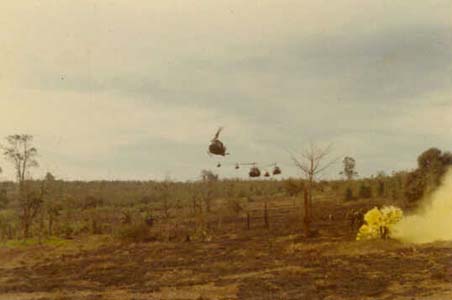
Robert recalled flying into Saigon and then travelling by truck up to Bien Hoa. He received his gear and his uniform but no weapon. He first had to go on the rifle range and qualify. He performed very well and was selected as a member of the 1st Air Cavalry and was only there a few days before being air lifted out into the jungle. He recalled a funny story on that first helicopter ride. “It was a Huey. It wasn’t anything big. I was in the back with somebody else, and then there was the pilot and the co-pilot and the gunners. The gunners were back there, door gunners. And I hear this whoosh sound, and the pilot and the co-pilot’s heads jerked and looked at each other. And I told myself, whatever that whoosh sound was, was not part of the deal. So, I have a feeling it was some kind of rocket shot at our helicopter. I definitely heard the sound but things were going so fast. It didn’t hit us, so we were lucky.”
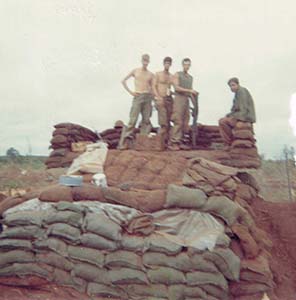
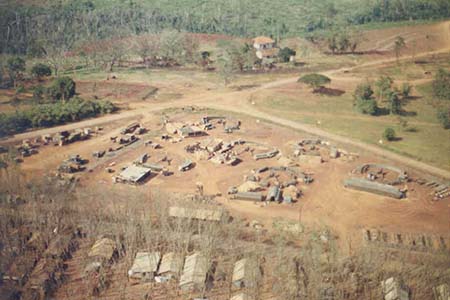
That first helicopter ride would land him at a place called LZ Dolly, a US Army landing zone located on the northern end of Razorback Ridge, approximately eight miles northeast of Kontum. It was on a high peak and full of communications equipment because it was a good location to transmit from. Even though the position was lined with barbed wired and filled with mines, claymores and flares, the position was still vulnerable. Robert and his unit would pull palace guard duty for about 5 or 6 days at the fire base before heading out into the field. That was the rotation pattern for Robert throughout his time in Vietnam. He would jump from firebase to firebase but spent most of his time out in the jungle.
During his time in the jungle, Robert had two different company commanders with two very different approaches to combat. “The first company commander was a believer in breaking jungle. We would chop trees or anything to use as roof cover and then sandbag that and dig a hole down about four and a half or five feet. We did that every day as long as I was with them. We would put out claymores, trip flares, listening posts, all kinds of stuff. But I never understood the military wisdom of that, because you made so much friggin’ noise. The second company commander liked us to walk trails, you know, enemy trails and that was a dangerous business. So we changed tactics there. We did run into more and more short, sporadic firefights when we were doing the trails. And they didn’t expect us there because it was kind of a mantra of infantry units, you don’t walk trails.”
In fact, Robert told me he actually felt safer when he was in the jungle. “You know, those fire bases were vulnerable. The fire base camp was stationary, so you knew the enemy was always trying to get in there. You knew there was always danger around those fire bases depending on the location. It seemed to me that the closer the fire base was to the Ho Chi Minh Trail, that’s when the VC would really make it uncomfortable for you. All in all, looking back, I think I was safer in the jungle in so many respects, but that’s just hindsight right now, I guess.”
At night Robert and his company slept in the jungle on top of their ponchos. “Usually your shift on watch was either an hour, hour and a half or two. Two is a long time. So if somebody would fall asleep, which happened, then you’re vulnerable. When you lay down on the ground with a poncho liner, you don’t know what you’re lying on top of. A lot of times they were red ants underneath us. And those things would come out and they had pinchers. They would come up out of the ground and they would try to get inside and draw blood. That’s how ferocious they were. So you’d have to just struggle through the night. And I won’t even mention the monsoons because then the next thing you know, you’re floating away somewhere. That’s why it’s called a jungle I guess.”
The clothing worn by the soldiers in Vietnam many times was worn for up to a month before fresh clothes were available. This was especially challenging for those like Robert who spent most of their time in the jungle. “Many times we went 30 days being in the same clothes. I’m telling you, some of it was just rotting off you. When I first went out to the field, I went out with this guy who was a Mormon. He had some kind of underwear that was considered a holy cloth. I was told early on by someone, you just don’t wear underwear in Vietnam because you’ll get jungle rot. So this guy came out, and I could tell from the minute I saw him, this guy wasn’t going to last very long in the field. Sure enough, he got a huge rash from his underwear and they made the guy the company clerk.”
During his time in Vietnam, Robert spent most of his time near the Cambodian border. “We were up in a place called the Tây Ninh province, near the Cambodian border. It’s a big area that the NVA would use to come down and terrorize these villages. You never knew who was who anyway. Because of where we were, we were in a free-fighter zone. Anything that moved could be shot. And believe me, that’s what happened. We all had hair triggers. For us, you couldn’t trust anybody and you never knew who was who, you know, it was so difficult.”
Robert even became squad leader for a short period of time, but not by choice. “I really wanted no part of that job, but due to attrition and by rank, that’s why it fell to me. So I did it for about, I want to say three or four weeks maybe.”
Despite being in the jungle for a month or more at a time, they did receive supplies and mail from home on a regular basis. “You know, the log birds is what we would call the guys who would bring mail. So, I would write home when I could. One of the saddest days is when you don’t get any mail. One time I got a letter from my sister. I’d read it and I thought I had put it in my rucksack, but apparently it fell out. Then a guy from another unit found it. And he actually wrote my sister and continued to write her for years after the war.”
After his time trekking through the jungle near the Cambodian border, Robert was sent to Quản Lợi Base Camp, a U.S. Army and Army of the Republic of Vietnam (ARVN) base east of An Lộc, Binh Phuoc Province, in southern Vietnam. The base was established in 1967 on the site of a former French rubber plantation. Robert recalled the difference in weather and combat conditions around that base.
“There were a lot of enemy soldiers in the rubber plantations. A lot of the plantations were French-owned. And it was cold in there because the tops of those rubber trees shut the light out pretty much. And nothing really grew very well in there. So the fields of fire were pretty good, except for the trees obviously. But whenever the cavalry would go in, the 11th Armored Cavalry would have to go with us with the tanks, half-tracks and APCs. The enemy had those hidden bunkers and they really blended in. The guys would come on top of those bunkers and they would twist their vehicles. The weight of the vehicles would crush the bamboo structure underground. Sometimes, enemy soldiers would slide out the sides and run and that’s when the infantry would just pick them off. That was kind of standard operating procedure in there.”
Despite facing horrible conditions in the jungle, Robert did receive R&R twice during his tour in Vietnam. On one trip to Hawaii he got in a lot of trouble just being on the loose. “I was just driving one of those dune buggies all over the place. I figured going to jail would actually be better than going back to Vietnam. But they only said, look, you’ve overstayed your welcome and you’re going back to Vietnam.” Robert and his same buddy also went on R&R to Sydney, Australia which Robert admitted was a much better place for them. “Kings Crossing was a beautiful place. We saw Sammy Davis Jr. in this bar when we were there. He was a pretty short guy but talented as hell, I’ll say that.”
Near the end of his service in Vietnam, Robert was pulled from the field and assigned to be the Quản Lợi company armorer. He joked about that assignment, “You know, I could tell you which end of a weapon was which, but beyond that, I don’t know why they made me the armorer. It was kind of a sweetheart deal in a way. I had my own little office deal and what I would do is repair weapons or find parts and send them out. There was a lot of talk about Vietnamization at that juncture of my time in Vietnam. We weren’t getting new M-16s. They were sending them to the South Vietnamese. So, we would have to find parts all over Quản Lợi to repair weapons, you know, firing pins or whatever they needed.”
Robert’s tour in Vietnam was set to end on May 3rd, 1970. But by then, the US was starting to pull troops out in fairly decent quantities. So soldiers that only had a very short amount of time left in country were sent home early. However, as Robert explained, many men were not so lucky. “As it turned out, I was lucky. I left Vietnam on April 12th. On May 1st, they took the Air Cavalry, I don’t know how many regiments, and airlifted them into Cambodia from Quản Lợi, from where we were stationed. And our rear didn’t exist anymore because they all wound up in Cambodia. And you’re talking about a lot of guys, a lot of guys who were now out of the army, and were trapped in Cambodia. They couldn’t get them out. So for all intents and purposes, they were civilians stuck in Cambodia. So I’m glad I missed that little soiree, I have to say.”
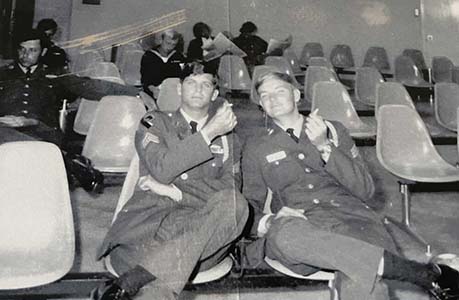
Robert and his buddy, Phil, flew from the base in Bien Hoa to Oakland, California, and he was finally back on American soil. While he was excited to be home and away from Vietnam, the war at home was still raging on. “There were a lot of protestors out there. Some of the guys were taking their uniforms off and putting them in the trash. Not a lot, but some. I never understood that, frankly. And Phil and I sitting there in the airport in uniform remembered the line from the movie Platoon. All we had to do was get out of there and the rest was gravy.”
Robert was finally home and safe and could now begin to enjoy the gravy he had earned in Vietnam. “I think that picture with me and Phil in the airport, that’s exactly the look on our face, you know? I should be frank with you. I never knew at an early time that I would ever have to go through anything resembling, or even getting close to the experience that I had in Vietnam. Nothing could have been worse than what we had to do there. I mean, it was difficult. Nothing in the world was ever going to touch what we did. That’s how I feel about it today. You’ve experienced the worst that you could possibly ever do in the world. Anything else in life after that was going to be nothing compared to what happened in Vietnam.”
That mantra ‘The Rest is Gravy’ would help Robert in his civilian life and in his career the rest of his life. To this day, he still uses it. Robert went back to college to finish his degree and then did a few odd jobs just to make a little money. His brother then got him a job with a company selling bricks and other hard materials. He really enjoyed the sales aspect of the industry. He would sell to architects and builders down in Chicago. He credits his time in Vietnam with his success as a salesman. ”It really helped me in terms of not being afraid to sell. There was always talk about this guy or this woman who was so ferocious. None of it ever scared me. I was respectful and I think when you have a lot of confidence, there’s an aura or an air about you when you walk into a customer’s office. So not bragging, just confidence, that’s all.”
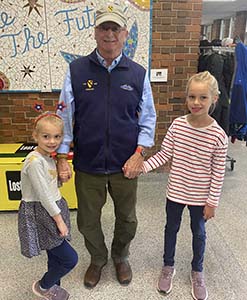
Robert ultimately moved into the printing business where he stayed the rest of his career. He even opened his own printing business with his brother and finally sold it in 2024. He married a teacher named Sharna 47 years ago and was blessed with two daughters and two granddaughters. Robert and Sharna now live in Fontana, Wisconsin, on the western end of Lake Geneva where they have lived and visited on and off since about 1977. Robert and Sharna are both pickleball players and enjoy retired life.