

Air Force Vietnam War St. Anne, IL Flight date: 09/17/25
By Kenna Rathai, Honor Flight Chicago Veteran Interview Volunteer
The desire to fly has been at the heart of nearly everything Rodney Franklin has done in his life, including graduating college, becoming an Air Force fighter pilot, a pilot instructor, and even air taxi operator in Hawaii.
His love of aviation started in high school, when his older brother took him up in his Aeronca Chief single-engine, side-by-side and they’d “buzz the tower” over farmers as they worked the fields near St. Anne, Illinois. Franklin was raised on a hog and cattle operation in the area, noting it was “a great place to grow up.” He earned his student pilot’s license when he was still in his teens.
Although several members of his family were in the military — his father served stateside in World War I, his older brother served as a tank commander stateside during the Korean War, and another family member served in World War II — he had no plans to join the military. In fact, he wasn’t sure what he wanted to do after high school…so he figured he should try college and enrolled at the University of Illinois Urbana-Champaign in agriculture.
He discovered that participation in the university’s Reserve Officer’s Training Corps (ROTC) could lead to an Air Force officer commission and then pilot training. That was the only motivation he needed to commit to higher education! However, his study habits didn’t match his ambition to fly. He was put on academic probation and believed he wasn’t cut out for college.
He connected with one of his elementary school teachers, explained the situation, told her he thought he studied hard but that he planned to quit. Her words of wisdom: “Don’t just study hard, study until you know the material. If you have a book to read, read it until you know what it says. If you attend a lecture, understand what was said and write it out yourself.”
He took her advice, learned how to study better, and made it through. He was commissioned as a Second Lieutenant in the Air Force after graduation.
There was one advantage of having to take summer school after his freshman year — he met his future wife, Connie. One of his friends lived in Champaign that summer. When Franklin visited his friend, he noticed an attractive girl was mowing the lawn across the street. After repeated attempts to take her out for coffee and getting a “no” every time, she finally agreed.
Although she moved back home to Miami to go to nursing school, they kept in touch, dating all four years of college, then marrying. During their 44-year marriage, they traveled the world and had four children. His first daughter was born the same day he received his pilot’s wings.
“That was a special day, not many others stand out like that one,” Franklin remembers. “On graduation day from Laredo AFB, I was nervous, because Connie had started having labor pains that morning. I was thinking let’s get this thing over with because I didn’t realize it sometimes took several hours for babies to be born.”
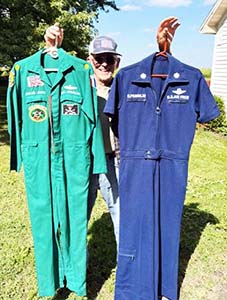
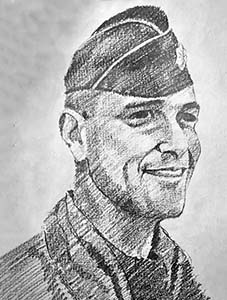
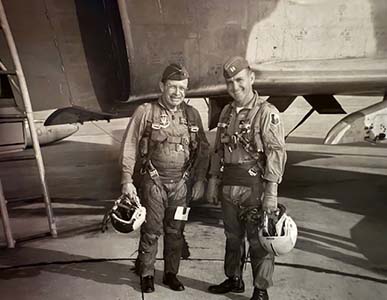
He also remembers that year of pilot training as very intense, especially academically. He says no one would have recognized him based on his past school records. He was an excellent student and an outstanding pilot; he graduated in the top five of his class and was able to pick his assignment.
He chose the F-86 Sabre Jet, a single-seat, transonic jet fighter aircraft. “I saw John Wayne fly that airplane in a movie.” He loved flying on his own, called it a “thrill” to learn the ropes with his instructor flying in a different plane next to him.
His skills earned him the responsibility of teaching others not long after he got to Perrin AFB in Grayson County, Texas. The United States was selling the F-86 to several foreign countries. Their pilots came to Texas — and to Franklin — for instruction. His wife and family became hosts for visiting pilots and their families, serving them Friday dinners and taking them to church on Sundays.
“Connie had that gift of making people feel welcome,” he said. “And we kept hearing how much it meant to people to be in our home.”
The Franklins’ home moved to Okinawa, Japan in 1961, where his role as a fighter pilot focused on Air Defense Command for both Japan and the Philippines, flying an F-102 Delta Dagger. His unit was tasked with the mission of protecting the air space from hostile aircraft and other airborne threats through detection, identification, interception and destruction.
He remembers one “scramble,” when fighter pilots had to rush to their planes and get airborne as quickly as possible, in response to a threat. It ended up being an off-course Navy pilot. Franklin took a couple extra minutes to fly low and appreciate the sun coming up on the island. He saw the beauty in everything. The Japanese fisherman in his little boat likely did not see the beauty in a beast of an airplane coming right at him. But they waved to each other!
The Franklin family then spent about five years at Eglin AFB in the Florida panhandle, where Rod got special treatment as he and other crew members personally picked up F-4 Phantom IIs from McDonnell Douglas in St. Louis. “We were celebrities,” he said. “Everyone in the manufacturing plant wanted to show off all the improvements they’d made to the design and instruments on this long-range supersonic fighter jet. The people who built those planes were so proud and excited, that was a real treat to be with them.”
He continued to instruct new pilots, but now the stakes were higher. They were preparing to go into combat in Vietnam. This was real. His students were being captured and killed. Some came back, but many didn’t. And it was a turning point for him.
“I couldn’t in good conscience send people out to do something I’ve never done.”
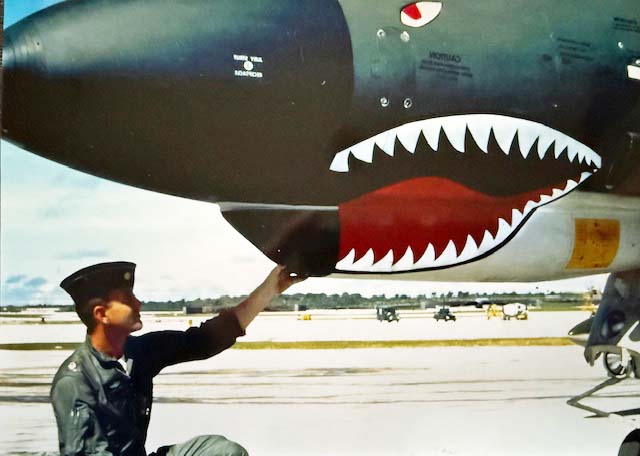
He deployed to Thailand in 1968 in one of just 20 or so gunship planes painted with the iconic Flying Tiger shark mouth design. It was technically illegal to have decorative paint jobs on the planes, but Franklin overheard a four-star general tell his commander, “The planes shouldn’t have any markings on them. You know you have to get rid of those paint jobs? But don’t be in a hurry.” Everyone was proud of those planes!
One of Franklin’s most memorable experiences was getting to know a fellow pilot named Emo. He helped train him specifically for combat missions and they went to Thailand together. “He was special, a great, personable guy.” However, Emo didn’t really believe in God. He’d say he was “okay, good enough” when Franklin would talk about the importance of a relationship with God especially since people were shooting at them every day.
Emo was on dawn patrol one morning — when pilots left by 3:45am to clear the Ho Chi Minh Trail while it was still dark, then monitor for threats — when he crashed on takeoff due to bad weather and confusion with ground lights.
“That sucked the air out of me, it changed who I am. Emo wasn’t interested in spirituality, but I really cared about him and that was a defining moment for me. If I care about you, I’m going to ask you about your relationship with Jesus. And I’m going to keep asking and talking about it, although I know God is the only one who can truly touch peoples’ lives.”
Franklin and his unit were trained to fly F-4E Phantom II fighter jets equipped with an internal Gatling cannon for combat. But within months of when Franklin arrived in Vietnam, there was a bombing pause that lasted the entire year he was stationed there. “It was okay with us, but a little disappointing, too, that I couldn’t help more.”
He made a few more stateside stops during his career, including the Air Command and Staff College in Alabama, where he served as commander of the student squadron. He also spent a couple years at the Pentagon, presumably because he was being promoted, but it was a miserable experience. After two years, he was able to return to pilot instruction at Reese AFB in Lubbock, Texas. He ended his career with staff work in Hawaii.
But he didn’t want to quit flying. “The staff work was boring. It was the first time I was at a job where I didn’t fly, and I didn’t care how I was going to do it, but I wanted to keep flying.” The Air Force allowed him to take a side job with the Hawaiian Air Tour Service, so he got his wish.
He retired from the Air Force in 1979, and the family stayed in Hawaii for another year so their son could graduate from his high school. He worked at a Christian counseling and medical center while there. Then they moved back to St. Anne, Illinois, and eventually helped re-start the area’s Youth for Christ organization and he became its executive director.
He continued to follow God’s lead, and returned to Hawaii to serve with the Bible Institute of Hawaii. After four years, he and his wife, Connie, returned to Illinois to deal with her dementia symptoms. She passed away in 2001.
God continued to be a force in Franklin’s life, as he earned his Master’s degree in counseling and led Bible studies at church. In fact, he met his second wife, Donna, at church, several years later. They were friends first, and eventually married in 2004. “She was a gift from God, and I had 19 wonderful years with her.” Donna passed away in 2023, also from dementia complications.
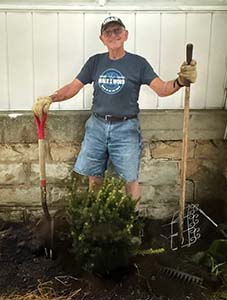
Franklin continues to be active in his church and still lives on his family farmland. He never dwells on the negative, and is excited to join an Honor Flight. We’re excited for you!