

Air Force Vietnam War Aurora, IL Flight date: 05/20/26
By Christina Nichols, Honor Flight Chicago Veteran Interview Volunteer
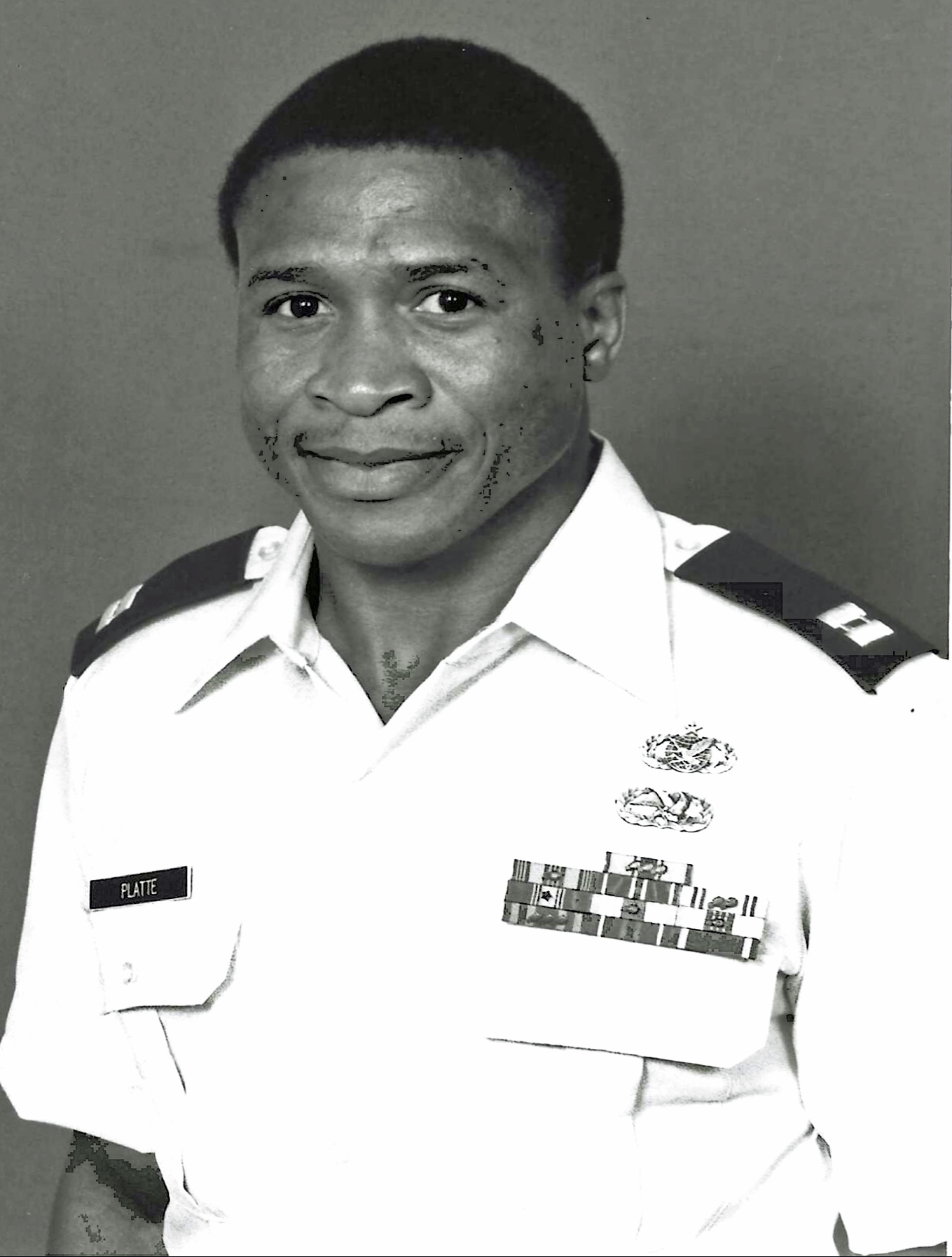
Captain Trainimair Platte, a native of Jacksonville, Florida, proudly served his country, like multiple members of his family had done before him. Trainimair’s dad served in the Air Force, his half-brother in the Marines, and his cousin in the Navy. Yet, the most significant reason that Trainimair decided to join the military is because he recognized and appreciated the value and usefulness of the GI Bill. Regarding his selection of the Air Force, Trainimair enlisted in it, specifically, because of his desire to learn how to fly. However, in 1973, when Trainimir enlisted in the Air Force after several months at Florida Junior College (which he attended prior to making any major decision regarding his future educational or career path), he never thought he would spend the next twenty years of his life in the military. That was not part of the plan.
Before entering college or enlisting in the military, Trainimair had achieved much success in high school, having the distinction of being on the honor roll and in the top ten percent of his class. He was also an exceptional athlete, running track and wrestling all four years of high school, later becoming one of the best wrestlers in the country! Knowing Trainimair’s capabilities, and the likelihood that he would continue to find success in whatever he pursued in life, Trainimair’s wrestling coach reached out to The University of the South, in Chattanooga, Tennessee, where his coach was an alum, to explain that he was coaching a star student-athlete. The University of the South proceeded to offer Trainimair a full academic scholarship. However, he turned it down, knowing that he was more interested in pursuing the opportunities that could arise from the GI Bill. In addition, Trainimair preferred the flexibility that the GI Bill offered, including the amount of control it permitted individuals to have over their educational pathway, in contrast to the various constraints associated with an academic scholarship from a university.
So, after graduating high school in 1973, at the age of 19, Trainimair enlisted in the Air Force. He immediately left for his basic training at Lackland Air Force Base in Texas. Following this, he went to Rantoule, IL, to Chanute Air Force Base, which has since closed. This is where Trainimair completed, within four to five months, his technical training to be a jet engine mechanic. After finishing this training, in 1974, Trainimair left for Eglin Air Force Base, right outside of Fort Walton, FL. He worked as a jet engine mechanic as part of the 33rd Tactical Fighter Wing (the “Nomads”). Since Trainimair had known, already back in high school, that he wanted to be a mechanical engineer, he had taken courses, such as drafting, which helped prepare him for this work in the military.
After about three years, in 1977, Trainimair embarked for a one-year remote tour, where he continued his work as a jet engine mechanic at Osan Air Force in Pyeongtaek, South Korea, around forty miles outside of Seoul. In 1978, when he returned to Eglin, he moved over to the “test wing side of things,” where he not only worked on a different side of the base, but also where he learned brand new aspects of his job as a mechanic. While in Eglin the next few years, his learning did not stop. Rather, he continued to gain even more training and learned how to become a maintenance planner, scheduling maintenance for various aircraft and jet engines.
It is no surprise that Trainimair rose through the ranks quickly; he became a Tech Sergeant and later attended OTS (Officer Training School) at Randolph Air Force Base, outside of San Antonio, TX. OTS is only a few months long, but it is incredibly challenging. However, for Trainimair, as well as his fellow servicemen who had “already been in the military, it was easy for us.” Trainimair explained how the student became the teacher, because he and the other enlisted soldiers, “we know how things work, so we actually corrected the teachers,” who were majors and lieutenant colonels, but had never enlisted. Trainimair recounts how “we told them, you’re wrong…when they were trying to teach us how to write APR’s (airmen performance reports)…yes, we were pretty hard core.”
Once Trainimair graduated OTS in 1983, and now being awarded the honor of becoming an officer, he was sent to Grand Forks Air Force Base in North Dakota, where he stayed for one year as a Munitions Accountable Supply Officer (MASO). In this role, he was responsible for the inventory and maintenance of weapon assets, including both special and conventional weapons. Trainimair remembers that he, and those he worked with at Grand Forks, “maintained the best munitions inventory control of anyone in Strategic Air Command (SAC) and we even won an award for this.”
By 1984, Trainimair was sent back to Korea, to Kunsan Air Force Base, where he stayed for another year or so, and where he continued to work as a MASO. While in Kunsan, Trainimair was sent to the Philippines for TDY (Temporary Duty Assignment). Although Trainimair was only in the Philippines for 90 days, his time there was incredibly well spent and he accomplished what he set out to do, as had always been the case when Trainimair put his mind to something. Indeed, as a member of the HQ, PACAF munitions accountability conversion team, Trainimair converted and computerized munitions accounts at Clark Air Force Base, in Luzon, to a manual system. This system was the prototype for the PACAF command procedures. Trainimair recounts that he was the only officer on the team of everyone stationed there. As he explains, they “don’t normally send an officer to go straighten these problems out,” but thanks to his munitions background and his technical knowledge, Trainimair was the right person for the job.
Trainimair had requested to go on TDY because “the bargain was, if I take a remote tour, then I want a COT (Consecutive Overseas Tour) in Germany as part of the deal.” So, after wrapping up his work in Korea, Trainimair returned to America, in 1985, and entered Squadron Officers School (SOS) at Maxwell Air Force Base in Montgomery, AL. After another few months of rigorous training, Trainimair graduated from SOS and was sent to Germany, just as he had requested. While at Memmingen Air Base, in the Bavaria region, he was part of a joint American German flying squadron unit. Trainimair was very busy during this time in Europe, being that he had many distinct jobs including being a Special Weapons Launch Officer, Command Staff Officer, Transportation Officer, Logistics Officer, a Financial Officer and an Emergency Action Officer. In this last role, he was rated “Outstanding,” during HQ USAFE.

Outside of his work on the base, Trainimair was asked by his commander to represent JaboG 34 in the upcoming First German Air Division track and field championships. This made sense because Trainimair’s commander knew he was a skilled and successful athlete, so he wanted Trainimair to be an American member of the German track team. Trainimair took him up on this offer, and it was a good thing that Trainimair did! After all, he was so talented that, in the CFC (Continental Fitness Championship), Trainimair competed in four distances, the 900-meter, 3,000-meter, 5000-meter and 10,000-meter. In every one of these distances, most impressively, Trainimair took either first or second place, making him the overall CFC Championship winner.
Then, after enjoying three years in Germany, both professionally, and on the track, Trainimair moved to Bitburg Air Force Base, in the Rhineland region of Germany, where he was stationed for the next two years. He worked as a Combat Liaison Officer, where he drafted messages to higher headquarters that resulted in five million dollars in funding for spare parts! This work, which he did as part of the 36th Tactical Fighter Wing, contributed to winning the Daedalian Award for being the best in the United States Air Force in Europe (USAFE) because of the spare parts actions. In addition, while at Bitburg, Trainimair advised the Deputy Commander for Maintenance on the required action needed to maintain F-15 aircraft. He did an excellent job in this role since the aircraft maintenance at Bitburg was selected the best in United States Air Force in Europe in that year, 1989. Before his time at Bitburg was complete, Trainimair also received the Air Force Achievement Medal for single-handily arranging publicity for charitable events that helped to benefit St. Martin’s School in Bitburg. This not only helped the children with disabilities who attended this school but also promoted a positive relationship between the Air Force Base and local Germans.
By 1990, Trainimair learned about another incredible honor: he was one of the very few people selected to attend the Air Force Institute of Technology (AFIT), outside of Dayton, OH. Trainimair studied there for two-and-a-half years and attained a graduate degree in logistics management. He explained it is a particularly challenging program, one in which only 25-30 percent of the officers who were enrolled, ended up graduating, since it is, as Trainimair describes, a “pressure-cooker.” Once again, Trainimair found himself challenging his teachers because he realized, it did not matter if the person running the program was a major, he knew it was important to explain, “It doesn’t work that way, you’re wrong, and [even though this] made the teachers mad, he didn’t care since he needed to tell them the right way to do things.”
Moreover, while at AFIT, Trainimir authored his thesis, the first-ever on “pipeline logistics for base level operations…and it is still quoted today!” After graduating in 1993, Trainimair was sent to Hurlburt Air Force Base, outside of Fort Walton Beach, FL, and was assigned a new role involving the responsibility to control and maintain special ops assets. About a year-and-a-half later, on January 1, 1994, Trainimair retired from the military.
Upon leaving the military, Trainimair decided to send his resume to General Mills in Golden Valley, Minnesota. He immediately got the job that he applied for because a retired military officer, who worked in HR, recognized the significance of Trainimair being an AFIT graduate. In addition, each and every one of the twelve people that Trainimair interviewed with was impressed by his logistics experience because “military logistics is at least ten years ahead of corporate America logistics.” After completing his interviews, Trainimair was offered the job the very same day. Multiple people called him daily to “persuade him to come work for General Mills” and, after a week, Trainimir accepted the position as a Senior Logistics Planner. Trainimair worked in this job for a year, where he was “in control of three different plants in different areas of the country…providing production schedules and coordinating with marketing people, product managers, salespeople and quality control people.”
However, Trainimair decided, since he had never worked in one of the production plants, that he wanted to give it a try because “he wanted to actually learn how operations worked at the plant level.” To get this kind of experience, Trainimair moved to Chicagoland, where he worked in West Chicago at the General Mills Plant. He ended up really enjoying the work and decided to stay there for the rest of his career.
The people at the headquarters of General Mills had no issue with this so long as Trainimair agreed to stay on their special team, going from plant to plant, “decoding software programs to mimic what a human planner would do in a live planning environment.” Trainimair agreed, and proceeded to work for General Mills for the next 17-and-a-half years, until 2012. At that point, he became a logistics consultant for the next nine-and-a-half years, working at a firm where he was responsible for “the planning and logistics systems” for multiple companies, including Caterpillar and Harley Davidson. In addition, he taught employees how to use “SAP software because it ties into different aspects of logistics, including manufacturing, plant warehouses, quality control, production planning, and transportation.” Trainimair explained that SAP is “the most sophisticated manufacturing software program in the world, used by most Fortune 100 companies.” It is not only extremely expensive, but also requires educated people, such as Trainimair, to teach others how to set up and use these programs.
Reflecting on his life, Trainimir realizes that he has “had a very blessed life,” and he considers himself to be truly fortunate due to “all the experiences and skills, the complete knowledge set” that he gained thanks to his life-changing decision to join the military, which then later provided him the opportunity to be employed at huge Fortune 100 companies. On the more personal side of things, Trainimir is also appreciative that the military “accelerates your maturity because of the number of responsibilities you have as you move up the ranks.” Indeed, when Trainimair initially returned home from serving in the military, he recalls “looking at all his friends who had graduated college, and they seemed so immature.”
Moreover, one of the ways that Trainimair continues to showcase his commitment to the ideals he believes in, such as his work ethic and steadfast determination which he honed in the military, is that even in his retirement, which he has only been enjoying for the last five years (since 2021), Trainimair still works out at the gym for 2.25 hours a day for 90 straight days. He takes one day off, and then “gets back up on the wheel.” His training program is identical to when he was a kickboxer, which he became during the military. Much earlier than that, at just 10 years old, Trainimair “already knew how to fight,” due to the boxing he did at that early age. Later in life, by the time he entered the Air Force, Trainimair had expanded into martial arts by taking karate, eventually becoming a first-degree blackbelt.
For all the amazing ways Trainimair has served our country, as well as our local Chicagoland community, where he has worked as an election judge in Kane County for years, thank you for always making sure that any job you do, Trainimair, is a job well done!