
Army Vietnam War Cedar Lake, IN Flight date: 04/15/26
By Al Rodriguez, Honor Flight Chicago Veteran Interview Volunteer
Terry Welch says he’s lived a charmed life. It does seem that way. Despite being wounded twice during his one-year tour in Vietnam, multiple skydives and almost crashing his Cessna airplane, his life has certainly been charmed and interesting.
Terry was born in Yreka, California. His father grew up in the Calumet region and served in the Army Air Corp during WWII. When he was a toddler, his father decided to move back to the Calumet Region and Terry grew up in Hammond, Indiana. As a teenager, Terry attended Gavit High School. He became interested in flying and got his pilot’s license flying small airplanes at what is now called Lansing Airport in Lansing, Illinois. In those days, he said the airport runway was a grass covered meadow. In 1967 he graduated from Gavit High School and was hired by the Illinois Central Railroad. He worked there for about a year until Uncle Sam requested his services and in June of 1968 he was drafted into the Army.
It was early summer when he arrived at Fort Leonard Wood, Missouri, for basic training. What he remembers most, besides the sergeants yelling at them, was the heat and humidity. He could see the salt marks on the shirt of the guy marching in front of him. After successfully completing his basic training, he was sent to Fort Ord, California, for Advanced Individual Training to become an infantry/rifleman. Terry learned how to use various firearms and explosives. He said Fort Ord was close to the Pacific Ocean but he never got a chance to enjoy it. When he was at the end of this training, their instructor told them that most of the class was being assigned to Germany except for four or five trainees. He said he relaxed and thought he wouldn’t go, even phoning his parents to tell them not to worry. Unfortunately, when he got his orders, they were for Vietnam.
In October 1968 he arrived at LZ Betty in Phan Thiet, Vietnam. LZ Betty was the landing zone camp for the 101st Airborne Division, 506th Infantry Regiment. In WWII the 506th was highly decorated in Europe. Terry was assigned to the 3rd Battalion and A Company. He said he hoped that being there in October the weather would be cooler but once again he found himself in sweltering weather. The 3rd Battalion was Airmobile using helicopters to deploy and supply the troops during search and destroy missions. Terry said he spent most of his time out in the field. A Company once spent 120 days out in the field being resupplied by helicopters.
As he became a seasoned soldier he was assigned as an RTO, radio operator. On one mission, as Terry was helping to fortify a perimeter for helicopter landings, he was shot by machine gun fire in the left upper thigh and the right hip. He said looking back at it he feels lucky it wasn’t a sniper or he would probably be dead. The medic who treated him cut his pants off to treat the wound and gave him morphine for the pain. He said the helicopter sent to evacuate him was under fire and the gurney to take him up was damaged and fell to the ground. The crew jerry rigged a tool box to get him aboard. He thought it was funny and probably a sight to see, him up in the air pant-less, on top of a toolbox or maybe it was the morphine that made it seem funny. They took him to LZ Betty and from there to the 67th Evacuation Hospital near China Beach.
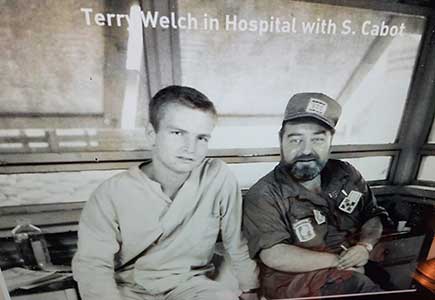
As they brought him into the hospital a nurse yelled at him to take his hat off inside the building. The doctors checked his wounds and found that the bullets hit close to his buttocks and was not serious enough to send him home. His therapy was to walk and heal. He even swam in the South China Sea. He always remembers the day he was shot because it was Richard Nixon’s first Presidential Inauguration, January 20, 1969. While in the hospital the actor Sebastian Cabot with the USO stopped by to say hello.
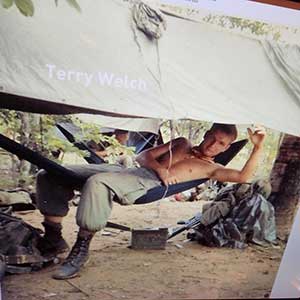
After a few weeks he healed up enough to return to LZ Betty and his old unit continuing with the search and destroy missions. The war was not just with the enemy but insects, reptiles and the monsoon season. He said once he was bug bitten and his left leg was double the size of his right. During the monsoon season he tried everything he could to not sleep in the mud. He bought a hammock and used a tarp overhead to keep himself dry. He remembers once that they were ordered to move out in the middle of the night. They had to gather their stuff and move to a new location, not an easy task with no lights and walking in the dark.
On his last mission his CO, Terry and two other soldiers were walking to the top of a hill to scope out a helicopter landing strip. He said typically the path up the hill would be booby trapped, this time the anti-personnel mine was set at the top. The first soldier stepped over it but the next one stepped on it. All four were wounded, some worse than others. Terry had shrapnel throughout his body. He didn’t realize his face was bleeding when he radioed for help. At the hospital they removed most of his shrapnel and cleaned out his wounds. Today Terry still has shrapnel in his body. Since he was close to the end of his tour, they didn’t return him to the field.
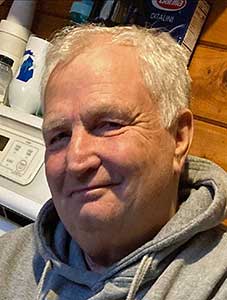
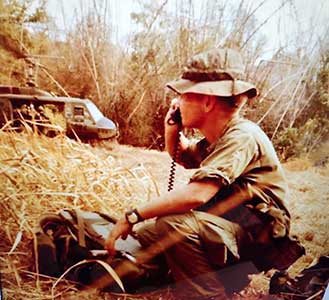
In October 1969 his tour in Vietnam was over. About his time in Vietnam Terry said, except for the shooting and explosives it was usually like a nice camping trip. But it was tough duty. At his lowest points what kept him going were his thoughts about his girlfriend, Michelle, and getting back to his grandfather’s fishing cabin next to the Kankakee River. Ironically, he and Michelle never married.
Terry flew back to the United States and was assigned to the 5th Infantry at Fort Carson, Colorado. He started feeling ill as soon as he arrived. He said he made repeated trips to sick call but the doctor’s could not find the cause of his illness. They thought he was ‘goldbricking’ until one day he passed out. He was diagnosed with malaria brought back from Vietnam. After a few weeks he recovered.
In June of 1970 he was honorably discharged as a sergeant, SPC/4 from the Army and went home to Hammond Indiana. On his discharge papers he understandably saw he received a Purple Heart but he also had a Bronze Star and the Army Commendation Medal. He’s not sure for which of his combat actions he received them. He flew into O’Hare Airport and caught a shuttle bus home. The shuttle driver was very nice instead of dropping him off at the bus station he dropped him off in front of his parent’s house.
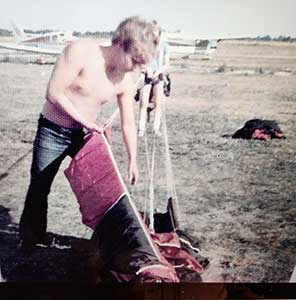
Almost immediately Terry went back to flying at the Lansing Airport. Looking for a new hobby, he joined the Midwest Sky Divers group that was based there. He not only learned to sky dive, but the most important lesson was how to inspect and pack his own parachute. Since the ’70s he has made countless jumps and has even piloted the drop zone airplane for the sky diving team. He never parachuted in the Army. Terry decided to use his G.I. Bill and enrolled at Purdue Calumet University. He completed two semesters before returning to the Illinois Central Railroad, Commuter Line. At the ICC he worked many jobs, electronics man, Tower Man, Load Supervisor and Dispatcher. He worked with ICC for 20 years until the commuter line was taken over by Metra. He retired in 2008.
As a pilot he had a close call when following another plane practicing his landings. The other pilot clipped his plane and Terry’s plane stalled out above the other parked planes. His quick maneuvering kept him from crashing onto the planes and landing it safely.
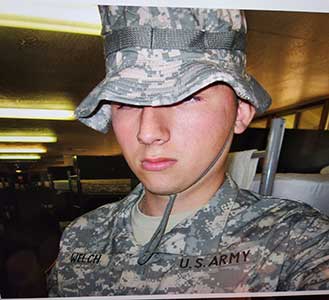
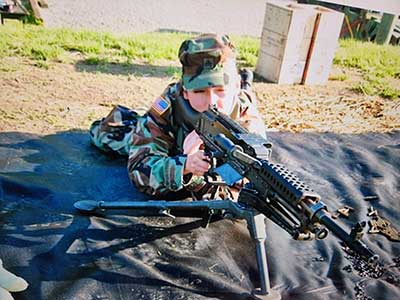
Terry has four children: Barbie, Nick, Lisa and Eric, and seven grandchildren. Two of his children followed their dad and joined the military. Lisa spent nineteen years in the Army National Guard. She was in Washington D.C. on 9/11. Terry said he was frantic wondering if she was safe. He was relieved when she called. His son Eric joined the Army and served in Afghanistan. Three generations of the Welch family have served in three different wars.
Terry says he’s been fortunate to have stayed active all these years. He loves to travel with his family, just last week they came home from Paris. Another of his hobbies is skiing. He’s gone all over the U.S. looking for fresh powder. Despite his time in Vietnam, he has not had physical problems from his wounds or chemicals used there. His daughter tells him he is sometimes hard to deal with. Terry says he’s been that way since coming back from Vietnam. This is understandable because of the stress of combat. Instead of being wounded he could have been another name on the Vietnam Memorial Wall.
Although he has travelled throughout the country, he’s never seen the memorials in D.C. He’s looking forward to seeing them for the first time with Honor Flight Chicago.
Terry, we hope you enjoyed your day of thanks!