
U.S. Air Force & Marines Vietnam War Palatine, IL Flight date: 04/15/26
By Mark Splitstone, Honor Flight Chicago Veteran Interview Volunteer
Joe Heater’s first childhood memory is going to a train station in the middle of the night to welcome his father home after his service as a Navy Seabee in World War II. What Joe didn’t think about then and never thought to ask his dad later was why he had been in the service at all. He was a husband, a father, and he worked for the railroad, considered a critical industry, so he would’ve had a draft deferral. Perhaps it was patriotism, or a sense of duty, or maybe even a thirst for adventure. Assuming it was a combination of these factors, it appears that Joe inherited some of these qualities and, just like his father, did more than his share in service to his country.
Joe was born in 1942 and grew up in Detroit and other midwestern cities before graduating from Lyons Township High School in 1959. While he had done fairly well in subjects that interested him, overall he says he hated school and decided early on to take a different path after graduation. He scored well on the armed forces qualification test and was able to pursue a technical career in the Air Force. Two weeks after graduation, Joe, only seventeen years old, was on his way to basic training at Lackland Air Force Base.
After basic training, Joe was sent to Keesler Air Force Base to learn to be a ground radio repairman, and he realized he had finally found something that he liked and was good at. He was then assigned to the 661st Radar Squadron, based at Selfridge Air Force Base, north of Detroit. At the time, there was concern that the USSR would send bombers over the North Pole to attack the US, and Selfridge was tied into a string of other stations that searched for Soviet bombers and housed interceptors in case they found some. Joe’s role was to ensure that radio equipment for communication between the ground and the aircraft was working. Ironically, one of the reasons that Joe had enlisted in the Air Force was to see the world, but he spent most of his enlistment stationed only fifteen miles from where he grew up. In 1962, he had an opportunity to go to Vietnam as part of a secret organization, the First Air Commando Squadron. The mission intrigued Joe, but he was rejected because of his poor eyesight. As it turned out, this wouldn’t be his last opportunity to go to Vietnam.
In 1963, after four years of service, Joe left the Air Force and, because of the technical skills he had acquired there, was quickly able to get a job at McDonnell Douglas in St. Louis, working as a fire control technician on the F4 Phantom. For a self-described “airplane geek” Joe says that this job was seventh heaven for him, but he eventually decided to move to California, which in the mid-1960s seemed like the place to be. Once again leveraging his Air Force experience, he was able to get a job testing torpedo components for Bendix Corporation.
After six months at Bendix, Joe decided he wanted to do more with his life. It was 1965, and the Vietnam War was heating up. Since he had previously served in the military, he knew he wouldn’t be drafted, but his sense of patriotism and duty, plus a thirst for adventure and desire to challenge himself, compelled him to enlist in the Marines. At boot camp at MCRD San Diego, 23-year-old Joe was older than most of the recruits, and because of his prior military service, he came into boot camp as an E2, or private first class. While his Air Force experience helped him since he already knew a lot of military skills and protocol, he says that Marine training was much more physically rigorous. Toward the end of his training, when Joe met with his sergeant to discuss what his MOS would be, he was hoping to become a part of the Marine Air Wing, since he was already familiar with the Marines’ primary combat aircraft, the Phantom. But that’s not what the Marines needed at the time, so his MOS became 0311, infantry rifleman, and in February 1966 he boarded a transport ship to Vietnam.
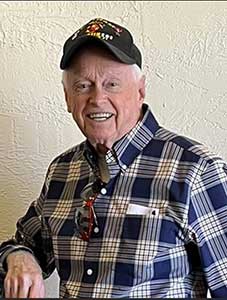
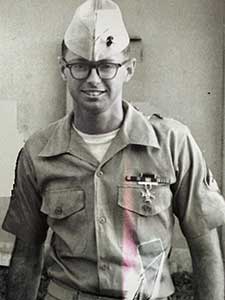
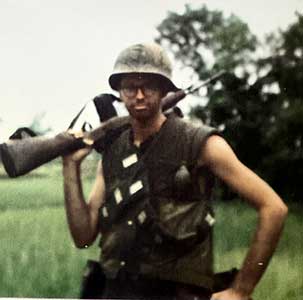
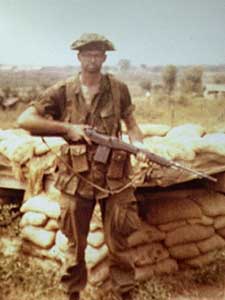
Joe didn’t think much about it when he was assigned to the 1st Battalion, 9th Marines, but discovered later that the nickname for this unit was the Walking Dead. The battalion ended up having the highest casualty rate of any Marine unit in the war, with over a quarter of the men who served in the 1/9 from 1965-69 killed. After spending his first few weeks performing perimeter defense duty at the Da Nang Air Base, Joe’s battalion was sent ten miles south of Da Nang to Hill 55. The Viet Cong had been infiltrating up from the south and attacking Da Nang, and the base at Hill 55 had been set up to stop this infiltration. Patrols were run nearly daily out of the base, some of which were focused on fighting the Viet Cong, but others of which were pacification efforts, including bringing medical assistance and food to villages in an effort to win hearts and minds. Joe’s perspective was that this wasn’t really effective, and history proved his opinion to be accurate.
While some of the patrols with bigger formations took place in the daytime, most were squad-sized ambush operations, which usually took place at night. They didn’t encounter the enemy very often, and most of the casualties they incurred were not from firefights but from booby traps. This was not only mentally stressful, but also frustrating because there was nothing to shoot back at. On one daytime patrol, just six weeks after his arrival, a remote-controlled mine blew up behind Joe. The radio operator, who was a good friend of Joe’s, and the platoon commander were both immediately killed. Joe had to go out on another patrol that night, which he says was extremely stressful. Because he had some experience with radios from his Air Force days, Joe was asked to become the replacement radio operator. His first thought was that the radio was basically a big target on his back, and his second thought was that it was really heavy, but he accepted the increased responsibility. Because a radio operator had to be on every operation, this new assignment meant that he’d need to go on even more patrols.
Something Joe learned early was not to walk on the easy path, because that’s where the Viet Cong would set their traps. One day he was walking up a small hill, a few steps to the side of the obvious path. The machine gunner behind him, who was only a few weeks from rotating back to the US, stayed on the main path and tripped a mine. He survived but lost both legs. Joe was hit with shrapnel in the back of his legs and arms, but the radio prevented it from hitting his torso. Despite his injuries and the damage to the radio, Joe managed to call in a medevac helicopter, and the entire unit was evacuated shortly before there was a major attack in the area. For his actions that day, Joe was awarded a Bronze Star in addition to his Purple Heart. Joe was taken to the hospital, where he recalls being relieved that his injuries weren’t more serious, but angry about one thing: like many other Marines, he hated the fact that his feet were always wet, and he had asked his parents to send him some clean, dry socks. To keep them dry in the field, he had put them in the space between the top of his head and his helmet. At the hospital, they took away his helmet, socks included, and he’s still somewhat angry about that to this day.
After spending two weeks in the hospital, he returned to the field. In September 1966, the battalion, which had suffered a huge number of casualties, was rotated out of Vietnam. They spent several months in Okinawa and the Philippines before being sent back to Vietnam in late December. There, they participated in Operation Deckhouse V, which was designed to sweep the enemy from the Mekong Delta. The Viet Cong were apparently forewarned about the operation and had largely vacated the area. Shortly after this operation, which Joe describes as a fiasco, his time in Vietnam came to an end, and he rotated back to the United States.
Upon his return, he was assigned to the security detachment at Naval Air Station Sanford in Florida, where he was promoted to E5, sergeant. While there, he met a young woman, Joan, who would become his wife. The Sanford base was being closed down, and Joe knew he would be transferred to Camp Lejeune in North Carolina. Although they had known each other for only a few months, he asked her to marry him and accompany him to North Carolina. On the day they were married, he was at the base closing ceremony in the morning and his wedding ceremony in the afternoon. In 1968, he was approached about re-enlisting, but knew that if he went back to Vietnam, there was a good chance that his luck would run out. He left the Marine Corps in August 1968.
Upon returning to civilian life, Joe got a job as a field service technician for Honeywell, a company with which he’d end up spending his entire 29-year career. Since his retirement, he has enjoyed being a volunteer American history teacher at the local high school, and he’s also given presentations to local students about his experiences in Vietnam. Over the years, he’s also been involved in various capacities in the organization of the 1/9. He feels that his military experience set him up for the rest of his life, both in terms of technical training as well as life lessons. He says that once he left the military, he didn’t really think about Vietnam for nearly 40 years and only recently began contemplating his experiences, both good and bad. He thinks that perhaps because he was older than most of the men there, he’s been better able to compartmentalize it. He’s proud of his service to his country and takes great pride in being a part of the teams that were the Air Force and the Marines.