

ArmArArmy Vietnam War Highwood, IL Flight date: 06/24/26
By Wendy L. Ellis, Honor Flight Chicago Veteran Interview Volunteer
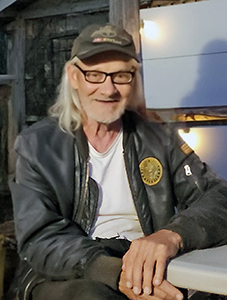
Bruce Callen did not choose to be a combat medic in Vietnam. It chose him. The 19-year-old Highland Park high school grad joined up a year out of school because he didn’t want to be drafted, and he didn’t want to spend any more time than necessary in the military. He got his first taste of the military at the induction center. “They lined us all up in a single line and a representative from each service made their choices. The Marine is saying, “You’re mine, and you’re mine,” says Callen. “and then he stopped at the guy right to the left of me. So the Army took me.”
He told the Army he wanted to be an engineer, but the Army told him he was too smart so they made him a medic. Like most other combat medics in Vietnam, he had little to no medical training, but he had plenty of informal knowledge to pull on.
“Growing up you do have medical training, at least my generation did,” says Callen. ”No helmets, no elbow pads, no knee pads. We played in the snow in the winter, climbed mountains of ice. Then when we were done at recess we went to the nurse’s office and got bandaged up.” Formal medical training followed at Fort Sam Houston in Texas before being shipped out to Vietnam in April of 1967. “It wasn’t a matter of liking it or disliking it,” says Callen. ”That’s the job they gave me.”
His first night in Vietnam he was put on guard duty with an M14 and a 16-gauge shotgun. “I happened to notice the sergeant of the guard sneaking up on people on guard duty. So I thought, I’m gonna get this guy. I took the shotgun and loaded it. I put my M14 on the sandbags where he could reach it. As he snuck up and he was reaching for the `14, I said, “That one’s not loaded but this one is, another step and I’m gonna pull the trigger. He walked away.”
The next morning he was on a plane to the 51st Medical company in Quy Nhon where he spent the first two months driving an ambulance working dust off missions to bring in wounded from combat zones. Eventually he was flown up the mountain and assigned to treat the guard post soldiers, treating everything from trench foot to sunburn to jungle rot. “One guy fell and drove a rebar through his arm,” says Callen. “He didn’t do anything about it until 3 or 4 days later when he came to me and it was infected.” Another soldier went wandering in the jungle and got bit by something, so Callen hiked a mile down the mountain to get him a tetanus shot. Another soldier declined the sun screen Callen gave him, saying he didn’t need it because he was black. “Three hours later he had blisters so big on his back I couldn’t cover them with my hand.”
Callen spent nine months on the mountain treating rotating guard units, and might have been there longer but in January of 1968, the Tet Offensive started, and he was called down the mountain for reassignment.
“As Tet went on, Westmoreland moved us farther and farther north,” says Callen. “I ended up in Chu Lai providing medical coverage for Convoys. We pulled in to Pleiku one day and on the side of the road they had VC bodies stacked 6 and 8 high. They were like cordwood, all up and down the highway.” Callen rode in a jeep with a driver, while the trucks had armored plates and sandbags and 50 caliber machine guns on them. For Callen, it became a defining moment of his life. They were headed into the Ahn Que pass when one of the trucks hit an unexploded ordinance set up by the VC. “The worst casualty was a 17-year-old from down south,” says Callen. “He had been riding in a vehicle up top and when the explosive went off the shrapnel took his head off. When I put him in the body bag, the last breath left his body. I had to go through his personal stuff and it showed me he was married and had two kids.”
Callen says it caused him to totally shut down his emotions. No matter what happened the rest of the time, it had no impact. “Unfortunately that also carried over into civilian life for probably my entire life. My emotions were not what they should be. My wife’s death last September seems to have unleashed all the emotions that I’ve had under control for so long.”
Callen was never wounded although he came close a couple times. He was however, the victim of a scorpion. One night as he stretched out in bed, “something went bam!” He didn’t know what it was at the time, but he walked down the mountain to the aid station where they tried ice on it, but it sent him through the roof. They put him in the hospital where doctors knocked him out for three days while the poison worked through his system. “When I woke up the guy next to me was from my unit. He’d slit his wrists. He stripped naked and ran out through the wire into the jungle. We sent guys out to get him back. He just couldn’t take it anymore. Taking care of the wounded. It was too much for him.”
Callen made it through his 12-month tour of duty and headed home in April of 1968. He did not have a chance to tell his mother he was coming home. “I got home, walked through the front door, and my mom says, “Who the hell are you?” She didn’t recognize me. I was dark from the sun, and almost everybody I was with was from down south, so I was rolling my r’s with the best of them.”
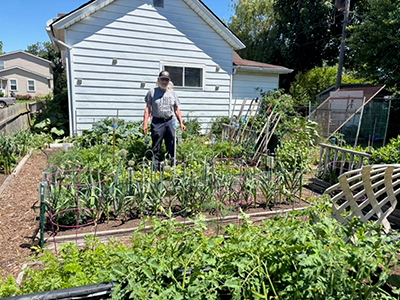
He held a variety of jobs over the next few years, then ended up with a 30-year career as a troubleshooter for Dominicks grocery stores. Since retiring in 2005 he has honed his skills as a gardener, something he learned working with his own grandfather on his Lake County farm as a boy. His garden has everything from lettuce, to carrots, to garlic whips, to squash, to several types of raspberries, lilies, even a pear tree, and much more.
He and his wife Kathryn married in 1971 and raised two daughters. They would have been married 55 years last April had she not passed away in September. What is obvious as you look around his home is that family is all important for Bruce Callen. There are pictures of parents, grandparents, children, grandchildren, even great grandchildren and one more on the way. As two of the latter walk in, there are warm hugs all around. If his emotions were once in check, they aren’t anymore. Thank you Bruce Callen for your service.