
Air Force Vietnam / Desert Storm Libertyville, IL Flight date: 08/26/26
By Wendy L. Ellis, Honor Flight Chicago Veteran Interview Volunteer
Remember the days when you could greet your loved ones at the arrival gate at airports across the country? When you could walk up to a ticket counter and book a flight that day, and nobody cared what was in your luggage? Jim Hamilton remembers being taken to the airport for dinner by his uncle, and afterward wandering from airline counter to airline counter picking up time tables and brochures, reading about $12 first class tickets and even youth fares. Hamilton was 14-years-old and had never been on an airplane.
“My dad did a lot of flying in the 40s and 50s and in the 50s he was at Midway Airport waiting for a friend to come in and the plane crashed,” says Hamilton. “He quit flying after that. My family never flew anywhere.” But Hamilton had decided he wanted to be an airline pilot and he was determined to find a way. He describes himself as the neighborhood kid who would mow your lawn, shovel your snow, do the paper route. And he saved his money.
“I decided I would go fly on my own without telling my parents so I rode my bike to O’Hare on school holidays like Columbus Day,” says Hamilton. ”Up on the second level I would chain the bike to the guard rail. You could do anything back then. The first time I went up to the ticket counter and I said I want to go on this flight right here to Fort Wayne, Indiana. It was a United Airlines DC6B. I’m like 15 years old. It took off at 10:30 in the morning. It stopped in South Bend and continued on to Fort Wayne where the same plane turned around and went back to O’Hare. It was a yo yo.” Hamilton went on to do similar trips four more times over a year and a half, visiting places like Kansas City and Cleveland, anywhere he could go in a single day.
“We were the kind of family that always sat around the dinner table and asked “How was your day?” I just said. “I rode my bike to the airport.” I don’t think I ever lied.”
It was enough, however, to convince him he wanted to be an aviator. It took him to the University of St. Thomas in St. Paul, Minnesota, where he joined the Air Force ROTC. He was designated as a pilot until the ROTC gave him a physical and told him his eyesight wasn’t good enough so they designated him as a navigator. He graduated in May of 1971, and was commissioned as a second Lieutenant in the US Air Force the same day. After 11 months of Navigator training in California, he finished 30th out of 90, which meant he had the 30th pick of airplanes from a list of 90.
“I knew I wanted to fly a fast airplane, a fighter plane. I sort of knew that if I picked that I may go to Vietnam,” says Hamilton. ”The two 111s went first, and there were six F4s, and I got the 6th one. So I got at least what I wanted. The F4 Phantom was the airplane of its day.”
Hamilton was part of the 421st Tactical Fighter Squadron based at Udorn RTAFB in Thailand, flying combat missions mostly over Cambodia and Laos. “The second day I’m there a Major says “You’re going with me tomorrow. We’re going down and we’re going to drop some bombs. I’ll tell you what to do.” Since the Major was on his second tour of duty, Hamilton figured he knew what to do. The plane went out carrying 18 500-pound bombs, dropping them somewhere in Cambodia.
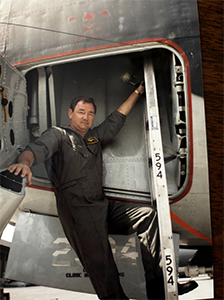
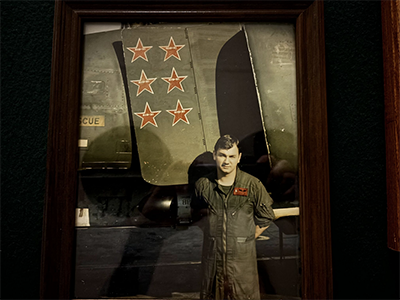
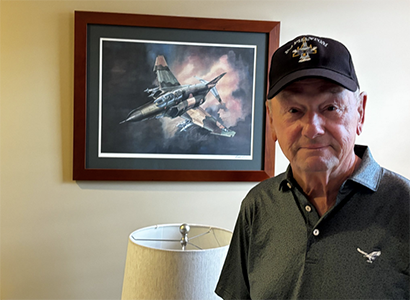
“I did that 70+ times, blowing up barges, and supply routes. It was mostly carpet bombing. We were shot at but nothing very significant. Not like over North Vietnam.” Some of his missions were night time reconnaissance with B52s. His F4 would get in front and lead the B52s to a preplanned point, telling them when to “pickle,’ or drop their bombs.” It was high level altitude bombing, and not as dangerous as some sorties. “When we were low to the ground it was a little scary.”
Because he flew the F4Phantom he was allowed to choose where he wanted to go after his time in Vietnam was up. He chose Spain, where his wife, Meg, joined him. From there he flew training missions to countries all over Europe. Then in May of 1975 he finally ended his active duty and came home to Des Plaines, where he joined his father’s packaging company. But his “free“ time was short lived. In January of 77 he met an Illinois National Guardsmen at a local bar and was told they needed Navigators. The next day he went to O’Hare, this time not on his bicycle, and a month later he was sworn in.
Hamilton served as a line navigator on refueling tankers, still flying at least 36 times a year, going anywhere within a thousand miles. He was promoted to Captain, then major, and became a flight commander. He became a Lt. Colonel in July of 1990, and became the operations officer of the 108th air Refueling Squadron at O’Hare.
Five months later came Desert Shield.
The phone rang at 2 am. The Squadron had been called up. They had to come up with five aircraft and five crews, basically a couple hundred people and fast. Sadam Hussein had invaded Kuwait and President Bush had committed 500 aircraft and half a million people to the fight. Because he was the operations officer Hamilton was on the first plane to Seville, Spain, where squadrons from Illinois, Ohio and Wisconsin became a tanker task force squadron, tasked with establishing an air bridge for the upcoming hostilities.
“The air bridge was fighter units from across the country flying non-stop to Saudi or the UAE and they needed gas enroute,” says Hamilton. “We were the first up so we had to be all set. We would fly our tankers from Moron airbase to the Canary Islands, meet the F16s and refuel them midair.” In January of ’91 Desert Shield became Desert Storm and refueling efforts intensified and expanded to Saudi Arabia, before it all came to an end in mid-March. Hamilton returned home to Meg and their four children for good.
The most tragic moment of Hamilton’s military career did not happen during Vietnam, nor Desert Storm, but in a relative time of peace. After spending the previous night on duty at O’Hare, he was watching the news on the evening of March 19th, 1982, when it was announced a plane had crashed in Wonder Lake in Northern Illinois. “He shot up off that couch,” says Meg. “He said, The Guard planes are the only ones allowed to fly over Wonder Lake. He was one of the first on the scene. The guys he had bunked with and shaved with that morning: he had to pull out of the seats. They knew they were going down because their heads were between their knees.” Four National Guardsmen and 23 reservists who had simply been catching a ride home when their own plane broke down, were killed. It is a tragedy that still haunts both Jim and Meg Hamilton to this day.
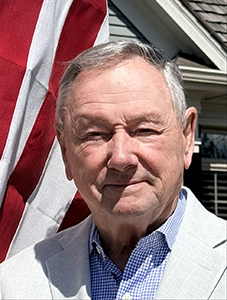
Hamilton’s National Guard unit eventually moved to Springfield, and after a few years of making the long trip down and back, Hamilton finally retired in 1998, receiving the rank of Brigadier General as he retired. He has five years active duty and 21 in the National Guard to his credit. In 2018 he retired from Colbert Packaging Corporation, where he had moved up to CEO and President.
And yes, his parents did finally find out about those clandestine teenage airplane trips, but not because he told them. Meg let it slip at a family celebration and took them all by surprise. But it became a great story for his parents to tell their friends for many years after.