
Navy Vietnam War Flight date: 08/26/26
By Joe Kolina, Honor Flight Chicago Veteran Interview Volunteer
A Rocket Ignites
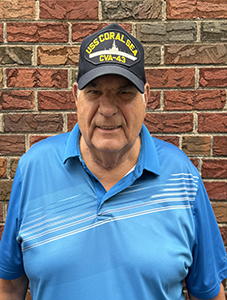
It was precisely 10 p.m. on October 25, 1967. The aircraft carrier USS Coral Sea was on the line at Yankee Station, the Navy combat operations area 100 miles off the coast of North Vietnam in the Gulf of Tonkin.
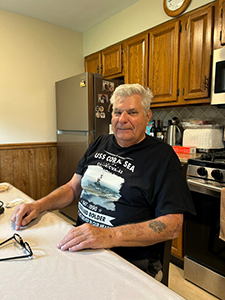
20-year-old boiler technician William “Corky” Gould was on duty deep below deck. It was his second combat cruise to Vietnam. He was accustomed to the heat and noise in the boiler room. But he never expected what was about to happen.
“I was on watch,” he says. “All of a sudden a big blast of air comes down there. I thought: what the hell was that?”
A fire alarm blared. A second alarm followed 20 seconds later. General Quarters sounded within two minutes.
“The captain came on,” Corky says. “He said it wasn’t a drill.”
It was a potentially catastrophic accident. A fire broke out below deck when a Zuni rocket motor somehow ignited in a forward assembly area. The rocket shot ahead about 20 feet and lodged in the steel bulkhead of a mess area. Nine sailors were hurt; four later died.
The rocket didn’t explode. But it was all happening next to the ship’s forward magazines. They were packed with ordnance used in Operation Rolling Thunder, the bombing campaign against North Vietnam. Officers feared a devastating blast.
“There were bombs all around there,” says Corky. “We used to crawl over them on our way to eat.”
Fire crews attacked the flames and smoke while damage control teams worked to contain the danger. It took hours to carefully cut the rocket out of the bulkhead, wrap it in asbestos, and lower it harmlessly into the sea.
“If it had blown that would have been it,” Corky says, “I wouldn’t be talking to you.”
He says the tense drama didn’t make a big impression on him at the time.
“You don’t think about stuff like that when you’re 18 or 20,” he says.
That reaction reveals a lot about Corky. This is the story of an ordinary guy who accepted—and mastered—the extraordinary risks of performing dangerous work while serving on an aircraft carrier in wartime.
Joining the Navy
Corky joined the Navy in 1965 shortly after graduation from Proviso West High School in Hillside, Illinois. He didn’t have a plan, so he followed his father’s advice.
“My cousin went in the military and my dad came home and said, ‘You ain’t doing nothing, why don’t you go in?’” he remembers. “So, I said okay.”
Why the Navy?
“I liked the movies I saw on TV,” he says. “The war movies, the ships.”
Corky had never heard of the USS Coral Sea. His arrival in San Francisco at the ship’s dock was memorably humbling.
“I didn’t see it at first,” he says. “It looked like a big warehouse. I thought ‘Man, what’s this?’ I never actually saw the whole ship until two or three days later.”
The Coral Sea was huge. It was as long as three football fields laid end to end, as wide as two Boeing 747s parked wingtip to wingtip, as tall as a 20-story building, and it weighed as much as 40,000 cars. The ship was a small city home to nearly 4,500 officers, pilots and sailors.
Life Below Deck
Corky had one of the most physically demanding and dangerous jobs on the ship. There were 12 boilers and four steam turbines. The ship’s speed and power needs determined how many were fired up at one time. Not much worked—from the catapults that launched the jet fighters to the ship’s lights and showers—without the steam power the boilers generated.
Working conditions in the cramped quarters at the bottom of the ship were brutal. Steam lines hissed. There were soot and grime.
“It was hot, well over 100 degrees,” Corky says. “And really noisy.”
Daily operations required vigilance. Boiler technicians constantly checked water levels, steam pressure and oil gauges. They inspected pipes and valves for leaks. They adjusted pumps, blowers, burners and fans. And more.
“It was just a lot of work,” says Corky. “We worked, ate, wrote letters home and slept.”
The job he dreaded most was cleaning the huge boilers.
“We had little scrapers and we had to go inside and clean the carbon off tubes, hundreds of them,” he says. “We had to put scaffolding up in there to get to them all. We had to stay there till it was done. It took a day, sometimes a day and a half.
“By the time we were done we were as black as coal,” he adds. “And we were like that for a couple of days. We could shower all we wanted, it just took forever to get that stuff off.”
The Price of a Mistake
Mistakes on the Coral Sea could prove deadly. Launching planes for attacks on North Vietnam was an intricate operation. Once, after a fighter jet took off, a crewman ran from the safety of what was known as the foul line back onto the flight deck.
“He saw something, I guess,” Corky says. “He ran back out there for some reason. And the next plane taking off hit him.”
He still remembers the orders to watch video of the accident.
“I don’t know why they had to do that,” he says. “Well, I guess they didn’t want anyone else to do it. But that still sticks with me, watching that. Damn.”
Young men could get reckless. Corky remembers two sailors who decided to race small tractors used to tow planes around the flight deck.
“It was at night. The joking around went too far. One guy went over the side of the ship,” Corky says. “They never found the guy.”
Ignoring orders could lead to close calls. In 1967, the Coral Sea was sent to rescue crewmen on a cargo ship breaking up on a reef in a fierce storm near Hong Kong. The Coral Sea was shut tight. Its’ crew was ordered not to open any hatch.
“You know when people tell you not to take a look. Well, we had to take a look,” he says. “We opened a hatch to see what the weather looked like.”
It was every bit as bad as the warning predicted.
“Worst storm I ever saw in my life,” Corky remembers. “A huge black thing. All of a sudden the ship looked like it was up in the air. Up and down. It was the only time I ever saw anything move that ship.”
They quickly shut the hatch, retreated to safety, and let the experts save the crew members on the stranded ship.
Sometimes the isolation at sea and unrelenting hours of hard work got to the sailors.
“You saw a lot of fights,” Corky says. “You had young guys in small quarters. After a while everybody got on each other’s nerves. I had a couple of fights when I was there.”
But overall, Corky was glad he joined.
“I liked the Navy,” he says. “I liked the travel. Seeing different places and lifestyles. If I hadn’t met my wife I would have stayed in.”
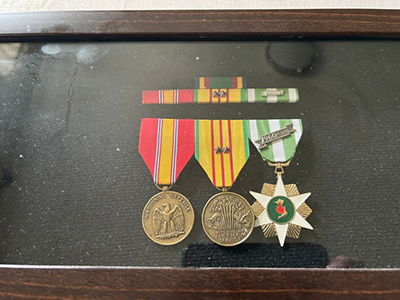
Corky’s family submitted an Honor Flight Chicago application for him. He doesn’t think he did anything noteworthy. The Navy does. It awarded him a Bronze Star (meritorious service), a Commendation Medal, a National Defense Service Medal, a Vietnam Service Medal, and a Vietnam Campaign Medal.
Now Honor Flight Chicago adds its’ heartfelt congratulations.
Thank you for your service, Corky.