
Navy Vietnam War St. Charles, IL Flight date: 08/26/26
By David Adams, Honor Flight Chicago Veteran Interview Volunteer
Charles H. (“Chuck”) Goebel was born and grew up in Elmhurst. He comes from a family with a strong military tradition. His grandfather immigrated from Frankfurt, Germany, in the early 20th century. In 1917 he was inducted into the Army and sent to France and was stationed in the Provençal region. He was concerned he might have to engage a family member who was in the Germany Army. He didn’t, returning to the States in 1918. Chuck’s father-in-law served in the Pacific during WW2. Two uncles served in the Marine Corps and Navy Seabees, respectively, during that war. They also saw service in the Korean War. Finally, his brother-in-law served in Vietnam.
During his senior year in High School, he attended a career fair. The Navy was looking for recruits as enlisted flight crew. When he learned that one of the Naval aircraft tracked Russian subs he was “all in”. Only 17 at the time he needed written permission from his parents to enlist, which he got.
Naval training
He entered the Navy in the spring of 1973 at Glenview NAS. He completed basic training at Memphis TN Naval Air Station followed by “A” school. There he learned basic electronics and anti-submarine warfare (ASW). He was now unsure which airplane he would choose to crew. He already had broad knowledge of the anti-submarine war discipline. He attended “C” School in Pennsylvania. The school provided him with advanced, specialized training. By completing this training, he was equipped with expert skills for the specific pieces of equipment, systems to function as an Aviation Warfare acoustic sensor operator (ASW). He was ready to join the fleet.
Anti-submarine warfare squadron assignments, 22 years-worth
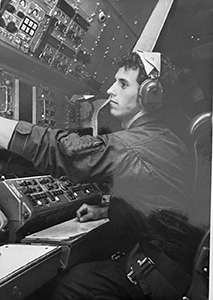
He reported to the P-3 Orion training facility at Naval Air Station Moffett Field, CA. There he joined VP-91, the “Black Cats”. The Orion, built by Lockheed, was a four-engined, turboprop anti-submarine and maritime surveillance aircraft. It had a distinctive tail stinger or “MAD” boom, used for the magnetic anomaly detection (MAD) of submarines. MAD employment success was challenging and rare according to him. Chuck states, however, that “The primary way to track a sub was with acoustics.” To become aircrew-qualified required six months in the squadron learning the electronic and related gear and the Orion itself. He remembers that a normal Orion crew complement numbered twelve but could be operated with a minimum of four: two pilots and two enlisted including the ASW. A navigator was often on a crew who Chuck says could “shoot the stars” to determine their position. Another training prerequisite was Deep Water Survival Training at Naval Training Center San Diego. He remembers being picked up by a helicopter at sea while floating in his raft.
Chuck manned the Acoustics Stations 1 and 2 crew position and later in his career non-acoustics stations. Typically, missions lasted 10-12 hours. To locate a Russian sub the Orion deployed sonobuoys. It carried fifty or more on each flight. When the device hits the water, it floats and sends a microphone down to a predetermined depth. Sounds are recorded and the sub’s location is determined by triangulation. Utilizing sound data from years of collection enabled the crew to identify an individual sub. Now declassified, human intelligence provided our country with photos and related information relating to subs, all of which was collected within Russia. In Regular Navy service, Chuck says squadron deployments lasted 6 months. Later when he was in the Naval Reserves, deployments were shorter lasting from 1 to 1 ½ months.
His career continued with VP-90 “The Lions” at Glenview Naval Air Station. Since VP-90 was assigned to Atlantic Naval forces, exercises and deployments took place in the Atlantic, Mediterranean, and Caribbean. It also participated in NATO exercises.
After about five years at Glenview, he was back on the West Coast. There he joined VP-69 “The Totems” stationed at NAS Whidbey Island, WA. There he became a simulator instructor. More importantly his son Jason was born in 1982. Another memorable event was a flight around Mt. St. Helens following the May 18, 1980, eruption and seeing the aftermath firsthand. The denuded slopes and crater were still smoking. On deployments from Whidbey, he flew out of Diego Garcia in the Indian Ocean, Kadena AB and Misawa AB, Japan, and NAS Subic Bay, Philippines among other airbases.
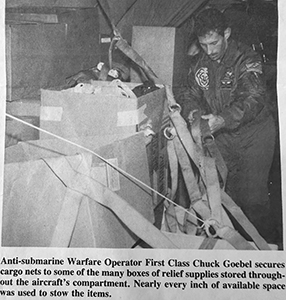
Beginning in 1985 his uninterrupted service continued in the Naval Reserve. He joined VP-93, the “Executioners”, at NAF Detroit, a tenant at Selfridge Air National Guard Base, MI. He recalls that “It was the most active squadron I was with.” It made deployments to Naval Station Rota, Spain, and NAF Lajes, Azores. The late 1980s witnessed the Reagan Administration’s War on Drugs. In conjunction with the DEA, VP-93 flew drug interdiction flights. Skimming along at 200 feet above the sea the Orion captured photos and related intelligence on the drug boats. These data were forwarded to the DEA and related forces for interdiction of the drug runners. In September 1989 Hurricane Hugo, a category 5 hurricane, struck the Caribbean islands and mainland United States. Chuck and his squadron flew humanitarian relief flights from Selfridge to Puerto Rico. Squadron efforts appeared prominently in the press. He himself is featured in a news photo securing boxes of supplies in the aircraft.
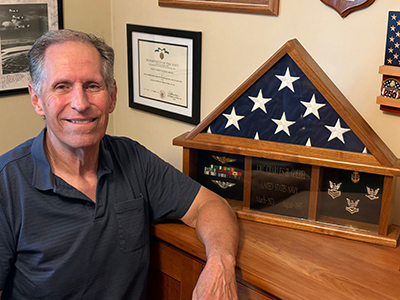
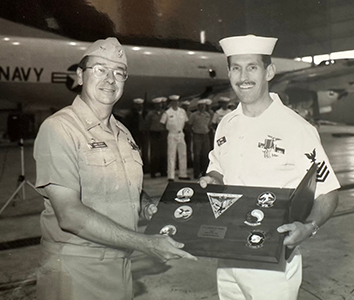
His last station from 1990 to 1995 was Glenview where his Naval service began. He rejoined VP-90. During this time, he earned Sailor of the Quarter and Sailor of the Year for his squadron and Wing Sailor of the Year. At Glenview he received his promotion to the highly competitive rank of Chief Petty Officer (E-7). A promotion board is convened periodically in Washington. Chuck passed every test and met all other qualifications for several years. In some years the promotion board did not advance any sailor. Finally in 1992 he succeeded. Chuck retired at Glenview Naval August 1995 as an E-7 Chief Petty Officer with 22 years of honorable service and more than 3,000 flight hours. During his career he was awarded the Navy Commendation Medal, Navy Achievement Medal (w/star), National Defense Medal (w/star), 5 Navy Good Conduct Medals, 2 Reserve Good Conduct Medals, Expert Pistol Shot Medal, Coast Guard Special Operations Ribbon, Coast Guard Meritorious Unit Commendation Ribbon (w/device), Naval Aircrew Designation, and Enlisted Aviation Warfare Specialist Breast Insignia.
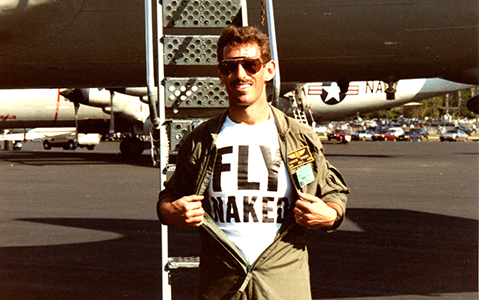
And now for some “war stories”
In the 1980-85-time frame, Russian MiG jet interceptors had the habit of coming up on the wing of surveillance airplanes including his Orion. The MiG would have gotten a “radar lock” on the airplane, preliminary to weapons firing. The MiG pilots understood his airplane had all necessary signals interception equipment to detect them. The next maneuver was a “nose job”, or “bump”, pulling up in front of the Orion. This tense encounter happened several times to Chuck..
On one flight across the Pacific from Moffett to Hawaii and at the halfway point, four hours either way to a runway, the Orion filled with smoke. The crew quickly analyzed the emergency and found the source, extinguished the “fire”, and continued the mission to Hawaii. Smoke and/or fire onboard is the last thing an aircrew wants to encounter.
When Muammar Gaddafi was Libya’s dictator (1969-2011) he sought to mine parts of the Mediterranean Sea. Chuck’s deployment to Naval Station Rota, SP found him locating the mines for removal.
Discharge and civilian life
Immediately after his discharge he remained at Glenview working in a civilian capacity.
He had begun on-line college studies with Northwood University, Midland, MI while with VP-90. Using the G.I. Bill, he completed a Bachelor of Business Administration. The next 30 years found Chuck as property manager for the family business. He volunteered for many years with the USO at O’Hare. He was honored to meet Navy recruits transiting the airport enroute to Great Lakes for basic training. He was perfectly situated to answer all questions they may have had; he had been through the same training himself.
He and his wife Tammy enjoy international travel. She wished to visit the places to which Chuck had been deployed. Easily done! They are particularly fond of the famous Viking River cruises. Their son Jason is heard to say that he “was born on an island” and he was–Whidbey Island NAS.
Personal reflection
“Joining the military is not for everyone. But, for a 17-year-old kid just out of high school with NO idea of what he wanted to do next, it was an option. I knew I didn’t want to go on to college (yet) as many of my friends and family were doing. A recruiter was at a career fair at my high school and I saw a “job” that sounded pretty good – challenging, technical, with traveling…..Navy enlisted flight crew. I figured if I didn’t make it or didn’t like it, after 4 years I would get out and have some GI Bill money for college. That didn’t happen. Getting away on my own matured me. Boot camp and technical schools challenged me and taught me about teamwork, camaraderie, and responsibility. I thrived. Coming home on leave, I would talk about the things I did, places I had seen, people I met, and experiences no civilian would have. 3,000+ flight hours and 22 years later, I retired as a Chief. The career I chose, I believe, was an honorable one and I believe it made a difference. The people I was stationed with and flew
with became close friends that I still have contact with to this day – 30 years later. It was an honor to know them. So… joining the military worked for me (and I did get that college degree attending night school – thanks GI Bill).”
Chuck, you deserve a day of honor in Washington, DC for your lengthy Naval career!