
Air Force Vietnam War Rockford, IL Flight date: 08/26/26
By Al Konieczka, Honor Flight Chicago Veteran Interview Volunteer
John Corcoran was one of seven children born and raised in Rockford, Illinois. His father was a machinist and served in WWII as part of an engineering group stationed in Italy building bridges. One of John’s younger brothers, Greg, also served in Vietnam during the Tet Offensive. After high school, John attended Northern Illinois University. When he first thought about college, he was interested in weather and the physical sciences but soon changed his mind. “One of my high school teachers I talked to convinced me to go into the field of shop teaching. He said there was a big demand for that.”
John would graduate with a teaching degree from Northern and he paid his own way and graduated with no debt. “I took some semesters off and worked to save money for the next semester several times during my college career. I also got married while I was in college and then had a full time job at night for several semesters and went to college in the daytime.”
After college John did his student teaching at Riverside Brookfield High School near Brookfield Zoo. John recalled a funny story during his first teaching assignment. “I was in a metal shop teaching these students how to read a micrometer. And a machinist steel rule was that you measured in a 64th of an inch. So I had a student who was turning the project on a lathe, and I asked him, well, what does it read? And he said, a half inch and a couple of real little bitty marks. So I thought that was hilarious.”
By the time John began teaching he was married and had started a family. He moved his new family down to Florida following his in-laws and finally settled in Hollywood, Florida. “I just happened to be downtown one time and I saw an Air Force recruitment office. I went in to see about getting to wear a uniform like that because I thought it looked pretty sharp. He told me I wouldn’t wear that uniform, because that was an NCO’s uniform. So I found out that I could go to officer training school and I did some testing and I qualified to go to pilot training school. So in January of 1970, at the age of 25, in my third semester of teaching school, I resigned and joined the Air Force.”
John began his Air Force Basic Military Training (BMT) at Joint Base San Antonio-Lackland in San Antonio, Texas. He would be there for three months and graduate in April 1970 and was commissioned as a second lieutenant. He would then head off to Columbus Air Force Base near Columbus, Mississippi. John would spend the next year in the pilot training program to earn his wings. John’s next stop would be Randolph Air Force Base (known as the West Point of the Air) for 3 months of pilot instructor school for the T37. The Cessna T-37 Tweet is a lightweight, twin-engine jet trainer affectionately known as the “Tweety Bird” or “Screaming Mimi” due to the high-pitched shriek of its-turbojet engines. It served as the primary jet pilot trainer for the U.S. Air Force from 1956 until its final retirement in 2009.
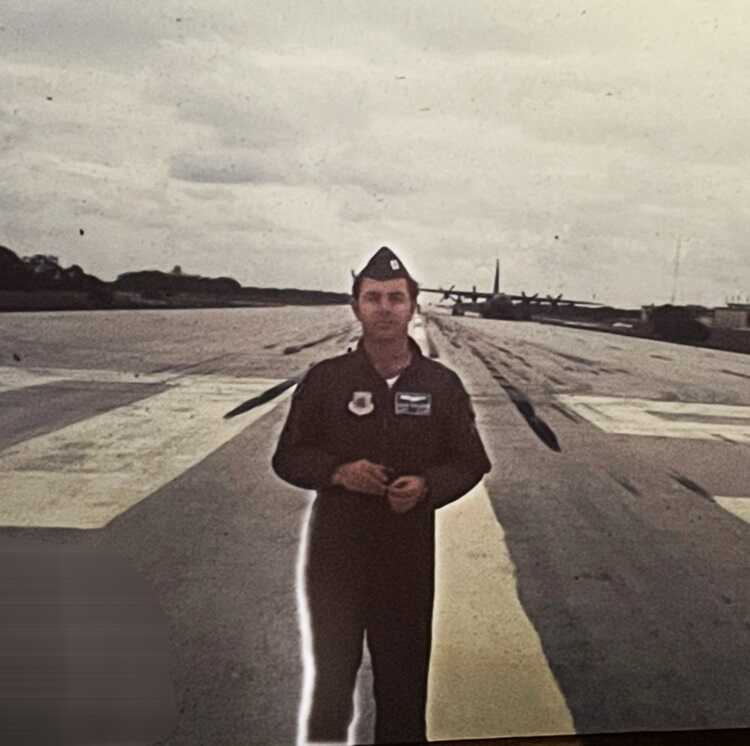
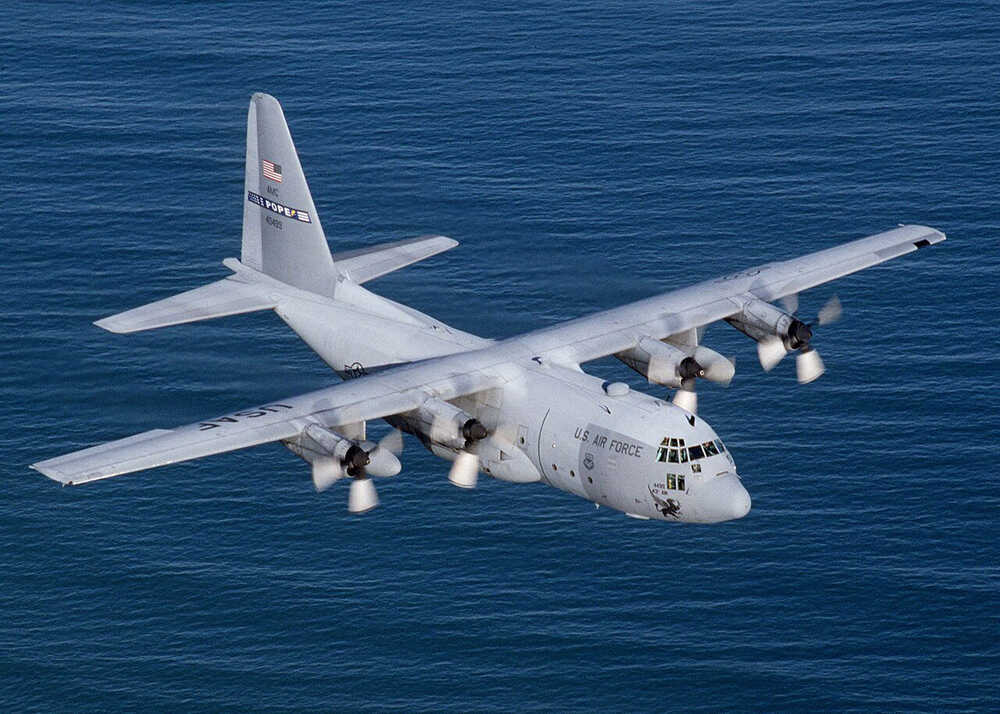
John then returned to Columbus Air Force Base and worked as an instructor until being reassigned to upgrade school in 1974 at Little Rock Air Force Base. He would spend another three months there training to fly the C-130. C-130s were used to haul massive amounts of cargo, troops, and equipment to airstrips throughout Southeast Asia.
However, all of John’s training and travel put a strain on his marriage and young family. “Throughout my various trainings I drove back and forth on the weekends to see my wife and family. After graduating from Little Rock I was being sent to Okinawa. My wife was supposed to go with me, but she didn’t want to stay with me, so we got divorced before I left for Okinawa.”
John was surprised at how small Okinawa was when he arrived there in October of 1974. “Okinawa was not a very big place. The island is totally about maybe 60 miles long from north to south. And it kind of reminds me of a pork chop steak with a long, thin end and a fat end at the bottom. And the speed limit on the whole island for cars was just 30 miles an hour.”
Kadena Air Base in Okinawa would become John’s base of operations for the next eight months. Shortly after John’s arrival in Okinawa, he was sent to Clark Air Base on Luzon Island in the Philippines for a couple weeks of in theater orientation. At the time, Clark Air Base was a major U.S. military facility located in Pampanga near Angeles City. John recalled the jungle training they went through. “We had to go out into the jungle and hide from the enemy. The local Filipino people, called Negritos, were native to the area and lived out in the jungle. A full grown Negrito man might be about five feet and the women were a little bit smaller. Their job was to go out and find us after we went out and hid. The Air Force gave us chips, and when the Negritos found us, they’d say, Chips, sir. And they received like five pounds of rice for each chip when they found us. But they were very nice, polite people.”
John estimates that during his time in Asia, he visited eight or so different countries and places and the total area he flew in was about 1,800 miles north to south and from east to west, it was about 3,000 miles. Flights and missions included his crew and other pilots and crew who needed certain qualifications. “Sometimes my crew would be with me, or you might have other people on board when you’re coming or going to certain places. Or sometimes we would fly around the island of Okinawa and do nighttime landings or heavyweight nighttime landings. So you might have several people who would trade places with the pilot to get their qualifications because you had certain qualifications you had to do like every half a year.”
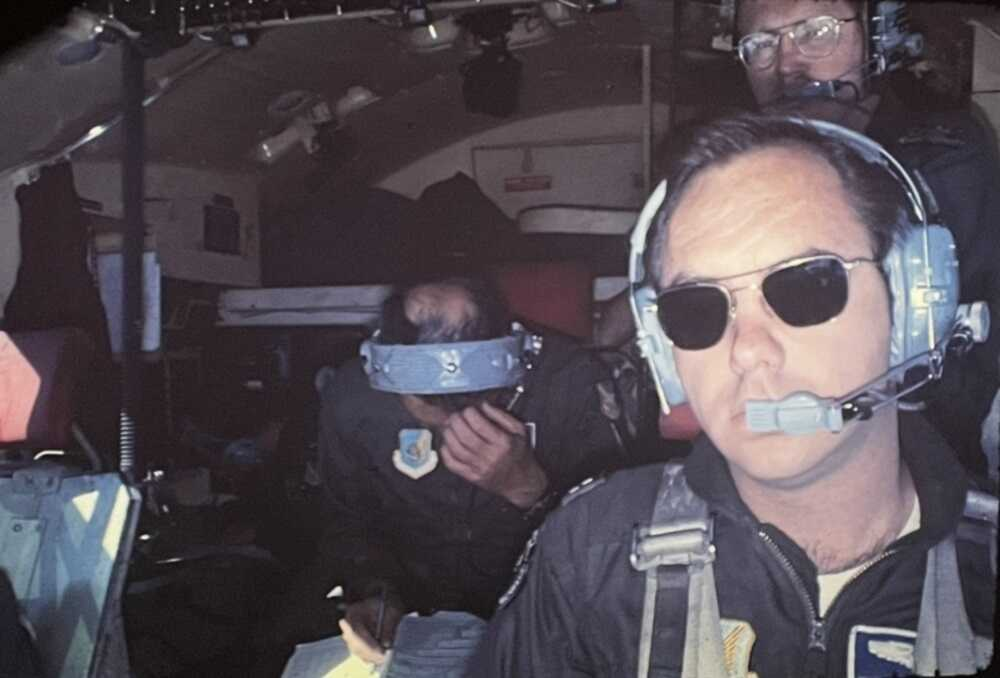
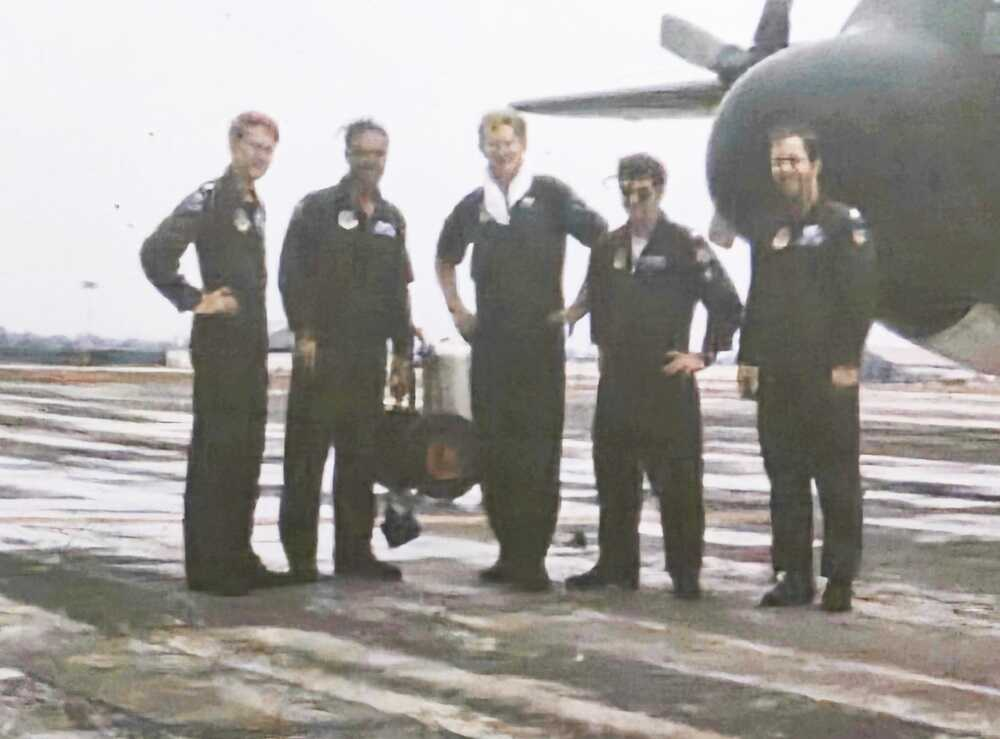
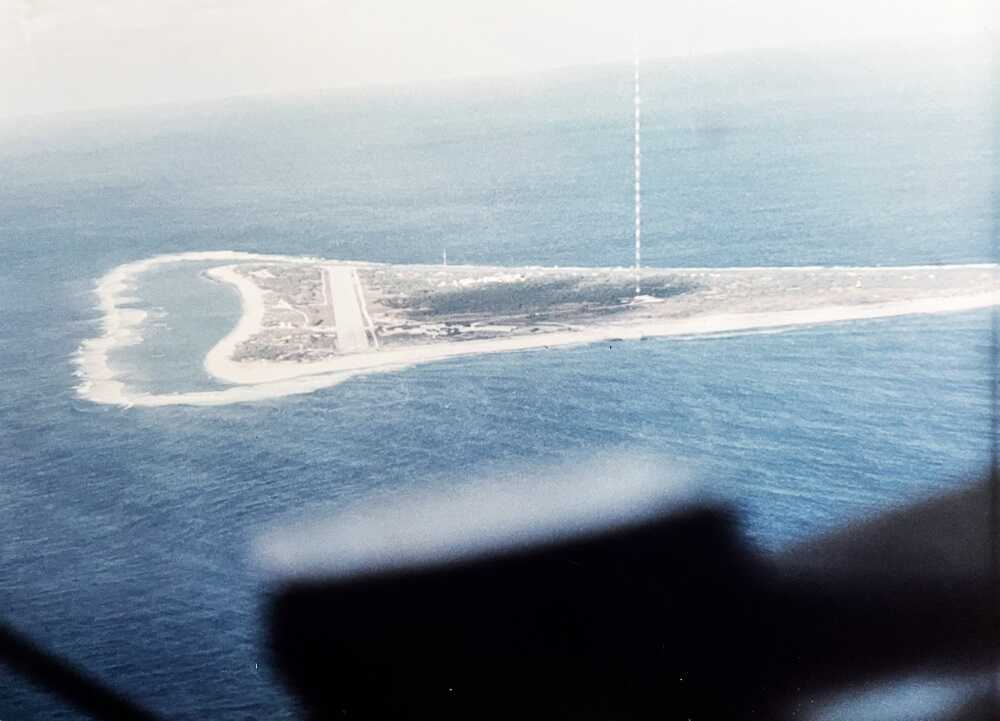
John’s crew consisted of a pilot, copilot, navigator, an engineer and loadmaster. An Air Force loadmaster is an enlisted aircrew member responsible for pre-planning cargo placement, loading and securing equipment and vehicles, managing passenger safety, and executing airdrop operations during global flight missions. Every member on board played a critical role in executing a safe mission. “One time we had taken off from Tokyo to bring supplies out to a Loran station on Marcus Island. If you look on the internet for Marcus Island, you’ll see a picture that looks almost identical to the one that I took from my cockpit in 1975. The island is about 1,300 miles southeast of Tokyo. Once we were a couple hundred miles out of Tokyo, you’re without your regular navigational aids but my navigator had me right on spot when we were 100 miles out from Marcus Island. So we descended through some clouds, and my airplane was pretty heavy, because when I took off I had to have the maximum amount of fuel it would hold because Marcus Island was in the middle of nowhere and if you can’t land there, it’s a long ways to anyplace else. So we contacted the tower when we were less than 100 miles out. They only get two airplanes a week there. So we had a person controlling the tower giving us the winds, temperature, the pressure altitude and all the stuff we needed to land. But if we had a wet runway, our landing distance with a wet runway for our total weight of our airplane was the same length as the runway, 4,000 feet. And that runway goes from water at one end to water at the other. So, we asked him, ‘Do you have a wet runway?’ And he spoke broken English and Japanese and didn’t understand what we meant by a wet runway. Because there had been rain in the area, we came down and made a low pass over the runway first and determined that it wasn’t a wet runway so we could come around and land safely.”
John’s work week consisted of many different flights. Sometimes they would fly around the island of Okinawa and do nighttime landings or heavyweight nighttime landings. Crews would change personnel frequently so other pilots could get their qualifications. They would transport people and cargo. There were also times on the base when John could see and hear SR-71 aircraft taking off. “I could tell from my quarters if I was in bed, I could hear the sound of one of them taking off. My quarters were about a mile from the runway parallel to the side of it. And, uh, it was interesting to see one of them take off too. They didn’t take off with a full load of fuel. Before they took off, there would be a tanker that took off first and they set a rendezvous point where they met to get fueled up in flight. So that was always exciting to see them take off.”
Now the war in Vietnam had been winding down prior to John’s arrival in Okinawa. The Paris Peace Accords were signed in January 1973 which led to the official withdrawal of direct U.S. military forces. By March of 1973 the final U.S. military units had departed Vietnam. By early April 1975, John would be stationed at U-Tapao , a U.S. Air Force base near the Gulf of Thailand for something they called the Klonghopper Shuttle. “Our call sign was Klong, and there were several teams involved. We might fly every other day and one team would fly clockwise around to about seven bases and come back, and the other team would fly counterclockwise, picking up people and mail that needed to be transported from different bases.”
Then on April 21, 1975, John’s team was diverted to fly to the Tan Son Nhut Air Base located just northwest of Saigon for a series of important missions. “The first time we went there, they gave me a lieutenant colonel to be my co-pilot. They said he needed to give me directions and special instructions on how to make a steep assault approach into Saigon. I don’t remember if he landed or I landed the first time we went in there, but I know he was flying the airplane at least part of the time. So upon our arrival into Saigon, every time we went in there, we would literally fly over the base at about 22,000 to 24,000 feet. We would slow down and lower our gear and our flaps on the way down so that we could make a steep assault and stay right within the perimeter of the base because the Viet Cong were literally around the field taking shots at us with small arms. When we got down to a low enough altitude near 10,000 feet, we opened our crew air deflector doors that they would use for parachute jumps. We had a guard standing with a flare in the doors in case they saw someone shoot up an RPG rocket at us. We hoped the rocket would hit the flare and make it explode before it got to us.”
That first flight into Saigon went smoothly. On that trip, no passengers were picked up, they just picked up cargo and took it back to U-Tapao Air Base in Thailand. John’s team would fly every other day into Saigon for the next few days making his final flight into Saigon on April 27, 1975. John recalled that being a very rushed pickup. “I’ve got it marked down that we had 120+ passengers. From the time we landed, rolled up and down, we lowered our big back door, and a lot of women and children ran into our airplane. They were seated on the floor on big aluminum pallets, and they were told to keep their fingers out of the joints between them because the pallets moved back and forth a little bit and you could get a finger pinched really bad in there. I think we were only on the ground for about 20 minutes from the time we had wheels touched down to when we went and parked and got loaded up. Our crew got the takeoff instructions and our clearance. We loaded up, raised the big back door, taxied and got out. We did all our checklists and got cleared while on the runway. So we were on the ground for about 20 minutes and we were back in the air headed for Clark Air Base in the Philippines.”
That would be John’s last flight into Saigon. His normal procedures and checklist were not used. They had no passenger manifest, just a quick head count. He was scheduled to fly again on April 29th, but they were not allowed to land. The area had become too dangerous. John would return to his base on Okinawa and finish out his term before returning to the US at McChord Air Force Base outside Tacoma, Washington to complete his paperwork and end his time in the Air Force. He returned to his hometown of Rockford and remarried in October 1979. He and his new wife Joyce had two children (making a total of four children for John) and he worked as a truck driver mainly transporting used cars to and from various dealerships and auction houses.
John’s oldest son followed in his footsteps with 29 years in the Air Force as a Senior Master Sergeant. John enjoys salmon fishing on Lake Michigan, and even volunteers with a local hatchery fin clipping to identify salmon released back into the lake. He has 6 grandchildren and 2 great grandchildren.
John, thank you very much for your dedicated service. Please enjoy your well-deserved trip to Washington D.C.!