
Army Vietnam War Flight date: 09/23/26
By Christina Nichols, Honor Flight Chicago Veteran Interview Volunteer
In the spring of 1947, Chris Orozco was born in Chicago’s West Side and spent his childhood there. Eighteen years later, in the spring of 1965, upon graduating from high school, Chris became the first member of his family to join the military. He did so because he knew that college was not the path he wanted to pursue. At the time, in the mid-1960’s, college students who were enrolled full-time received student deferments and were granted student deferment status (2-S), which allowed them to avoid the draft. However, Chris chose a different path: he joined the Reserves and, in October of 1965, he signed “what is effectively a six-year contract with the government.”
His basic training took place in Fort Leonard Wood, MO, located in the Ozarks. After coming back to Chicago and serving in the Reserves, Chris attended monthly meetings at Camp McCoy in Wisconsin. It had opened in 1909 as a “Camp,” and became a “Fort” in the mid-1970’s. The distinction between the two is based on the temporary, seasonal training status of a “Camp,” rather than the permanent, year-round training facilities and capabilities of a “Fort.” On that note, when Ft. Sheridan, located in Lake Forest, IL, officially closed in the fall of 1993, Fort McCoy grew dramatically in size, not just in terms of military personnel, but also in terms of equipment and administrative duties. Over that period, over $150 million dollars was spent to help modernize Ft. McCoy.
By 1967, within less than two years of becoming a reservist in Forest Park, IL, as a member of the Army’s 724th Reserve Truck Company, Chris was a married man and a dad to a one-year-old daughter. Like many other men at that time, Chris thought joining the Reserves would provide him with a way to serve his country but also, hopefully, to avoid the draft and stay home with his family. However, unlike university students with their 2-S status, Chris and other reservists could be mobilized at any time if the president, or Congress, deemed it to be necessary.
By the spring of 1968, that is exactly what happened when Chris’s reserve unit was activated due to “The Pueblo Incident,” that had occurred earlier that year on January 23, 1968. On that fateful day, “the naval and air forces of the Democratic Republic of Korea (DPRK) attacked a U.S. Navy intelligence ship with eighty-three men onboard. When the captain of the ship, Commander Lloyd M. Bucher, surrendered without firing a shot, he became the first U.S. Sea Commander to do so since 1807.” This ship, the USS Pueblo, was a World War II Army cargo vessel, posing as a ship conducting scientific research; the reality was it had been conducting electronic surveillance on behalf of the Navy and NSA (National Security Agency). However, on January 11th, a short twelve days after the USS Pueblo, sailing in international waters, set sail from Japan, the North Koreans claimed that the ship had entered their territorial waters, and so they attacked, killing one American sailor in the process.
The remaining eighty-two servicemen were taken as prisoners, where they were brutally interrogated and beaten. With no combat ships, nor aircraft, ready and able to help, President Johnson swiftly called up 14,000 Air Force and Navy reservists, which was the largest mobilization of American military personnel since 1962, when the Cuban Missile Crisis took place. By April of 1968, President Johnson also called up over 12,000 Army National Guard and Army reservists, among them, Chris. In total, close to 38,000 military personnel, across all military branches and reserve units, were mobilized at that time. In the end, after all the newly mobilized forces had been sent to Vietnam, and after a grueling, long eleven months, great news was heard around the world on December 23, 1968: the eighty-two prisoners of war were released! However, despite that amazing news, the USS Pueblo holds the unique distinction of being the only U.S. Navy ship ever held captive by a foreign government, and it remains so to the present day, currently moored in Pyongyang, North Korea.
Meanwhile, Chris, who had been stationed in Ft. Carson, CO, since the spring of that year, had just been granted permission to live off base with his wife and daughter, having both the necessary rank and having already fulfilled the requirement of living on the base for six months. So, being that his wife and daughter were already living out in CO with Chris, during the holiday season of 1968, when Chris had a two-week leave, they all drove back to Chicago together in order to celebrate Christmas at home.
After being home for only a few days, a colleague and friend from Ft. Carson called Chris and relayed the news that “his orders were up.” As much as that was not the news Chris wanted to hear, he appreciated that his friend gave him the heads-up. So, once Chris received his orders, he left his family in Chicago and drove back to CO. He then packed up his belongings in CO and turned right back around to drive home to Chicago again. While traveling through Nebraska, in the early morning hours, a state trooper pulled Chris over for speeding. To Chris’s shock, despite explaining to the officer that he was reporting for duty in Vietnam, the officer still gave Chris a speeding ticket! Thankfully, Chris later wrote to the judge to appeal the ticket and, fortunately, his ticket was thrown out.
In the first few days of the new year, 1969, Chris initially reported to Ft. Ord in California, on beautiful Monterey Bay, where he stayed for just a few days, while waiting to receive his assignment. During those couple of days, Chris was put on guard duty. Although Chris’s experience serving on guard duty was not lengthy, it was memorable. In fact, Chris can vividly recall how his shift consisted of being on duty for two hours and then off for two. He was one of about six men in opposing corners of an area that needed guarding. He remembers the rotating spotlight shining not only on the area, but also on the faces of each of the guards, including his own, as it continuously revolved its way around the perimeter. In the early morning hours, when it was still very dark, Chris recounts, “The spotlight goes dead, and I had no idea what had happened—it was the longest two hours of my life!” Chris was thinking the worst and was getting mentally prepared for it; in reality, the cause of the spotlight going out was, fortunately, just a problem with the generator!
When the day, January 15, 1969, came for Chris to leave for Vietnam, he recalls looking around and, despite being only 22 years old, “he felt like a grandpa, since most of the guys were 18 or 19 years old.” Chris, and his fellow men in the service, left on a commercial flight, landing in Bien Hoa Airport (VV02), located within Dong Nai Province. This airport has major historical significance because it was a key military base during the Vietnam War, primarily being used by the Republic of Vietnam Air Force, as well as by U.S. forces, between the years of 1961 and 1973, to host various military units. After arriving in Vietnam, everyone flew from Bien Hoa to Da Nang; although the flight was not nearly as long as the lengthy flight from America to Vietnam, the journey was a much more unique and cumbersome adventure. It entailed Chris, and a couple-hundred servicemen, sitting literally on the floor of a cargo plane with the only way to secure themselves being “interlocking arms with one another and only on either end was the person harnessed in!”
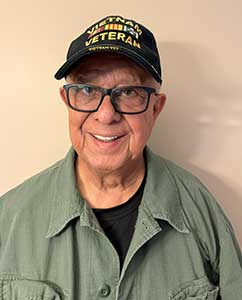
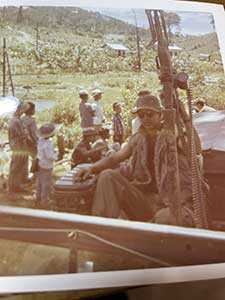
Chris was then assigned to the 360th Medium Truck Petroleum Company and they were informed that they were leaving for Da Nang. When they arrived, each person was told to leave the plane, except Chris! He was told to stay on board and go to the cockpit, where he learned that they were going to Cam Ranh Bay. Chris was informed that his job was to replace a sergeant supply clerk who had been arrested for selling a 5-ton tractor trailer on the black market. Chris was selected for this role, he believes, because in Ft. Leonard Wood, he had gained experience as a supply clerk during basic training. Therefore, his new role was to replace the disgraced sergeant.
In this capacity, Chris took inventory of supplies and, in the process, discovered an over-abundance of gas masks. The same dishonored sergeant had also been selling the gas masks on the black market because they were desired as a form of protection that hippies used against the tear gas that police had been using on them at this time. A few months later after the unexpected drama involving the dishonored sergeant, a replacement for Chris came to relieve him as a supply clerk. Chris then worked as a truck driver, where he drove convoys and delivered fuel, while supporting airborne units traveling throughout Vietnam. Chris recounts that it took ten people, with varying roles in support units, to support each active-duty serviceman; clearly, there was much work to be done to assist those serving in active duty.
In his role driving convoys, Chris recounts how “there are a hundred vehicles, anywhere you go, there is always a crew of people.” Also, he explains, to safely clear through the jungle and make a passageway for the convoy, the Army picked a spot that they wanted to go through and proceeded to spray it with Agent Orange. This would make it easy for a bulldozer to come right through and clear the area. Chris recalls how he and his company would “stop overnight at an outpost and then continue on the next day or two before stopping to spend the night at a fire support base (FSB),” a temporary military facility that provides “fire,” or “artillery,” support to the infantry in the area.
One outpost, Da Lat, stands out to Chris for very good reason. It is known as the “City of Eternal Spring,” thanks to its unique, temperate climate. In fact, it is so beautiful, that dating back all the way to the start of the 20th century, the French developed it as a resort destination. Today, it is the honeymoon capital of Vietnam. Sitting high up in the mountains, Chris recalls that, not only did the architecture look distinctly European and modern, which was vastly different from the very old temples dotting the Vietnamese landscape below, but also the temperature difference was amazing. In Da Lat, nestled at the mountaintop, it was refreshing and cool, about 75-degrees, versus at the foot of the mountain, where it was hot, humid, and around 20-degrees hotter. Undoubtedly, that was the most beautiful place that Chris saw during his time stationed in Vietnam, which concluded exactly 365 days after he had arrived. On his journey back to the United States, Chris made his way through Ben Hoa Air Base which, during the late 1960’s, the peak of the Vietnam War, was the busiest airport in the world (in regard to the number of airplanes taking off and landing).
Chris vividly recalls sitting in the terminal, listening to many stories of servicemen who had been severely injured, some of whom had not received medical help as quickly as they needed. This made Chris even more self-aware of how fortunate he was to be coming back home without any significant injuries nor having experienced any major trauma while in Vietnam. Then, after an 18-hour flight back to the States, flying by coach, on Tigerair, he landed in Washington. Chris explains, “As brutal as that flight is, you don’t care, because you are going home!”
When he arrived, he explained that the reception at Fort Lewis, just south of Tacoma, WA, was amazing; steak and baked potatoes were served, and there was a warm, friendly welcome! While in Fort Lewis, Chris, and many other men formally separated from the army. At this time, Chris noticed many soldiers taking off their fatigues, throwing them in the garbage, and going to the store to buy civilian clothes, all before flying home. Chris was not really realizing the significance of why they were doing so. However, when Chris left Chicago, traveling through Seattle-Tacoma International Airport, he was waiting in the terminal, and it took him a while to realize that the reason no one was sitting near him, even though there was plenty of empty spaces, was specifically because he was dressed in his uniform. Then, to make matters worse, after boarding the plane back home, Chris poignantly recalls a “bitter memory:” the flight attendant on board refused to serve Chris any refreshments and never even brought him a glass of water that he had requested.
When he landed in Chicago, it was uneventful; Chris’s wife was waiting for him, and he remembers that “no one said anything at all to him when he landed…there is a just a thick fog all around those memories.” Chris was married to his wife for 23 years and they not only share those painful memories from Chris’s time during the Vietnam War, but they also share a daughter together. Since then, Chris has happily remarried and has a son and daughter.
Thinking back on those unfortunate and sad memories upon Chris’s return home to America after the war, he explains how, initially, he was embarrassed to have served our country in Vietnam; moreover, he did not discuss his experience there with people, at all! The fact that, for many years, there was not any formal recognition given to Chris, nor his fellow Vietnam veterans, for their honorable service to our country, made Chris’s attitude about his service in the war even more painful.
But, after more than a decade had passed since Chris returned home, finally things started to change thanks to the 50th mayor of Chicago, Jane Byrne, who served between 1979-1983. What Jane did was long overdue—she dedicated the city’s first-ever Vietnam Memorial and time capsule on Veterans Day, 1982. In addition, a few years later, in June of 1986, eleven long years after the Vietnam War had formally ended in 1975, Chicago Mayor, Harold Washington, provided the municipal support for an idea presented to him: Chicago was going to host a “Welcome Home Vietnam Veterans” parade. So, that summer of 1986, a parade including 200,000 veterans took place; they were cheered on by close to 300,000 spectators who finally gave the veterans the honor they so- deserved, after being terribly robbed of it for far too long. The parade made its way from Navy Pier, through downtown, and concluded at Grant Park, and is still regarded as the largest one of its kind in U.S. history. These most-deserved events helped to create a positive shift in Chris’s personal reflection about his service in the Vietnam War and led him to become very proud of his service, just like all Americans should be!
Upon returning to civilian life, Chris remained a public servant, working for the Chicago police department on the West Side, where he was born and raised. After 27 years working in law enforcement as a police officer, Chris shifted careers with a “nice transition” to working on the regulatory front for the Illinois Gaming Board, where he processed gaming licenses for bars and casinos in the area.
Around a decade ago, while still working, Chris took a vacation and headed to Washington D.C. He made his way to the various veteran memorials but recalls not being able to make it down to the famous, black granite wall of the Vietnam Veterans Memorial, featuring the names of all the 58,000 veterans who lost their lives or who are still missing. He remembers “bawling his eyes out,” as he saw the names from afar, and was poignantly aware of how fortunate he was to not have his name be on that wall, while also feeling so much sorrow for those whose names are there. Chris retired a year ago, and has been enjoying his retirement ever since, especially his involvement in the American Legion. For all your many years of service to our country and to our local government, for all the multitude of ways you have been a diligent public servant, we all say a huge thanks, Chris!