
Navy Vietnam War Hammond, IN Flight date: 06/23/26
By Al Rodriguez, Honor Flight Chicago Veteran Interview Volunteer
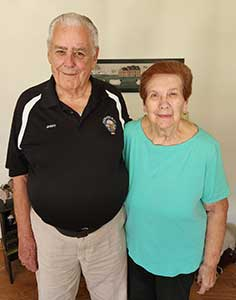
For nine years, Jerry Pawlus traveled throughout the Pacific Ocean aboard various naval ships. When his second enlistment ended, he wanted a career with a sense of adventure and excitement, so he became a fire fighter.
Jerry was born and raised in Hammond, Indiana. He was the oldest of three boys. Dennis and Michael were his younger brothers who also served in the military. At Hammond Tech High School he was a competitive swimmer and also was a life guard at the Douglas Park pool, so he was a natural fit for the Navy. During his senior year, Jerry and his best friend, Ed, decided to enlist in the Navy under the buddy system after they graduated in 1954. But first they enjoyed their summer before going to the Navy recruitment office and enlisting.
On November 1, 1954, they were bused to Great Lakes Naval Training Center for boot camp. It was November on Lake Michigan, but Jerry said the weather wasn’t bad. He loved basic training and being away from home for the first time because he could do and get away with stuff that he couldn’t with his parents. He was made his Ship’s Squad Leader which helped him to be promoted to an E2 – Seaman Apprentice at graduation.
After boot camp, Jerry was sent for Coxswain training to Coronado, California, at the Naval Amphibious Training Base, which was nicknamed the Gator Navy. Coxswains were responsible for driving and managing amphibious ships for beach landings of Navy and Marine personnel and equipment. He trained primarily on the LCVPs, Landing Craft Vehicle Personnel and the LCMs, Land Craft Mechanized. These ships were 36 feet long by 11 feet wide, low hull shallow draft boats built to navigate shallow coastal waters, rivers and zones where large warships cannot go. Their maximum speed was 12 knots or 14 MPH. They were capable of carrying 8,100 pounds of cargo, a standard jeep with a 12-man squad or a full 36-man Marine platoon. An LCVP/LCM coxswain worked alongside a small crew, including two deck hands managing the ramp and mounted machine guns and an engineer who maintained the ship’s diesel engine. Jerry was also trained to be a Beach Master. Landing personnel and equipment on the beach needed a traffic cop to control amphibious vehicles, manage beach traffic, direct landing craft, coordinate supply movements, and handle boat salvage operations. This is a complex job while training, but imagine doing all this in a battle with incoming enemy mortars and small arms fire.
In 1955 the movie Francis in the Navy was partially filmed at Coronado. Jerry was selected as an extra for a scene where they needed some sailors to walk in the background carrying their sea bags. He met the actor Donald O’Connor. Later, while at a restaurant in Acapulco he met Kim Novak and other actors.
Jerry said that after completing his training, his training never ended. They practiced landings on other domestic and foreign beaches. Their smaller ships were loaded into an LSD, Landing Ship Dock to transport to long distance locations. He was sent to the Philippines for tropical training, Alaska and the Aleutian Islands for cold weather training and to Hawaii because the heavy surf made landings tricky to keep these shallow ships from taking on water and sinking.
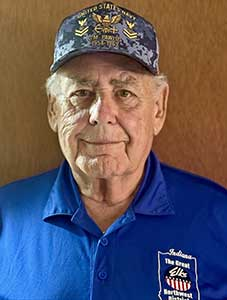
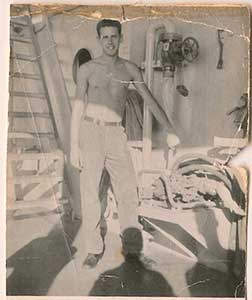
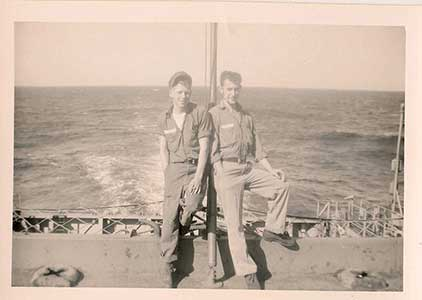
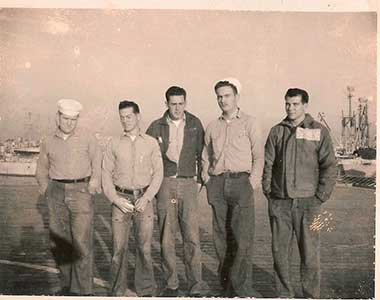
He also had a six-month deployment to Yokosuka Naval Base in Japan and practiced beach landings in Okinawa and Hong Kong. After each deployment he returned to Coronado. His enlistment as an E3 – Seaman was coming to an end and he thought about reenlisting but didn’t want to stay with the Gator Navy. He said it was a dead end job with promotions to higher rates slow in coming. The Coxswain and Beach Master are specialty jobs and the Navy was reluctant to let anyone trained in them move to another job but they eventually agreed to let him move on.
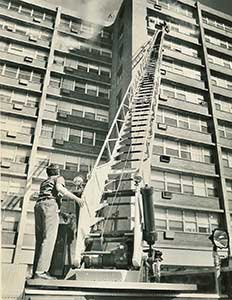
In 1958 Jerry was sent to ship maintenance school at the San Diego Naval Station. There he became part of a maintenance group that had multiple damage control duties for any break down on a ship, fire fighting, electricians, welders, carpenters, plumbers and sheet metal repairs. Although they cross trained on each job, Jerry was designated as a welder/fire fighter. He was taught high pressure and arc welding. Also because a fire on a ship is critical to control as quickly as possible, he was part of an organized team trained to respond to them.
Jerry’s Navy buddy Ed, wrote him and asked him to be his best man at his wedding In May of 1958. Jerry got permission to attend. At the wedding he was attracted to a bridesmaid. Her name was Sharon who would later become his wife. A day after the wedding he saw her walking to town and gave her a ride. And as he said the rest is history. They wrote letters to each other while he was serving in the Navy.
When Jerry finished training In October 1958, he was assigned to the newly commissioned attack transport ship the U.S.S. Paul Revere, LPA-248, that was located in Long Beach. Jerry said he was a plank owner, the nickname for the sailors of a new crew on a newly commissioned ship. The crew’s first responsibility was to make the ship seaworthy and then sail it to the San Diego Naval Base with all the other 7th Fleet ships. They made several training shake down cruises to make sure that the sailors were familiar with the ship and knew their battle stations and fire station assignments. As the sailors gained proficiency in their duties, these cruises sent them to ports in Hawaii and Alaska. Jerry was promoted to E4 – Petty Officer 3rd Class.
As was the Navy’s custom after two years at sea, Jerry was assigned to shore duty. He was sent to the Mare Island Naval Shipyard near San Francisco. This shipyard was used to store inactive ships temporarily or permanently. The sailors assigned there were responsible for maintenance and security for these ships. When a ship was activated for duty, the sailors would verify the integrity of the ship. A skeleton crew would sail with it while the ship was being towed to its assigned port. Since San Francisco was close to the shipyard Jerry chose to get an apartment off base. He saw a lot of the city.
In 1962 after one year on Mare Island he was assigned to the U.S.S. Oriskany CV/CVA-34 an aircraft carrier. When he and two other sailors assigned to the ship arrived at the San Diego Naval Base they found that the U.S.S. Oriskany had already sailed and was in the Sea of Japan. They were military transported to Subic Bay Naval Base in the Philippines. From there they got a ride from the oil tanker that was going to refuel the U.S.S. Oriskany. There was no other way to get them aboard the ship other than a highline. This was the way they would get people, mail and other cargo between two ships. They would shoot a special feeder line from one ship to the other. Then they would connect a specialized highline chair to it. One by one the sailors were pulled up to the ship. Jerry said he was never as scared as he was being pulled and swinging inside this chair between the two ships.
The U.S.S. Oriskany was called a long-hulled Essex Class ship. It was longer than the previously built WWII aircraft carriers. It was able to carry more squadrons of specialty aircraft, fighters, bombers, surveillance and even propeller driven planes. Jerry loved being at sea. There were fantastic sunrises and sunsets and clear dark night skies filled with stars and constellations. His fondest memory in the Pacific Ocean was the traditional Navy rite of passage when a ship passes through the equator and the International Date Line. The International Date Line is an imaginary boundary where one calendar day ends and the other begins. The Navy tradition states that any sailor on the ship that has never crossed this line must go through a gauntlet of tests. Once they are completed he goes to the Court of King Neptune, the King is the oldest serving sailor of either rank. He then becomes a member of the Silent Occult Mysteries of Far East in the Domain of the Golden Dragon.
After several months the U.S.S. Oriskany returned to the San Diego Naval Base for deep maintenance and replenishment that could not be completed at sea and for the well-being of the crew. He was promoted to an E5 – Petty Officer 2nd Class. Jerry had an unexpected family reunion. Unbeknown to him, his brother Dennis had joined the Navy and surprised him aboard the U.S.S. Oriskany. His brother was a mechanic on a fighter whose squadron was using the U.S.S. Oriskany for practicing takeoffs and landings. In 1963 the ship was ordered to sail to Yokosuka Naval Base in Japan. Tensions were mounting in Vietnam and it was sent there as a show of strength. Jerry had only a few months left on his enlistment but he travelled with the ship. Jerry’s commanding officer assumed he was going to stay in the Navy and presented him with his reenlistment papers. He did not reenlist for a very good reason. Sharon had written and told him that she would never marry a sailor.
When the ship returned to Yokosuka he was flown by military transport to Treasure Island Naval Station in San Francisco and discharged. As he was walking out of the gate the Marine guard told him that President Kennedy had just been killed. Jerry said he never forgot the day, November 22, 1963. There was also a tragic connection to the ship he had served on. In 1966 while operating off the coast of Vietnam the U.S.S. Oriskany experienced a fire that killed 44 sailors and injured 156 others.
After leaving the Navy, Jerry flew from San Francisco to Chicago Midway Airport and went back home to Hammond. With his training as a Navy firefighter he applied to the Hammond Fire Department but worked at Standard Railway in the Research and Development section waiting for his appointment. He married Sharon in October 1964.
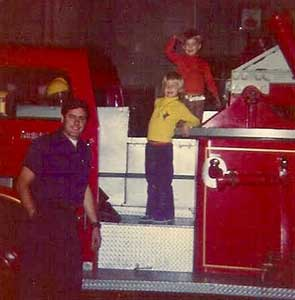
After a year he was accepted into the Chicago Fire Academy for six months of intensive training. In 1965 he joined the Hammond Fire Department as a probationary fire fighter at Station number 1. That same year his son, Scott, was born.
A fire fighter‘s job is dangerous. They run into a burning structure while most people are running out. Jerry worked his way through the ranks, first as a 1st Class fire fighter and then as an engineer. The engineer drives the fire truck and makes certain the right pressure is applied for pumping the water through the hoses to the fire. His daughter Erin was born in 1969.
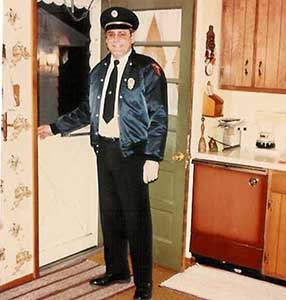
In 1982 he was promoted to Captain of fire station number 8. Jerry explained that all fire fighters essentially perform the same job, but the captain has additional duties. He assesses the situation, orders search and rescue missions and if the fire is escalating, calls in a second alarm to bring in another fire station to help. In 1985 Jerry retired from the Central Station, the busiest engine company in the city of Hammond, taking 2/3 of the calls that went to them initially or was called in as a second alarm.
After retiring Jerry decided to join the Highland Elks Lodge 981. He was interested in the Elks because of its work raising money for community needs and fundraising for social programs. The Elks also has programs to support and honor military veterans. Jerry held many positions in the Lodge including the Exalted Ruler which is the highest ranking officer. Since he is an avid golfer, he is the past president of the Indiana Elks Golf Association that hosts a state golf outing for all Indiana Elks Lodges.
Jerry has had no service-related health issues from his time in the Navy. He says “I’m proud to have served my country and grateful for the friendships and memories the Navy gave me. Experiences I never could have imagined as a young man.”
In 2002 he and his wife met his daughter in Washington D.C. He has seen the Vietnam Veterans Memorial and the Korean War Memorial but is looking forward to his Honor Flight to see them again and all the memorials that have been built since his last visit.
A double thanks to you Jerry for serving your country in the Navy and as a first responder. Enjoy your day!