
Air Force Korean War Western Springs, IL Flight date: 09/23/26
By David Adams, Honor Flight Chicago Veteran Interview Volunteer
That December Sunday afternoon in Rogers Park started out as any other for ten-year old Bill Leider. One found him outside his home playing in the street which was the rule in Chicago at that time. Bill suddenly heard a frantic pounding on the front room window. His mother had just heard the radio broadcast news of the Japanese attack at Pearl Harbor. She was afraid of an attack on Chicago. The window broke since she hit it so hard. With cuts on her hand from the shattered glass, she was taken to hospital for stitches. Bill remembers this was “a very frightening time.”
Bill graduated from Senn High School in June 1950. In both primary and secondary school, he became proficient in the visual arts. From the third grade onwards, he earned competitive scholarships to attend Art Institute of Chicago classes. While at Senn, he needed at least four honorable mentions, or better, in art shows to get a scholarship. He remembers that “Senn had a great fine arts department.” Yes, match that with talent and you are on your way. After graduation he enrolled in Chicago’s Institute of Design. His goal: become a commercial artist. Best laid plans. The Korean War began on June 25, 1950. Bill reasonably expected to be drafted into the Army. Getting ahead of the curve, he enlisted in the Air Force while his probable draft notice loomed over him.
Air Force training
In December he boarded a train at Union Station for San Antonio and Lackland AFB where he reported for basic training. His dad had received the expected draft notice while Bill was enroute. He sent it to him at Lackland as a joke. Bill had the last laugh. After basic he reported to Keesler AFB, MS for about ten months of electronics and radar school. The first 18 weeks dealt with electronics and the next 12 with advanced training in radar. Training was hard: eight hours a day, six days a week,. “No goofing off or you could be put on permanent KP.”
Airborne radar training was on a C-47 flying out of Keesler. Radar scopes were circular with the airplane in the center. The scopes were WWII vintage, although adequate for aircrew training. His final several months of training was at Lowry AFB, CO. There he trained in the B-29, B-25, C-47 on airborne radar bombing systems.
Korean war service
With nearly two years of intense training completed, Bill traveled to the Korean War theater and his destination Tachikawa AFB, Japan. He made his way to the West Coast where he embarked on a Navy ship headed to Asia. It took the Northern route across the Pacific via Alaska encountering severe weather. He arrived in Japan in the early spring of 1952. He was surprised to find that Japan has “very tame winters”.
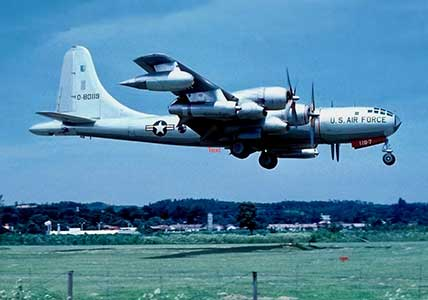
The war had reached a stalemate, but fighting continued for another year and a half. He recalls that Tachikawa was “very busy” and close to Tokyo. At Tachikawa he got training in the Boeing B-50 Superfortress. The B-50 was a strategic bomber, a post-WWII revision of the B-29. It was fitted with more powerful engines, stronger structure, a taller tail fin, and other improvements. The radar bombing system, which Bill knew intimately, replaced the WWII Nordan bombsite.
A “couple” of bombing missions
According to Bill he flew a “couple of bombing missions” into North Korea. Basically, takeoff from Tachikawa, engage the target, recover and refuel at an airfield on an island in the Han River near Seoul. This airfield, code name K-16, was essentially just two Quonset huts and fuel for Far East Air Forces (FEAF) airplanes. His combat sorties were long, but Bill remembers them seeming “very short: five minutes”. F-86D’s flew fighter escort for the bombers. Missions continued to Okinawa and back to Tachikawa. His aircraft commander, a captain, was of Scottish descent and thus was called “Scotty”. Bill learned so much flying with Scotty. Visions of Star Trek.
During Bill’s tour at Tachikawa the USAF retired the B-50 and replaced it with the jet-powered B-47. The B-47s were confined to the States. This meant that he was “out of a job”. He transitioned to a specialty which used his radar expertise. He trained as a GCI (ground-controlled interception) operator and became proficient in system maintenance
Radar surveillance of China
After the cease fire and armistice in July 1953 Bill joined a GCI unit on an island in the Sea of Japan near the 38th parallel and close to North Korea, but in international waters. From there the Air Force could conduct radar searches of the sky at high altitudes. As Bill puts it, “We were interested in the Chinese.” Using what he calls “high beam” the unit could surveil the sky over China. His radar had a range of 400 miles. While there he became familiar with the mission of the Navy’s P2V “Neptune” reconnaissance aircraft. He recalls with a laugh that it had the callsign “Baby Food”. Bill talked to them daily.
Bill completed his tour in late 1954. He had spent 2 ½ years in Japan. Travel back home was on a Navy ship, part of a large convoy. This time it took the southern route and took 22 days. The warm weather stood out in stark contrast to the northern route going over.
After a well-deserved 30-day leave at home, he reported to Lake City Air Force Station near Lake City, TN. The city itself is now called Rocky Top. It was one of twenty-eight stations built as part of the Air Defense Command (ADC) network. Lake City AFS was a stone’s throw from Oak Ridge, a key site during the Manhattan Project. The station functioned as a Ground-Control Intercept (GCI) and warning station. Bill and his colleague’s role was to guide interceptor aircraft toward unidentified intruders picked up on their radar scopes. When his fellow airmen discovered he was an artist, he was “recruited” to make Christmas decorations for the 1954 holiday celebration.
Bill was honorably discharged from the Air Force in February 1955 with the rank of Airman First Class. He holds the Enlisted Aircrew Member Badge, Korean Service Medal, Campaign Ribbons, and National Defense Service Medal. The Air Force allowed him to attend a seemingly constant number of schools which “kept me thinking.” In summary, “Uncle Sam was very, very good to me!”
Civilian life
Returning to Chicago, he first went to work as a technical illustrator for Hallicrafters in Chicago. His primary task was preparing illustrations for color televisions. Being skilled in electronics Bill took the opportunity to build a color television of his own. Why buy one when you can make your own?
He eventually joined Northrop Corporation in Arlington Heights following a recommendation from a friend. Northrop was designing and building the B-2 “Spirit” stealth bomber at the time. He came on to design illustrations for the bomber, especially for its Electronic Countermeasures (ECM) systems. In about 1985 Northrop sent Bill to school to learn computer-aided design (CAD). Thereafter he was intimately involved in CAD for the B-2. He retired from Northrop Grumman in 1999.
Immediately after retirement Bill continued to fully enjoy golf and bowling as well as fishing. He eventually turned these pastimes and equipment over to his grandchildren. Bill and wife Stephanie share a blended family of three children, four grandchildren, and five great-grandchildren. They are fond of Viking River Cruises and visiting such European countries as Germany and Greece.
Bill, thank you for your faithful service to our country. Enjoy your Honor Flight to Washington in the company of other veterans!