Army Vietnam Era Chicago, IL Flight date: 10/28/26
By Ginny Williamson, Honor Flight Chicago Veteran Interview Volunteer
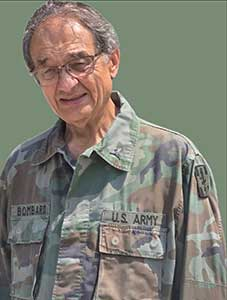
Garry Bombard served in the U.S. Army 14 days short of 30 years, with most of his time coming in the Reserves. He joined the Army Reserves in March 1971 while still in school, waiting to join until he completed his degree from Quincy College, where he obtained his BS degree in Biology and Medical Technology. He grew up in Mt. Greenwood, attending Queen of Martyrs grade school and Brother Rice High School.
Garry’s Basic Combat Training (BCT) took place at Ft. Knox, Kentucky in 1971, then it was on to Ft. Sam Houston in Texas in February 1972. Applying his biology and medical technology background, Garry worked in the medical labs there.
Until May 1972, Garry worked at the Brooke Army Medical Center (BAMC). There he worked in the blood bank and provided guidance based on his civilian experiences. After this assignment, Garry was assigned to the 374th Convalescent Center in Chicago from 1972 as a Clinical Laboratory Specialist. After completing his officer training, he was commissioned as Second Lieutenant in 1972. He served at the 374th Convalescent Center until 1977. Then from 1977 until 1980, Garry served as a Clinical laboratory Officer at the Det 1, 801st General Hospital, in Chicago.
Convalescent Centers provided physical therapy for those injured in Vietnam instead of shipping them to Germany or other locations for recovery.
Garry would go to Ft. Carson in Colorado Springs, where he helped with orthopedic injury recovery. This was a smaller unit than the typical convalescence centers. The military did away with convalescent center in 1977, assuming there was not a great need for them as the war wound down.
As a reservist, Garry went to ‘summer camp’ each year. His assignment during these summer camps was either Office in Charge (OIC) or Executive Officer (XO). He served as the Entomologist at the 180th Medical Detachment in Honduras in 1987. They were in the capital of Tegucigalpa (Teguch, as they referred to it).
They worked with the local families there who welcomed them. While there, roads were built in the mountains for military movement (not necessarily for the locals). Garry and his unit would go up into the mountains to help the local communities with medical and dental needs. The locals had very little food. They would chew on sugar cane which ruined their teeth. So the dental care that the unit provided, unfortunately, was mostly to remove their sugar-rotted teeth.
Garry and his unit lived in tents. The Army Hospital used a water buffalo as the hospital water source and had burnout latrines. The Air Force, who were also on site, lived in concrete buildings. This is where Garry went to take a hot shower.
Catholic Mass was said by priests who were from the U.S. They were the chaplains who served with them at the same time. The chaplains participated in the summer camps also. There were several chaplains – Catholic, Jewish. The chaplains participated in the real-world exercises, caring for those who were not expected to survive. For those, the chaplains would stay with that group of casualties, during these exercises.
He spent the summer camps from 1988 to 1990 at Ft. Bliss, William Beaumont Army Medical Center (WBAMC). In 1991, he was tasked with running the troop medical clinics (TMC) at Ft. McCoy in Wisconsin. They would rotate every two weeks at Ft. McCoy. He was the Medical Coordinator, Troop Medical Clinic there. Garry was responsible for covering the staffing for all the shifts. There were approximately 5,000 who participated at the summer camps.
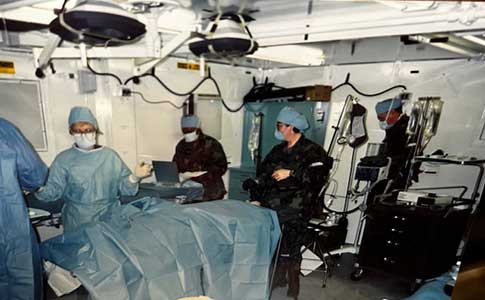
In 1992, he went from a General Hospital (GH) environment (500 fixed beds) to a Combat Support Hospital (CSH) (500 beds in the field). He participated in: Deployable Medical System (DEPMEDS) for new equipment training; sustainment – more training, as a refresher; was an External Evaluation – evaluation, reviewing all the medical training going on. These were joint training exercises – Air Force was also there – medical and non-medical.
During this time, they would do ‘sand box’ exercises which included how to set up the hospitals and determine how they wanted them to function.
The hospital was constructed using large medical tents and ISO containers (reused for each summer camp), set up in the field as emergency rooms and hospitals. The ISO containers included portable equipment, simulating a fully operational hospital to include ICU and various wards.
Exercises involved a moulage – applying mock injuries for the purpose of training emergency response teams and other medical and military personnel. The moulage patients included active duty and reserve members.
Garry was in charge of a base cluster, with several small units under the ‘patient play’ scenarios – simulated war. These included Tactical Operations Command (TOC) – Garry was responsible for everything, in 12- hour shifts. All the senior staff (S1, S2/3, and S4) worked in the TOC. They would work with the Air Force. Garry would work with those in the field, treating ‘patients’ with injuries and those taken to emergency rooms and surgery. With the Air Force, they had to medivac to places like Germany so they practiced the medivac exercises. The unit had maps up to see the forward edge of battle areas (FEBA). If a Nuclear Biological Chemical (NBC) occurred, the CSH had to take appropriate actions.
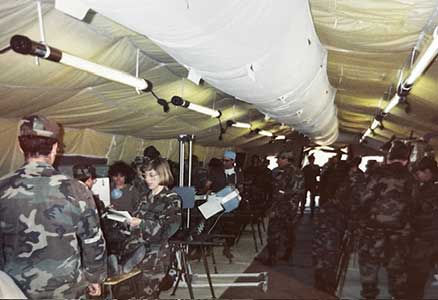
From 1994 to 1997, Garry served as the Training Officer/Security Officer (S-2/3) with the 801st Combat Support Hospital. He then was the Executive Officer (XO) from 1997 to 2001.
In 2000, Garry served as the OIC at the Operation New Horizons, JTF MIDAS, Medical Readiness Training (MEDRET) in Grenada, West Indies. In Grenada, they did real-world training. The State Department coordinated the assignment there; he worked with the assistant ambassador in Grenada.
Cuba was responsible for the original building of the air strip in Grenada. So, there was a lot of anti-American sentiment from the locals there. Previously, the active-duty Army personnel were sent there to rescue the U.S. medical students from the local medical school. Everyday Garry and his unit would go out, all day, with a Marine guard escort, due to the anti-American sentiment.
There was an advance party in Grenada who arrived about one week before the two-week assignment. This advanced party included Garry as the OIC and the Training Officer. The advanced party went around the island, identifying potential locations to use as medical facilities, schools and clinics.
Included in Garry’s Grenada team was the Head of the Illinois Public Health Department for Virology. Garry wanted to know what diseases or bugs his troops would be facing. Garry needed to know what he was dealing with. “I saw bugs I’d never seen before.”
As Garry said, “I don’t think people realize the depth of detail” that these summer camps went into (AT simulations and MEDRETS) in preparation of what might happen.
From 2000 to 2002, Garry was still the XO in the Chicago area. He coordinated with the next group who went to Peru who were there for two weeks. There was a medical lab unit that did not have a slot for Garry at the time. That unit ended up going to Desert Storm, assigned at Abu Ghraib. At that location, prisoners of war needed to be tested for biologicals.
Garry’s appointments/promotions included: Second Lieutenant (1972), First Lieutenant (1974), Captain (1978), Major (1985), and Lieutenant Colonel (1992).
Among his decorations/service medals, Garry received the following: Army Service Ribbon, Army Service Reserve Medal, Army Achievement Medal, Army Reserve Components Achievement Medal with Four Oak Leaf Clusters, National Defense Service Medal with Bronze Star, Army Reserve Overseas Training Medal, Meritorious Service Medal, and Army Commendation Medal.
During his years in the reserves, Garry worked as a Forensic Scientist (has his PhD in this discipline). He worked for the Chicago Police Department for five years and the remainder of his career was with the Illinois State Police. He served as the statewide training coordinator – training and application, a two- to three-year program for all newly hired forensic scientists and provided continuing training to current forensic scientists. The training function was the largest section within the Illinois State Police Forensic Sciences Command.
After his retirement from the Illinois State Police, Garry took a teaching role at Loyola University Chicago. There he was the Forensic Science Program Director from 2003 to 2022. This was a nationally accredited program. While there, everything was pulled down during COVID. So, Garry had to stay there as the director, otherwise they would have lost their accreditation.
Today, Garry volunteers his time with the National Technology Validation and Implementation Collaborative (NTVIC). The NTVIC develops guidelines for establishing new forensic testing, such as Rapid DNA, Single Cell DNA, and Forensic Investigative Genetic Genealogy (FIGG) programs. FIGG is a technique that combines genetic testing with traditional genealogical research to generate investigative leads in unsolved violent crimes and cases of unidentified human remains.
The NTVIC has developed national guidelines and is deploying Rapid DNA testing. Rapid DNA is a fully automated process of developing a DNA profile from a mouth swab. This happens in one to two hours – without the need for a DNA laboratory. Garry said that rapid DNA is going to be big. The FBI is expanding access to include searching open case files for the arrestee samples, potential of solving many unsolved cases.
Garry runs and chairs the Evaluation Public Policy and Analysis division at NTVIC. This is an international role, and every state’s largest crime laboratory is involved. He runs the task group; everything else is a working group. Garry enjoys the forensic science field. He used to watch the show, ‘CSI’ and said they had excellent technical consultants.
Two national cases that Garry worked on during his employment with the Illinois State Police were the John Wayne Gacy case and the Tylenol murders case.
In 1978, John Wayne Gacy was arrested for the murder of a 15-year-old boy. He was convicted for the murder of 33 men and boys. During the investigation, Garry was involved with the excavation under Gacy’s home. With the work that Garry did – trying to identify the victims – they were able to tie back their findings to Gacy.
The Chicago Tylenol murders were a series of poisoning deaths resulting from drug tampering in the Chicago metropolitan area in 1982. Garry got the initial call about the case while he was at the Illinois State Police. For this investigation, everything was pulled from the store shelves. And everything, every capsule, was tested.
Garry was involved in testing the capsules. They were looking for the contaminants in the capsules tested. He mentioned that only six labs made cyanide in the world. They were looking at the invisible elements to trace the cyanide that was found in the original capsules and back track through distribution channels. Since there were no leads in the case, the capsules were sent to the U.S. Government lab in Washington, D.C. However, they never could identify the person responsible to the poisoning.
(Note: As a result of this case, safety caps/foil seals were required for the over-the-counter medications and all products we consume.)
Garry is looking forward to this Honor Flight experience. He has friends who volunteer for HFC who encouraged him to go. We remember his late wife, Kathryn whom he married in 1971. They have three sons, nine grandchildren and one great grandchild.
Welcome aboard, Garry. Enjoy your day of honor. And thank you so very much for your years of service.