
Army Vietnam War Chicago, IL Flight date: 04/15/26
By Marilyn Lucas, Honor Flight Chicago Veteran Interview Volunteer
We often hear the battle cry of “ NO MAN LEFT BEHIND“, but seldom have the opportunity to meet an individual who performed this mission. SP4 Edward Johnson, while on a search and recovery mission, was wounded in his left shoulder on December 18, 1965, for which he later was awarded the Purple Heart. It was common practice for companies to be sent out into the jungle on operations that could last anywhere from 10-to-20 days in search of Viet Cong. Soldiers were ankle deep in mud living off of canned sea rations which they often carried stuffed in their socks hanging out of their back pockets. According to Ed, your socks would get too wet and smelly because of the mud and moisture, so for expediency, they removed their socks and used them as a pouch for the canned C rations.
It was on one of these operations that a fellow soldier was killed. The company was sent out on a recovery mission. During this time both Ed and his captain were wounded, and the long 12-hour trek through the jungle began. Fifty soldiers were walking through the jungle shooting flares in order for the rescue helicopters to find them. The danger was highlighted by VC hiding in the trees waiting to ambush. The VC would sit in the trees smoking marijuana, patiently waiting for their prey. Little did they realize the Marijuana odor was a signal to the Americans of the VC’s presence. Another concern was the punji sticks placed by the VC in camouflaged pits or shallow holes. These bamboo or wooden spikes approximately 6 to 24 inches long were covered with human feces or plant poisons to maximize damage. The physical wound was minor but the resulting infection would cause hospitalization. Fortunately without further incident, Ed and the captain were rescued by the helicopter teams once they reached the designated clearing. A Christmas blessing!
As one can only imagine after 10-20 days in the jungle a shower was a welcome site. In the picture below Ed is standing in front of a makeshift shower, certainly not highly sophisticated. The men were given a 5 gallon can to fill with water. They would put half of the water in the barrel and stand below “sudsing up”. Once they had finished with the soap they would pull the cord to release the remaining water to rinse. Amazing how man figures out how to survive.
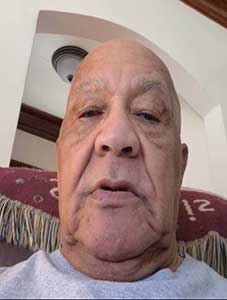
Ed joined the military in August of 1963.He did basic training at Ft Knox,Ky. Being the astute soldier that he was, Ed did a quick analysis of military pay. Ed’s base pay was $79 a month. He discovered that if he went to jump school he would get $55 more a month, and an additional $55 for combat pay. Off to jump school to become a “Sky Soldier!” Jump school took place at Fort Benning, Georgia. It was a three-week training course focusing on parachute landing falls, tower training, and five qualifying jumps to earn paratrooper status. Ed laughingly commented on how he had never seen so much gum chewing during this training. When asked why, Ed explained because everyone was so nervous before they jumped, as if Wrigley could soften the landing. It took only one occurrence of being caught in an air pocket, and Ed gained a whole new perspective on the dangers of parachuting and deep breathing.
Ed was deployed to Okinawa to become a part of the 173rd Airborne Brigade. This was the only separate airborne brigade to exist in the history of the US Army. It was formed to be a quick reaction force for the protection of American interest in Asia. The brigade underwent extensive jungle training followed by parachute jumping. The locals gave the paratroopers the nickname “Tien Bing,” Chinese for “Sky Soldiers”. This became the official nickname for the “Brigade”.
In 1965 the brigade deployed to South Viet Nam as the first US Army ground combat unit in that war. With the attachment of the Royal Australian Army and a battery from New Zealand, the 173rd Airborne became the only multi-national combat unit in the war. This famous brigade was depicted on the cover of “Life“ magazine in October of 1965. Ed‘s entire company meets once a year for a reunion in various states around the country. The 173rd Airborne Brigade remained in combat longer than any other American military units since the Revolutionary War. It earned four unit citations and had 12 Medal of Honor winners along with Purple Hearts awarded for wounded or killed. The Brigade is now based in Vincennes, Italy, able to be deployed anywhere within an 18-hour radius.
Okinawa, being a large training camp, did provide some activity for the soldiers. Ed played football, but never made it to the Bears team when he returned to Chicago. Ever industrious, Edward used his ration card to purchase liquor, but keep in mind he did not drink. He would either sell the liquor to fellow soldiers or use it to trade for other desirable items. No wonder this clever soldier went on to use the G.I. Bill and get his degree in marketing at Chicago State University.
Eventually, Ed was sent to Bien Hoa. The first 35 days in Bien Hoa they lived in pup tents, which barely protected them from the pouring daily rains. Larger tents were later built to accommodate 14 people. This was the beginning of the 10-to-20 day operations that would take place in the jungle. A perimeter of Claymore mines were placed around the camp to protect from night attacks and provided early warning of enemy presence. These mines were detonated by soldiers using a firing device, allowing them to strike at the precise moment to maximize casualties and avoid friendly fire. These mines were carefully monitored as the VC were notorious for tampering with the wires and turning the mines so they would aim towards camp.
First in first out. SP4 Johnson returned home in August 1966. He finished his service with the 82nd Airborne Division at Fort Bragg. He was awarded the Purple Heart, the combat infantry badge, the Vietnam campaign medal and Vietnam service medal. His unit also received a citation for combat operations.
Ed was glad to come home to his wife of 62 years. Ed and Faye, who still live in Chicago, have two sons, one of whom is a Medic in the military. They also have five grandchildren and 11 great grandchildren. After the war, Ed, now retired, worked for Peoples Gas for 13 years and then Xerox 18 years. He has also been a substitute teacher. While feeling an allegiance to the military, Ed has put those Vietnam years behind him. He harbors no ill will towards that time in our history. He has taken the opportunities his service has awarded him by his use of both the G.I. Bill and the VA hospital.
Edward, thank you for your years of service to our country. Enjoy your day of honor as you experience Washington DC.