
Navy World War II Flight date: 07/29/26
By Joe Kolina, Honor Flight Chicago Veteran Interview Volunteer
Patrick Lloyd will never forget the first time he saw Pearl Harbor. He was just 18 in the summer of 1944, still new to the U.S. Navy. And he couldn’t believe his eyes.
It was three years after Japanese war planes sank the USS Arizona, the USS Oklahoma and the USS Utah in a surprise attack. They were among 21 vessels destroyed or damaged along “Battleship Row” on what will always be remembered as a “day of infamy.”
The destruction, desperation and chaos of that day remained vivid memories. Patrick stared in jaw-dropping amazement at the carnage still visible, mangled hulks of wreckage sitting in the harbor.
“It was bad. To see the ships that had been sunk, to think of the people who died. It was shocking,” Patrick says. “We knew we were at war. We had to accept what we saw. But it was something you never wanted to see again.”
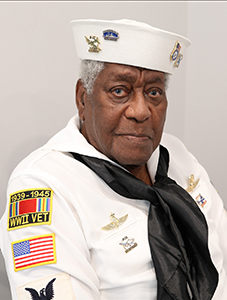
Patrick Lloyd turned 100 on May 3. He is one of the dwindling number of surviving World War II-era veterans. The remarkable story of how he advanced from steward to band musician spotlights a fascinating period in the gradual integration of the U.S. Navy.
Patrick joined the Navy for the same reason that millions of other young Americans enlisted after the Japanese attack on Pearl Harbor.
“I just wanted to serve my country,” he says.
Limited Opportunities for Black Sailors
Patrick was born in Meridian, Mississippi. The U.S. Navy had restricted service opportunities for Black Americans when he came of age. The Navy had only resumed enlisting Black sailors in 1932 after a long pause, but only in the Stewards Branch. It was the branch responsible for cooking, serving and valet service for officers.
It’s not easy to document Patrick’s service history. There aren’t many records available and his memory has faded. But what he does remember and what we’ve learned suggest that he was part of a fascinating transformation in the Navy.
Pentagon records and those available on ancestry.com reveal that Patrick Lloyd joined the Navy in January 1944. He was sent, after basic training at Naval Station Great Lakes, to the Pearl Harbor Base Reshipment Depot as a seaman second class in April. Patrick was listed as a steward second class on May 31, 1944. By the end of the year, he was a steward first class, with a cryptic notation about his service in a Navy “recreation” program. That’s where Patrick’s story takes a surprising turn.
A Different Assignment
Patrick says he spent his time at Pearl Harbor playing tenor saxophone in a Navy band, not working in the Stewards Branch. He says his 17-piece band played before audiences of as many as 1,000 people. They were sailors assigned to bases on the island, on their way home, or preparing for what many expected was the coming invasion of Japan.
“All we did was play,” he says.
Duke Ellington and Count Basie songs were standards. Patrick’s favorite was a Count Basie signature tune called “Jumpin’ at the Woodside.” It was a hard-driving swing number with a fast, buoyant rhythm meant for dancing.
Playing was hard work. Patrick tells stories about the trumpet player who sat behind him.
“He played that trumpet so loud in my ear that it got messed up,” Patrick says. “I had to have hearing aids later.”
But he loved performing.
“We tried to make everyone happy,” Patrick says. “They enjoyed it. And so it made me happy to play.”
Music Boosted Wartime Morale
It was a time of great musical excitement and experimentation on Pearl Harbor. The Navy had a great need for good bands. They entertained at USO dances, battle of the bands, officer galas, rec hall parties, movies, smokers, and ball games.
But Patrick’s stories also posed a mystery. Why don’t surviving rosters list his name among members of well-known all-Black Pearl Harbor Navy bands like the Mañana Meteors, The Moonglowers, The Melody Masters and the Barber Point Hellcats. One historian of the period offers an interesting hypothesis to explain what may have happened.
Searching for the Historical Record
Alex Albright is the author of a history of the biggest all-Black band at Pearl Harbor: The Forgotten First: B-1 and the Integration of the Modern Navy. (2013 R.A Fountain). He says men were sometimes sent to Pearl Harbor as stewards but reassigned unofficially to a band after the discovery of their exceptional musicianship.
“Navy bandsmen were supposed to be graduates of the Navy School of Music, which was not open to Blacks until after World War II,” Albright says. “So the Navy relied on finding sailors who were already good musicians.”
The best example involves jazz legend John Coltrane. The Navy initially sent him to Pearl Harbor in 1945 as an apprentice seaman. But when his musical genius was noticed he unofficially joined The Melody Makers as a “guest player.”
Sailors prized jobs in Navy bands. It beat the hard labor and poor working conditions associated with steward service.
“The bands had to be top-notch,” Albright says. “So, much of the job was practicing, which they got to do around the base while the rest of the troops got sent off to work.”
Bands Role In Navy Integration
Albright says all-Black bands played a role in the eventual integration of the Navy both before and after President Truman’s executive order desegregating the armed services in 1948.
“Musicians were the first to break through the barrier of only cook and steward jobs for black sailors, and their service proved enormously successful,” Albright says.
By 1944, the Navy had 13 black admirals and over a hundred Black bands.
“But because the Navy did not keep records of individual bands, it is impossible to know how many existed, and that is made further complicated by stories of service like those of Patrick Lloyd,” he says.
Whether Patrick officially belonged to one of Pearl Harbor’s legendary bands or was assigned informally his story illustrates how talent sometimes opened doors the Navy had long kept closed. Musicians like Patrick Lloyd entertained thousands of servicemen, demonstrating that Black sailors could excel far beyond the narrow roles the Navy had assigned to them.
After the war, Patrick returned to civilian life in Chicago, joining his father at Lloyd and Son Construction Company. Patrick later ran the company himself for 35 years. He also taught carpentry for many years at Olive-Harvey Community College in Chicago. Patrick has a lovely wife, Ruthie, four children, six grandchildren, eight great-grandchildren and two great-great-grandchildren.
U.S. Rep. Robin Kelly (D-Il.) sponsored a congressional resolution commemorating Patrick’s 100th birthday. She lauded “a proud veteran, master craftsman, educator, business leader and patriarch whose century of service and sacrifice continues to inspire” all who know him in his hometown of Calumet City, Illinois.
Honor Flight Chicago and its many volunteers and supporters agree wholeheartedly.
Thank you for your service, Patrick.