
Army Vietnam War Portage, IN Flight date: 07/29/26
By Al Konieczka, Honor Flight Chicago Veteran Interview Volunteer
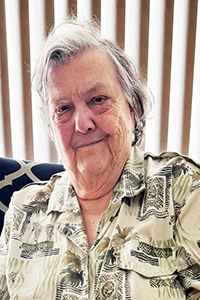
Mary McCafferty was born and raised in Chicago. Her mother’s ancestors were some of the early founders of the city of Chicago. Her father, Thomas Schmitt, was raised in an orphanage because his mother died when he was just 11 years old. Mary recently found out that her grandfather on her father’s side was an umpire for the Negro Baseball League in Chicago. Mary’s father never served in the military. “My father was not eligible for the service. He was blind in one eye. He had some vision, but very poor vision. But he did serve in the Civilian Conservation Corps (CCC) back in the 1930s fighting forest fires in Idaho I think.”
The Civilian Conservation Corps (CCC) was a voluntary public work relief program created by President Franklin D. Roosevelt in 1933. Operating until 1942, it employed over 3 million unemployed, unmarried young men (ages 18–25) in environmental conservation and infrastructure development across the United States.
Mary recalled being in the sixth grade when the family moved to Indiana. “I went to three different elementary schools. My dad never had a car because he couldn’t drive. We never owned a home. We always rented someplace, and we moved so many times. I used to say we moved when the rent came due. I would have gone to four different high schools if I hadn’t stayed my sophomore year. I was always the new kid in class. And I hated it because you never had any long term friends. I was determined that when my children were born, they were never going to change schools.”
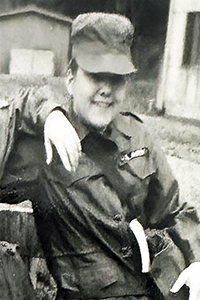
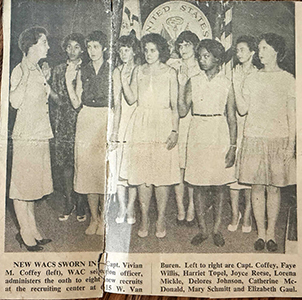
Mary admitted she joined the military by accident. “My best friend Beverly wanted to join the service. That was all she wanted to do and I said I’d join with her. But Beverly’s mom would not sign for her to go because she was still 17. Plus Beverly had like a full ride scholarship to Purdue University and Beverly’s mother didn’t want her to give that up to join the Army. So, I ended up going by myself. I really had nothing else to do. I couldn’t afford college. We weren’t in poverty, but we weren’t wealthy either.”
Back in the Vietnam era, they didn’t draft women. So when Beverly joined the Army, she did so under the Women’s Army Corps (WAC). The Women’s Army Corps (WAC) was established as a pioneering branch of the U.S. Army during World War II to fill vital noncombat roles. Initially created as the Women’s Army Auxiliary Corps (WAAC) in May 1942, it was granted active-duty status as the WAC in 1943. Over 150,000 women served in the WAC, working in over 200 specialties including mechanics, cryptographers, mapmakers, and switchboard operators to “free a man to fight“. The WAC became an official part of the Regular Army in 1948 and was permanently disbanded in 1978 when women were fully integrated into the regular armed forces.
Mary began her tour with eight weeks of basic training at Fort McClellan just outside of Anniston, Alabama. Mary recalled a historic event that took place there. “In May of 1961, Anniston, Alabama, which is where Fort McClellan was, is where the Freedom Riders bus was set on fire. You know, that was a big moment in the civil rights movement. I didn’t know anything about civil rights at the time, I was from Gary, Indiana. I was from Chicago. There was a racial divide, but not in my family. My father would not allow it.”
Joining the Army changed Mary’s life. Mary knew that the military teaches discipline and learned to obey without question. Mary was not used to that at all. “I was a big mouth and demanding, why do I have to do that? I was a terrible child, a brat. But the Army cured that. I became a more responsible adult instead of a wild child. They broke me down and built me back up during basic. During high school we were living in a housing project. My friends were a little rough, and I was a little rough. In the WAC we were ladies first and soldiers second. I remember that. And we were limited to only two areas, either medical or clerical. Those were the only two jobs that we could have. And of course I was into the clerical.”
Basic training for the WAC was different than the training the men went through. “We had all kinds of crazy punishments. I laughed because we had to, fall into formation completely, lipstick and all. If you didn’t have your lipstick on, they’d send you up three flights of stairs, come down, put it on, wipe it off and send you back again. We didn’t crawl through the mud on the obstacle course or have to scale the wall. I got familiarized with five weapons. I fired five guns, the M1, the M14, the 45, the 22, and the M60. I had to fire all those. I had never fired a gun before basic and I have not had a gun in my hand since.”
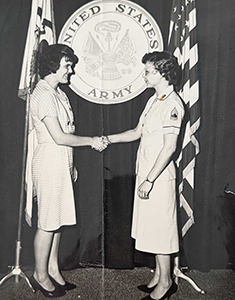
Being in the south, Mary also witnessed the effects of segregation for the first time in her life. “In basic training, we were not issued dress shoes. We had to have like two inch black pumps to wear with our dress uniforms. So we were given some money to go to town to buy our shoes. We went as a group with like four or five of us, and one of the ladies in the group was a black girl. We stopped at a restaurant to have something to eat, and the waitress came over and said, I’m sorry, ma’am, we can’t serve you today. And we’re like, what the heck is going on? And the black girl in our group said, ‘You know what? I forgot I was going to stop at the drugstore. I’ll meet you guys back at base.’ And I said, okay. And she left. The waitress came right over and said, I can take your order now? And I was like, what was that? And it just kind of hit me. I never saw that in Chicago or Gary.”
Mary recalled an emotional meeting with her sergeant after graduating from basic training. “Everybody got to go into Sergeant Willard’s office and she would say goodbye and wish them well. So I went in there and she goes, oh, I got nothing to say to you. You’re never going to amount to anything – get out of here. That tore me up. I went on to signal school and graduated with honors. I was determined to show her I could be somebody.”
Mary was definitely a person on the move. She left basic with orders for Fort Gordon, Georgia, to be part of the Signal Corps. After a few weeks of learning how to operate a teletype, they selected three ladies out of the 40 in the group to do crypto. “I took a lot of tests. And our crypto group was kind of an elite group. We learned different machines and different techniques. I did find out later on that they did research to get me my top secret clearance because they contacted my school, my neighbors, you know everyone.”
Mary spent about six weeks in crypto school before being sent to her first duty station at Fort Hood, Texas. One of her first assignments was working in the communication center. “One day they pulled me out to teach these three guys how to use a portable crypto machine. And I don’t know why these three guys were picked. As we got talking, they were going on some secret assignment as Coca Cola salesmen and staying at the Sands Hotel in Saigon, Vietnam. I said, where’s that? I’d never even heard of Vietnam. So that was the beginning of Vietnam for me.”
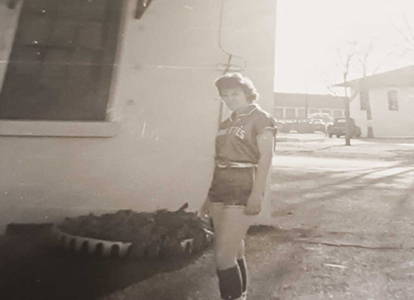
Shortly after that first assignment, Mary joined the women’s Army basketball team. “I played basketball in high school, so I thought, why not try out. We traveled by bus to the different bases all around the southwestern US playing split court. The guys team and the girls team traveled together. That’s when I learned another part of life. The women’s team was probably 75 percent lesbians. I never knew they existed. I didn’t know there was such a thing.”
Mary was part of another historical event while assigned to Fort Hood. “I was sent to the communication center one day and literally locked in there with three generals, just me and three generals. The reason I was there is because I was the only one with top secret clearance. The entire armored division shipped out in the middle of the night by train and headed to the shores off of New Orleans. They were boarding barges with their equipment, their tanks, and everything on their way to Cuba during the Cuban crisis.”
So for three days Mary and three generals worked the communication center at Fort Hood. Mary was never allowed to see one message. She was simply there to keep the machines full of paper and to fix them when the papers jammed. The generals even covered the messages with paper when the machine jammed so Mary could not see the content. Mary took her role in the mission very seriously. “One day, one of the generals went out at 6 o’clock in the morning to stand reveille. We had an armed guard at the door. The general comes back from reveille, knocks on the door, and I said, password please. He says, open the door. This is general so and so. I said, password please. Open the blank, blank door. I said, password please. He turns to the guard and says, what’s the password? The guard gave him the password. He gave me the password and I was then able to let him in. He was so mad. I didn’t know what to do. It was protocol. I thought, if I let him in without giving me the password, I’m in trouble. When the Cuban crisis ended, I got a letter of appreciation for my help and assistance and all three generals signed it.”
Mary had signed up to serve three years in total. After a little more than a year at Fort Hood, Mary headed to Camp Zama, Japan aboard a prop driven cargo plane. “The floor was corrugated steel, just with all these ruts and everything. There was like a window every five or six seats, and there were seats on one side and benches on the other side. I was the only female member of the armed services on board. At one point, flying over the Pacific Ocean, the pilot invited me up to the cockpit and I got to sit in the co-pilot seat for about 10-15 minutes and that was a spectacular view.”
In Japan, Mary again worked in the communication center. She met her future husband there because he worked there also. According to Mary, working in Japan was like working a normal job. She would get up, go to work, come home, and do the same thing every day. “So messages were coming in on a teletype machine from Vietnam and some of them came in encoded. I would have to take those to the crypto machines and decode them. A lot of them were just longitude and latitude. But I didn’t really read the messages. You’re typing the crypt and the machine types it out regular. It prints out on a tape and it goes to the stamping table. Every message was stamped three times. Then, of course, if it was top secret, there were only a couple of us that could handle those. We put them in envelopes, and the courier would take them to wherever they were going.”
Mary explained that everyone working in the communications center had a secret clearance. In certain cases, as a transmission came in, if it was top secret, an alarm would go off on the machine to indicate the message had top secret status. “So you knew it was top secret coming in. It would stop and you had to put in a code to get the message to come all the way through. There were machines in the back room, I called them the refrigerators. There were 2 or 3 of them the size of a refrigerator. Every day we had to set the dials and set the codes for the transmission because we were sending messages to Washington. Vietnam was sending them to us in Japan. For the troops out in the field, they didn’t have the equipment to make it all the way to Washington so it had to relay through us.”
On November 12, 1963 Mary would experience another front row seat to history – the assassination of President Kennedy. “That was very unsettling because we didn’t know if we were going to war. The information was so slow getting to us. The assassination took place at 3 o’clock in the morning, Japan time. The next morning, when we woke up, the base was on lock down. And it was chaotic because there were a lot of GIs that were staying outside the base at night with their little girlfriends, and they got locked out and couldn’t get back on base. I remember we had a funeral parade on the parade grounds that I participated in. It was very sad. I was also a Kennedy supporter during high school, when he was running for president.”
Mary recalled one special assignment during her time in Japan. “I spent three days in Tokyo on a special assignment. Civilian clothes only, no military identification. And we stayed at this hotel. There were six of us. We worked two people per shift and three shifts. I had the day shift. We were in a conference room with a little office behind it with a small closet. In the closet was a safe and in the desk drawer there was a gun. An admiral and two bodyguards came in and he was handcuffed to a suitcase. The suitcase was put into the safe. We had to send a teletype message every two hours around the clock if all was well with the suitcase.”
Mary left Japan at the end of August, 1964 and was discharged from the Army. Her future husband would leave Japan in January and they were married in May 1965. Mary worked at US Steel right after the Army. They needed teletype operators so they recruited her. At the time they wouldn’t hire a woman if she was married. Four months after Mary was hired she got married. Seven months later she was pregnant with her first child and four months into the pregnancy she was let go. After a few years being a stay at home mom she got a job at the Post Office.
She was divorced when her children were young and found it very difficult to function as a single mother. “I’m looking for a place to rent, and no one would rent to me. I was a woman alone with children. One woman actually said, Oh, I can’t rent to you. You’ll have men coming and going all hours of the night. I went to a loan officer to get some money to get myself set up in another place to live. I had a job, but without a husband’s signature, I could not get a loan.”
Once Mary’s children got older, she returned to the Post Office and retired after a 30-year career as a supervisor. Mary keeps busy these days at the Bonner Senior Center in her home town. She also has been crocheting for 60 years and is learning how to quilt. She enjoys spending time with her three children, her seven grandchildren and two great grandchildren and is awaiting the arrival of a third great grandchild due in September.
Mary, thank you very much for your dedicated service to our country and please enjoy your well-deserved trip to Washington D.C.!